How Can We Grow Rice Sustainably in a Changing Climate?
TL;DR
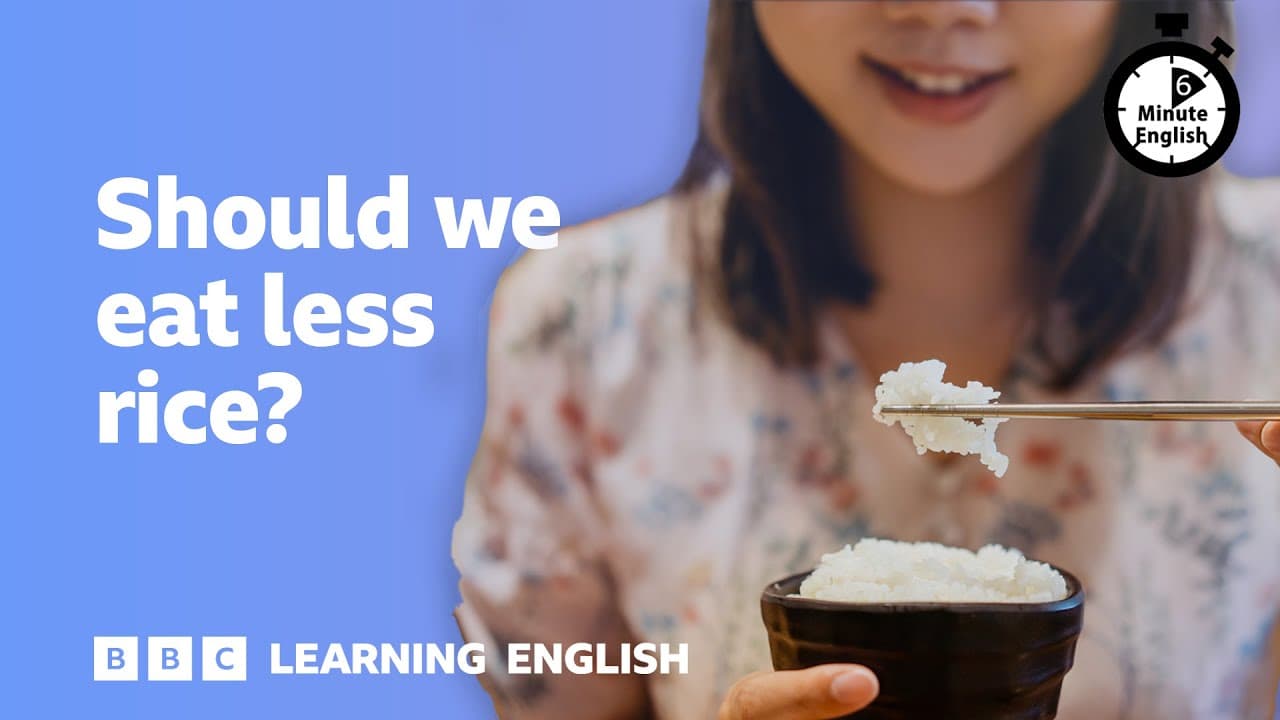
Sustainable rice growing can be achieved through the Alternate Wet Drying (AWD) technique, which reduces water use from 25 flooding cycles to 20, saving resources and lowering methane emissions. This innovative method has shown measurable benefits, including increased rice yields and widespread adoption by farmers in India.
Transcript
Hello. This is 6 Minute English from BBC Learning English. I'm Neil. And I'm Beth. Neil, what type of foods do you often eat? Well, basic things to fill me up. That's sort of bread, potatoes. Well, food like this, which is regularly eaten by many people, is known as a staple. In Britain, bread is a popular staple, but for large parts of the world, ... Read More
Key Insights
- Rice is a staple food for over half of the world's population, heavily consumed in Asia and increasingly in Africa and Europe.
- Rice cultivation is water-intensive, requiring between 3,000 to 5,000 liters of water per kilogram, posing environmental challenges.
- Climate change-induced droughts and floods are complicating traditional rice farming, necessitating new agricultural techniques.
- The International Rice Research Institute focuses on developing rice varieties that can withstand varying water conditions.
- Alternate Wet Drying (AWD) is a promising technique that reduces water cycles, saving water and decreasing methane emissions.
- AWD involves placing measuring pipes underground to monitor water levels, reducing flooding cycles from 25 to 20.
- Farmers initially hesitant about AWD were convinced by tangible results: reduced water use, lower emissions, and increased yields.
- AWD demonstrates that sustainable farming methods can yield environmental benefits without sacrificing agricultural productivity.
Install to Summarize YouTube Videos and Get Transcripts
Explore YouTube Video Summarizer or Get YouTube Transcript Extractor
Questions & Answers
Q: What is the main environmental challenge in rice cultivation?
The main environmental challenge in rice cultivation is its high water requirement, with each kilogram of rice needing between 3,000 to 5,000 liters of water. This is problematic in the face of climate change, which causes droughts and floods, making traditional rice farming increasingly unsustainable.
Q: How does Alternate Wet Drying (AWD) benefit rice farming?
Alternate Wet Drying (AWD) benefits rice farming by reducing the number of flooding cycles from 25 to 20, saving significant amounts of water. This technique also decreases methane emissions, a potent greenhouse gas, making rice farming more environmentally friendly while maintaining or even increasing crop yields.
Q: What role does the International Rice Research Institute play in rice cultivation?
The International Rice Research Institute plays a crucial role in rice cultivation by developing new rice varieties that can adapt to changing environmental conditions. Their research focuses on creating rice strains that can thrive under varying water availability, addressing the challenges posed by climate change and ensuring food security.
Q: Why were farmers initially hesitant to adopt AWD?
Farmers were initially hesitant to adopt AWD due to concerns about potential revenue loss. The apprehension stemmed from uncertainty about whether the new technique would yield tangible benefits. However, the measurable results of increased yield and reduced resource use eventually convinced many farmers to implement AWD.
Q: What measurable results did AWD produce for farmers?
AWD produced measurable results by significantly reducing water and electricity usage in rice farming. It also decreased methane emissions and increased rice yields, demonstrating tangible benefits that convinced skeptical farmers of the technique's effectiveness and its potential to improve both environmental sustainability and agricultural productivity.
Q: How is the global demand for rice changing?
The global demand for rice is increasing, particularly in Africa and Europe, alongside its traditional consumption in Asia. As a staple food for over half the world's population, rice's popularity is growing, necessitating more sustainable cultivation methods to meet this rising demand without exacerbating environmental issues.
Q: What is the significance of rice as a staple food?
Rice is a significant staple food as it serves as the principal dietary component for over four billion people worldwide. Its extensive consumption, especially in Asia, underscores its importance in global food security, making sustainable cultivation methods crucial to meet the nutritional needs of a growing population.
Q: How does AWD reduce methane emissions in rice farming?
AWD reduces methane emissions in rice farming by altering the traditional flooding cycles. By decreasing the number of cycles and allowing fields to dry out between floods, AWD limits the anaerobic conditions that produce methane, thus reducing the overall emissions associated with rice cultivation and contributing to climate change mitigation.
Summary & Key Takeaways
-
Rice is a crucial global staple, but its water-intensive cultivation is challenged by climate change. New techniques like Alternate Wet Drying (AWD) offer a solution by reducing water use and emissions. Farmers in India have adopted AWD, showing tangible benefits in water conservation and increased yields.
-
The International Rice Research Institute is developing rice varieties adaptable to climate change. AWD reduces the traditional 25 flooding cycles to 20, saving water and cutting methane emissions. Farmers initially skeptical of AWD were persuaded by the technique's measurable benefits and increased rice production.
-
AWD, a new rice growing method, helps address climate challenges by conserving water and reducing emissions. Implemented by over a thousand farmers in India, AWD has shown real, measurable results, proving that eco-friendly farming can be both sustainable and productive, benefiting both the environment and agriculture.
Read in Other Languages (beta)
Share This Summary 📚
Summarize YouTube Videos and Get Video Transcripts with 1-Click
Try YouTube Summary with ChatGPT & Claude or YouTube Transcript Generator
Explore More Summaries from BBC Learning English 📚
Summarize YouTube Videos and Get Video Transcripts with 1-Click
Try YouTube Summary with ChatGPT & Claude or YouTube Transcript Generator