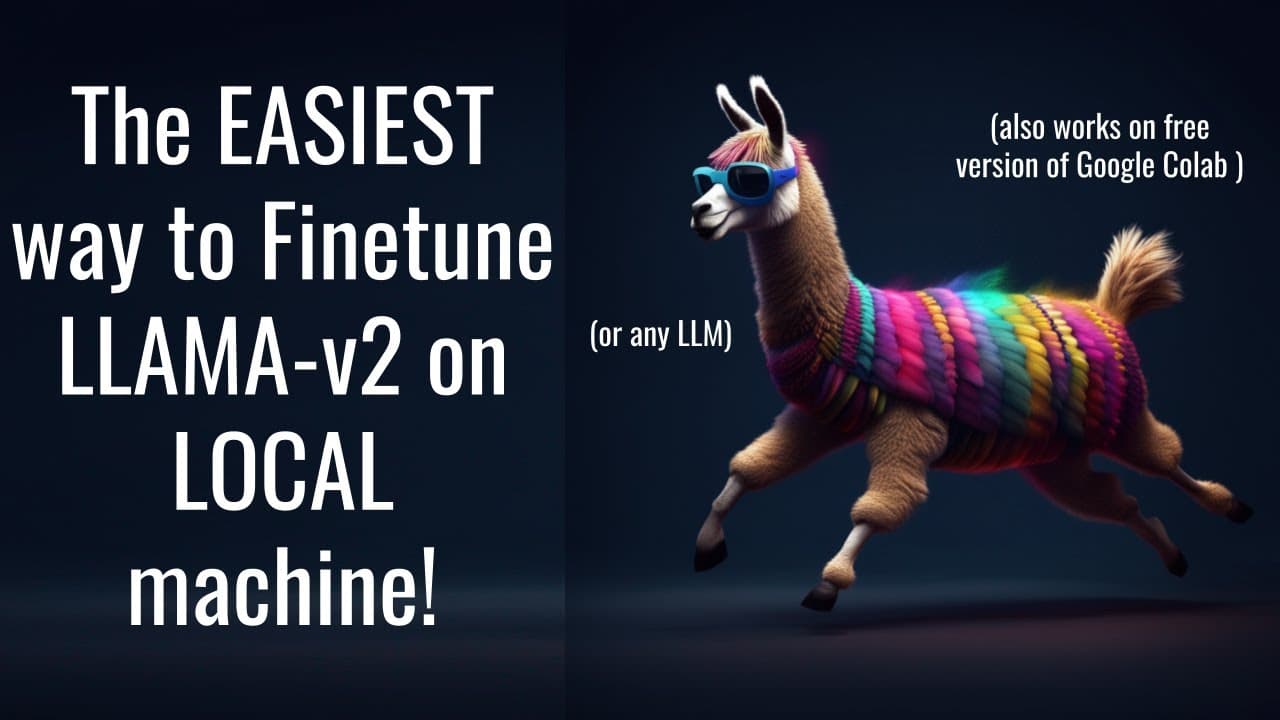
The EASIEST way to finetune LLAMA-v2 on local machine!
TL;DR
This video demonstrates the simplest method to fine-tune a large language model using a custom dataset.
Transcript
hello everyone and welcome to my YouTube channel in today's video I'm going to show you the easiest way to fine tune a large language model such as Lama V2 you can also apply the same for any other llm such as falcon or llama V1 or any other llm available out there today we are going to use a custom data set which is in CSV format and we it has thr... Read More
Key Insights
- 💁 The process involves converting a CSV dataset into a format compatible with Auto Train for fine-tuning language models.
- 👻 Auto Train allows for the easy setup and training of language models using different parameters and datasets.
- 📽️ Fine-tuning can be done using a specific project name, model name, and data path.
- 😒 The use of a prompt, instruction, and response helps in training the model to generate appropriate responses based on given instructions.
- 🥠 The SFT trainer provides specific parameters for fine-tuning language models.
- 🚂 It is possible to train language models on a single GPU or distribute the training across multiple GPUs.
- 😒 The trained model can be saved and pushed to the Hugging Face Hub for future use and deployment.
Install to Summarize YouTube Videos and Get Transcripts
Explore YouTube Video Summarizer or Get YouTube Transcript Extractor
Questions & Answers
Q: What is the purpose of converting the dataset to a specific format?
Converting the dataset to a specific format allows for compatibility with the Auto Train tool, which is used for fine-tuning language models.
Q: Can any type of dataset be used for fine-tuning a language model?
Yes, as long as the dataset contains text, it can be used for fine-tuning a language model.
Q: Is it necessary to have an input query for each instruction in the dataset?
No, if an instruction does not have an input query, it can be left empty or replaced with a suitable placeholder.
Q: Can prompts be customized for different fine-tuning tasks?
Yes, prompts can be designed based on the specific task, and different variations can be used to train the language model.
Summary & Key Takeaways
-
The video explains the process of fine-tuning large language models like Lama V2 using a custom CSV dataset.
-
The dataset consists of three columns: instruction, input, and output.
-
By converting the dataset to a suitable format, the language model can be fine-tuned.
Read in Other Languages (beta)
Share This Summary 📚
Summarize YouTube Videos and Get Video Transcripts with 1-Click
Try YouTube Summary with ChatGPT & Claude or YouTube Transcript Generator
Explore More Summaries from Abhishek Thakur 📚
Summarize YouTube Videos and Get Video Transcripts with 1-Click
Try YouTube Summary with ChatGPT & Claude or YouTube Transcript Generator