What Are Activation Records and How Do Stacks Work?
TL;DR
Activation records store essential values during procedure calls, including arguments, return addresses, and local variables. A stack data structure efficiently allocates and deallocates these records in a last-in first-out (LIFO) manner, allowing recursive calls to be managed effectively. This method ensures that each active procedure call maintains its necessary information without interference.
Transcript
The problem we need to solve is where to store the values needed by procedure: its arguments, its return address, its return value. The procedure may also need storage for its local variables and space to save the values of the caller's registers before they get overwritten by the procedure. We'd like to avoid any limitations on the number of argum... Read More
Key Insights
- ↩️ Activation records are essential for storing the necessary values of procedure calls, such as arguments, return addresses, return values, and local variables.
- 🤙 Recursive calls require multiple active procedure calls, each with its own activation record.
- 🪈 The stack is a data structure that efficiently manages the allocation and deallocation of activation records in a last-in first-out (LIFO) order.
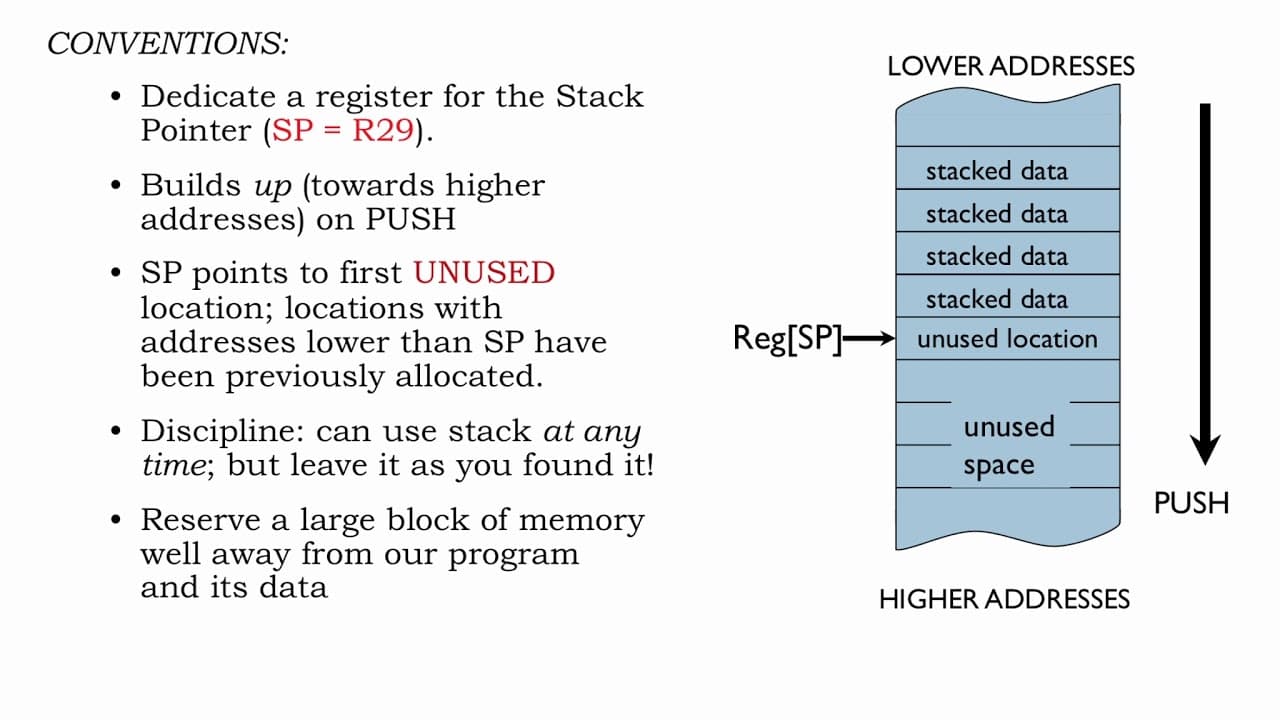
- ®️ In the Beta architecture, the stack is implemented using the stack pointer register R29.
- 💗 The stack grows to higher addresses as activation records are PUSHed onto it.
- 😒 The stack discipline ensures that intervening uses of the stack do not affect later stack references.
- 💾 The stack can be used to save and restore register values during computations.
Install to Summarize YouTube Videos and Get Transcripts
Explore YouTube Video Summarizer or Get YouTube Transcript Extractor
Questions & Answers
Q: What is the purpose of an activation record?
Activation records store the necessary values for procedure calls, including arguments, return addresses, return values, and local variables.
Q: Why can't a single block of storage be statically allocated for a procedure?
Recursive calls result in multiple active procedure calls, each requiring their own activation record, making it impossible to statically allocate a single block for a procedure.
Q: How does the stack implement the allocation and deallocation of activation records?
The stack, implemented using the stack pointer register, PUSHes activation records onto the stack during procedure calls and POPs them when the procedure returns, following a last-in first-out (LIFO) order.
Q: What happens to the activation records of nested procedure calls?
The activation record of a nested procedure call is always discarded before the activation record of the caller, as the execution of the caller cannot complete until the nested call returns.
Summary & Key Takeaways
-
Activation records are blocks of storage that store procedure values such as arguments, return addresses, return values, and local variables.
-
Recursive calls require multiple active procedure calls, each with its own activation record.
-
The stack, implemented using the Beta register R29 as the stack pointer, allows for the efficient allocation and deallocation of activation records in a last-in first-out (LIFO) order.
Read in Other Languages (beta)
Share This Summary 📚
Summarize YouTube Videos and Get Video Transcripts with 1-Click
Try YouTube Summary with ChatGPT & Claude or YouTube Transcript Generator
Explore More Summaries from MIT OpenCourseWare 📚


Summarize YouTube Videos and Get Video Transcripts with 1-Click
Try YouTube Summary with ChatGPT & Claude or YouTube Transcript Generator