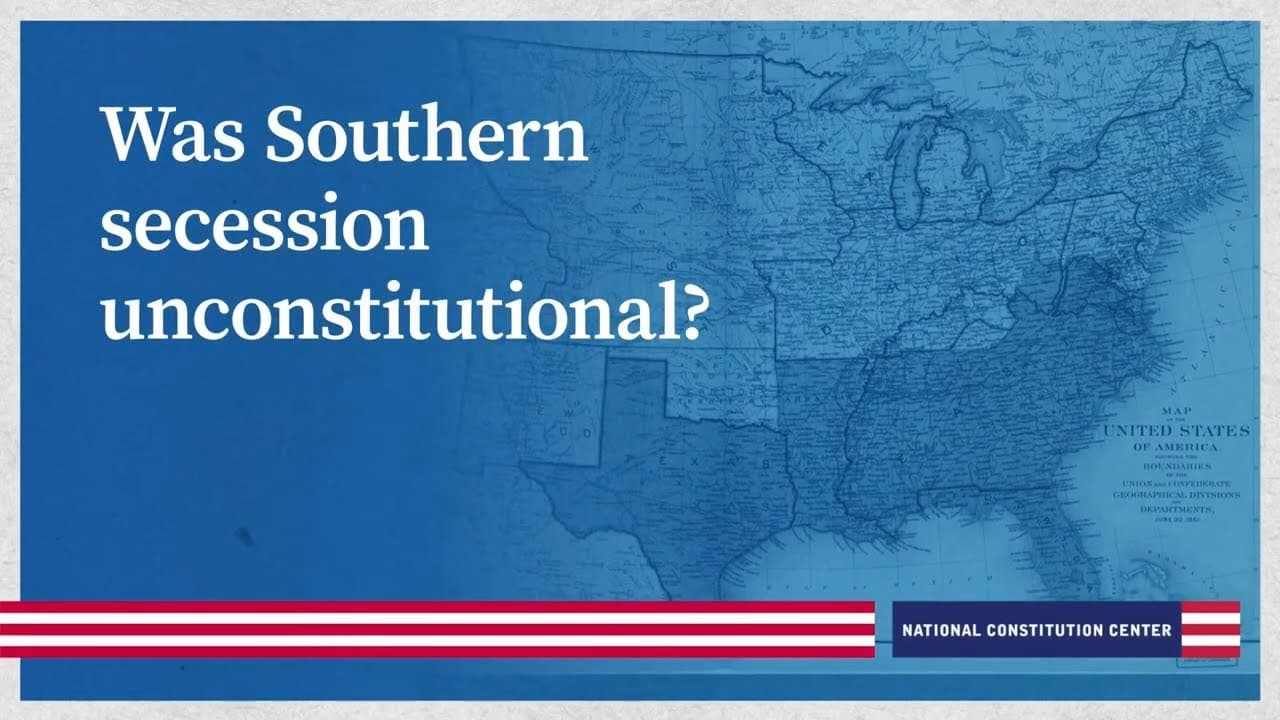
Was Southern secession unconstitutional?
TL;DR
Lincoln argued secession was unconstitutional and undermined democracy.
Transcript
Read and summarize the transcript of this video on Glasp Reader (beta).
Key Insights
- Southern states believed in their right to secede based on states' rights and the Constitution not explicitly forbidding secession.
- Lincoln countered that the Constitution, as a legal document, lacks a secession clause, implying permanence of the Union.
- Lincoln highlighted the absence of a reversion clause in the Constitution, indicating no legal framework for secession.
- He argued that the Constitution is detailed in important matters like presidential elections, yet silent on secession, implying it's not intended.
- Lincoln questioned the logic of a government providing a mechanism for its own destruction, seeing it as contrary to democratic principles.
- He emphasized the impracticality of secession, as geographical proximity would not resolve tensions between North and South.
- Lincoln viewed secession as an act of anarchy, not democracy, and warned it could lead to dictatorship.
- He saw himself as a national figure, prioritizing the unity of the nation over regional allegiance, and believed the Civil War affirmed this unity.
Install to Summarize YouTube Videos and Get Transcripts
Explore YouTube Video Summarizer or Get YouTube Transcript Extractor
Questions & Answers
Q: What was the basis for Southern states believing they could secede?
Southern states believed they had the right to secede based on the concept of states' rights. They interpreted the Constitution as not explicitly forbidding secession, and believed the Ninth and Tenth Amendments supported their view that anything not forbidden was permitted. This belief was rooted in their interpretation of the Constitution as a document that reserved certain powers to the states.
Q: How did Lincoln argue against the legality of secession?
Lincoln argued against the legality of secession by emphasizing that the Constitution did not include a secession clause, implying the Union's permanence. He pointed out the absence of a reversion clause, which would outline the process for breaking up and redistributing property, indicating no legal framework for secession. This lack of provision suggested that secession was not intended or permitted by the Constitution.
Q: Why did Lincoln believe secession was impractical?
Lincoln believed secession was impractical because geographical proximity would not resolve tensions between the North and South. He argued that even if the Southern states formed their own nation, they would still be neighbors, sharing rivers and borders. This close proximity meant that secession would not improve relations or solve underlying issues, making it an impractical solution.
Q: What did Lincoln see as the consequences of secession?
Lincoln saw secession as leading to anarchy, which could ultimately result in dictatorship. He argued that secession undermined democracy by allowing a minority to reject the majority's rule and create chaos. In such a scenario, a dictator could rise to power, offering orderliness as a solution to the anarchy. This potential shift from democracy to dictatorship was a significant concern for Lincoln.
Q: How did Lincoln view himself in the context of national unity?
Lincoln viewed himself as a national figure, prioritizing the unity of the nation over regional allegiance. Despite being from the West, he identified as an American first and foremost. He believed in the importance of national unity and saw the Civil War as a test of this unity. Lincoln's perspective was that being fundamentally American was crucial for the nation's strength and future.
Q: What role did Lincoln believe the United States played in global history?
Lincoln believed the United States played a crucial role in global history, particularly in defending democracy. He argued that the nation's unity, reaffirmed by the Civil War, enabled it to rescue democracy in World War I, combat Nazism in World War II, and lead the free world during the Cold War. The nation's existence and unity were seen as essential to the course of modern history.
Q: What did Lincoln say about the Constitution's detail on important matters?
Lincoln pointed out that the Constitution is detailed on important matters, such as the process for electing a president through the electoral college, which takes up a significant portion of the text. He argued that if secession were intended or permitted, the Constitution would similarly provide detailed instructions on how to carry it out. The absence of such detail suggested that secession was not part of the constitutional framework.
Q: How did Lincoln compare secession to a divorce?
Lincoln compared secession to a divorce, noting that in a divorce, parties can separate and go out of each other's sight and company. However, secession would not allow such separation, as the Southern states would remain geographically close to the Northern states. This lack of physical separation would not resolve tensions, making secession an ineffective solution, unlike a divorce where parties can distance themselves from each other.
Summary & Key Takeaways
-
The Southern states believed they had the right to secede based on states' rights and the Constitution not explicitly forbidding it. Lincoln argued against this, saying the Constitution's lack of a secession clause implies the Union's permanence, and the detailed nature of the Constitution on other issues suggests secession was not intended.
-
Lincoln questioned the logic of a government providing for its own destruction, arguing it contradicts democratic principles. He highlighted the impracticality of secession, as geographical proximity would not resolve tensions, and viewed secession as leading to anarchy, potentially resulting in dictatorship.
-
Lincoln saw himself as a national figure, prioritizing national unity over regional allegiance. He believed the Civil War affirmed the nation's unity, which later played a crucial role in global events such as World War I and II, and the Cold War. He emphasized the importance of being fundamentally American.
Read in Other Languages (beta)
Share This Summary 📚
Summarize YouTube Videos and Get Video Transcripts with 1-Click
Try YouTube Summary with ChatGPT & Claude or YouTube Transcript Generator
Explore More Summaries from National Constitution Center 📚

Summarize YouTube Videos and Get Video Transcripts with 1-Click
Try YouTube Summary with ChatGPT & Claude or YouTube Transcript Generator