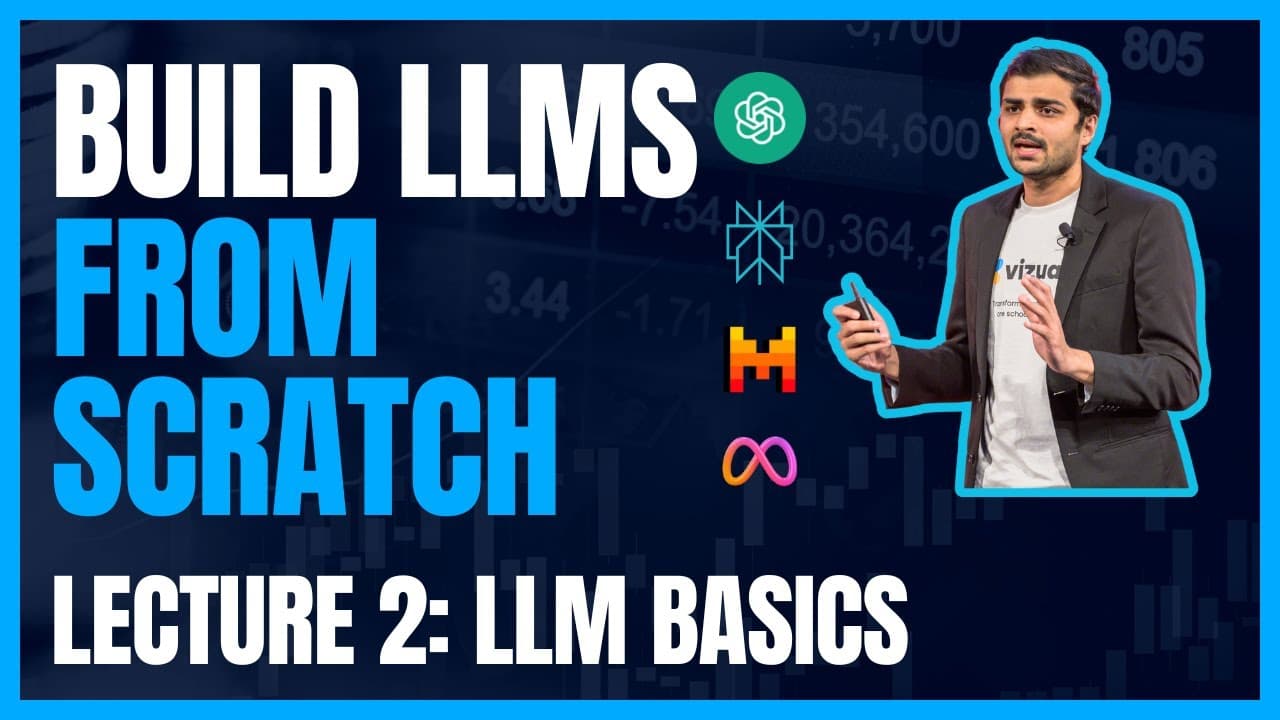
Lecture 2: Large Language Models (LLM) Basics
TL;DR
Explains the basics and significance of large language models.
Transcript
Read and summarize the transcript of this video on Glasp Reader (beta).
Key Insights
- Large language models (LLMs) are neural networks designed to understand, generate, and respond to human-like text, making them versatile in text-related applications.
- The term 'large' in LLMs refers to the massive number of parameters, often in billions or trillions, which allows for complex processing and improved performance.
- LLMs differ from earlier NLP models by being capable of handling a wider range of tasks, whereas older models were task-specific.
- The success of LLMs is largely due to the Transformer architecture, introduced in 2017, which revolutionized AI with its attention mechanisms.
- Understanding the differences between LLMs, generative AI, deep learning, machine learning, and artificial intelligence is crucial for grasping their unique roles and applications.
- LLMs have diverse applications, including content creation, chatbots, machine translation, text generation, and sentiment analysis.
- The growth of LLMs has led to unprecedented capabilities in AI, with models becoming increasingly human-like in their responses.
- The lecture emphasizes the importance of understanding the foundational aspects of LLMs, such as Transformer architecture, for meaningful contributions in AI.
Install to Summarize YouTube Videos and Get Transcripts
Explore YouTube Video Summarizer or Get YouTube Transcript Extractor
Questions & Answers
Q: What is a large language model (LLM)?
A large language model (LLM) is a type of neural network specifically designed to understand, generate, and respond to human-like text. These models are characterized by their large number of parameters, often in the billions or trillions, which enable them to perform complex text-related tasks effectively.
Q: Why are LLMs called 'large'?
LLMs are termed 'large' because they have a massive number of parameters, typically in the billions or trillions. This large scale allows them to process and generate human-like text with high accuracy and versatility, handling a wide range of natural language processing tasks.
Q: How do LLMs differ from earlier NLP models?
LLMs differ from earlier NLP models in their ability to handle a wide range of tasks with a single architecture. While older models were designed for specific tasks like translation or sentiment analysis, LLMs can perform many tasks, such as text generation and question answering, using the same model architecture.
Q: What is the 'secret sauce' behind LLMs?
The 'secret sauce' behind LLMs is the Transformer architecture, introduced in 2017. This architecture uses attention mechanisms to process text, allowing the model to focus on different parts of the input sequence. This innovation has significantly improved the performance and capabilities of LLMs compared to previous models.
Q: What are some applications of LLMs?
LLMs have a wide range of applications, including content creation, chatbots, machine translation, text generation, and sentiment analysis. They are used in various industries to automate tasks, generate creative content, and provide human-like interactions in customer service and other areas.
Q: How do LLMs relate to generative AI, deep learning, and machine learning?
LLMs are a subset of deep learning, which is itself a subset of machine learning. Deep learning models use neural networks, and LLMs specifically focus on text processing. Generative AI encompasses LLMs and other deep learning models that create new content, including text, images, and audio.
Q: Why is understanding the Transformer architecture important?
Understanding the Transformer architecture is crucial because it is the foundation of modern LLMs. This architecture introduced attention mechanisms that allow models to process text efficiently, leading to significant advancements in AI capabilities. A deep understanding of Transformers enables better development and application of LLMs.
Q: What is the significance of learning the basics of LLMs?
Learning the basics of LLMs is important for developing a comprehensive understanding of how they function and how to leverage their capabilities effectively. By understanding foundational concepts such as the Transformer architecture, individuals can contribute meaningfully to AI research and development, creating innovative applications and solutions.
Summary & Key Takeaways
-
This lecture introduces large language models (LLMs), explaining their significance and how they differ from earlier NLP models. LLMs are neural networks designed to understand and generate human-like text, with the term 'large' referring to their massive parameter size.
-
The lecture covers the key differences between LLMs and earlier NLP models, highlighting the versatility of LLMs in handling multiple tasks, unlike older models which were task-specific. The Transformer architecture is identified as the 'secret sauce' behind the success of LLMs.
-
Various applications of LLMs are explored, including content creation, chatbots, and machine translation. The lecture stresses the importance of understanding foundational concepts such as Transformer architecture to fully leverage the potential of LLMs.
Read in Other Languages (beta)
Share This Summary 📚
Summarize YouTube Videos and Get Video Transcripts with 1-Click
Try YouTube Summary with ChatGPT & Claude or YouTube Transcript Generator
Explore More Summaries from Vizuara 📚


Summarize YouTube Videos and Get Video Transcripts with 1-Click
Try YouTube Summary with ChatGPT & Claude or YouTube Transcript Generator