Why It Sucks to Be the Sun...
TL;DR
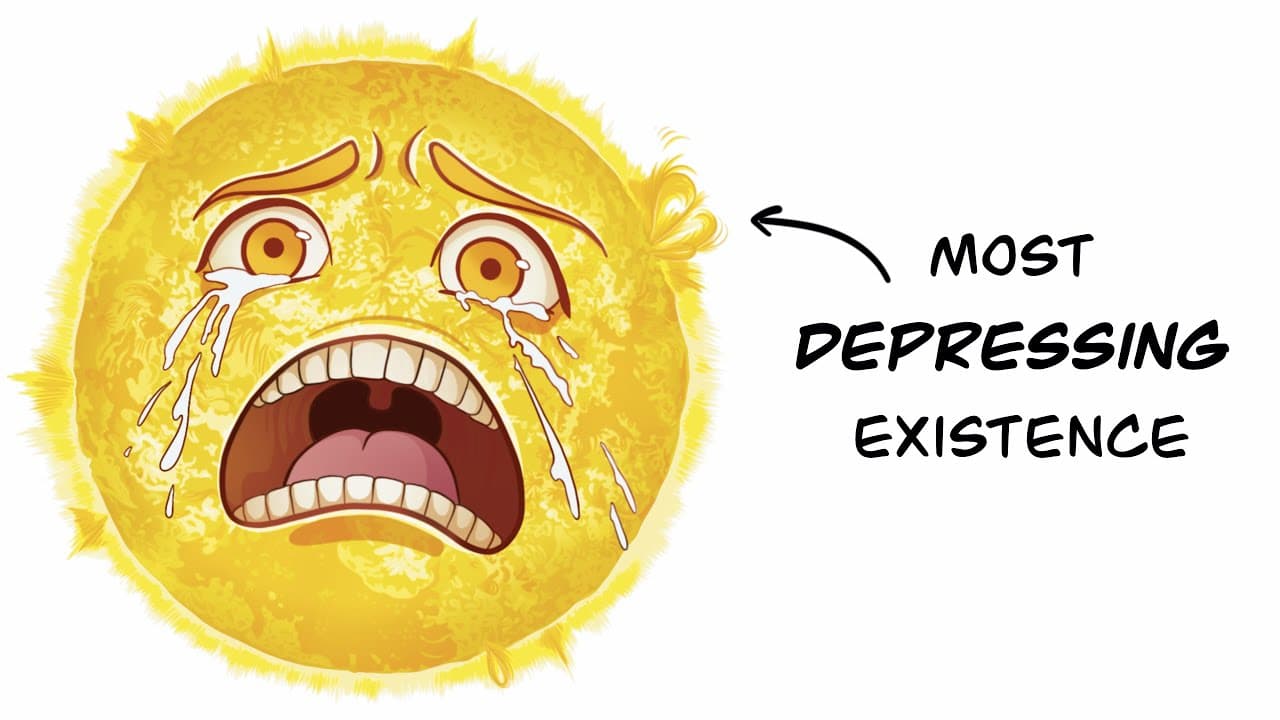
The Sun's existence is long, lonely, and ultimately futile.
Transcript
Read and summarize the transcript of this video on Glasp Reader (beta).
Key Insights
- The Sun's formation begins with a massive gravitational pull, turning gas into a star through nuclear fusion, allowing it to emit energy for billions of years.
- The Sun's journey through the Milky Way takes approximately 230 million years per orbit, involving complex gravitational interactions with planets and other celestial bodies.
- As a star, the Sun experiences various phenomena such as sunspots, which are cooler, darker areas on its surface occurring in an 11-year cycle.
- The Sun's gravitational pull creates a dynamic solar system, with planets like Jupiter and Saturn influencing the orbits of other celestial bodies.
- Over billions of years, the Sun will expand into a red giant, eventually engulfing nearby planets and losing its outer layers to form a planetary nebula.
- Despite its size and energy, the Sun is considered an average star, overshadowed by larger, more luminous stars in the galaxy.
- The Sun's ultimate fate is to become a white dwarf, a dense, hot remnant that will cool over trillions of years into a black dwarf.
- The Sun's existence highlights the transient nature of celestial bodies and the universe's indifference to individual aspirations or desires.
Install to Summarize YouTube Videos and Get Transcripts
Explore YouTube Video Summarizer or Get YouTube Transcript Extractor
Questions & Answers
Q: What is the initial process that forms the Sun?
The Sun forms from a massive gravitational pull that condenses gas into a star. This process involves nuclear fusion, where hydrogen atoms combine to form helium, releasing energy that allows the Sun to emit light and heat for billions of years.
Q: How long does it take for the Sun to orbit the Milky Way?
The Sun takes approximately 230 million years to complete one orbit around the Milky Way. This journey involves complex gravitational interactions with other celestial bodies, making the path twisty and curvy, akin to bouncing on invisible trampolines.
Q: What are sunspots and how do they affect the Sun?
Sunspots are cooler, darker areas on the Sun's surface that occur in an 11-year cycle. They are a natural phenomenon of the Sun's magnetic activity and do not significantly affect its overall energy output, but they are visible manifestations of the Sun's dynamic nature.
Q: How do Jupiter and Saturn influence the solar system?
Jupiter and Saturn, as gas giants, have significant gravitational influence, shaping the orbits of other celestial bodies. Their presence creates a dynamic environment, contributing to the formation of asteroid belts and affecting the stability of other planets' orbits.
Q: What is the Sun's fate after becoming a red giant?
After expanding into a red giant, the Sun will shed its outer layers, forming a planetary nebula. The core will remain as a white dwarf, a dense, hot remnant that will eventually cool over trillions of years into a black dwarf, marking the end of its life cycle.
Q: How does the Sun compare to other stars in the galaxy?
The Sun is considered an average star, overshadowed by larger, more luminous stars such as super red giants and hot blue stars. While it plays a central role in the solar system, it lacks the size and energy to become a supernova, highlighting its modest place in the galaxy.
Q: What is the significance of the Sun's transformation into a white dwarf?
The transformation into a white dwarf signifies the end of the Sun's active life, as it no longer undergoes fusion reactions. This stage reflects the natural progression of stellar evolution, where stars shed their outer layers and leave behind dense cores that gradually cool over time.
Q: How does the Sun's existence reflect the universe's indifference?
The Sun's existence, marked by its long, solitary journey and eventual cooling into a black dwarf, underscores the universe's indifference to individual aspirations or desires. Despite its central role in the solar system, the Sun will ultimately be forgotten, highlighting the transient nature of celestial bodies.
Summary & Key Takeaways
-
The Sun's life begins as a mass of gas undergoing fusion, providing energy and light to the solar system. Its journey through the galaxy is long and solitary, marked by interactions with planets and other celestial bodies.
-
Over billions of years, the Sun will expand into a red giant, eventually shedding its outer layers and becoming a white dwarf. This transformation highlights the Sun's role in the cosmic cycle of birth, life, and death.
-
Despite its central role in the solar system, the Sun's existence is ultimately one of loneliness and futility, as it will eventually cool into a black dwarf, forgotten by the universe.
Read in Other Languages (beta)
Share This Summary 📚
Summarize YouTube Videos and Get Video Transcripts with 1-Click
Try YouTube Summary with ChatGPT & Claude or YouTube Transcript Generator
Explore More Summaries from Gravipull 📚
Summarize YouTube Videos and Get Video Transcripts with 1-Click
Try YouTube Summary with ChatGPT & Claude or YouTube Transcript Generator