What Are Programming Concepts in Java?
TL;DR
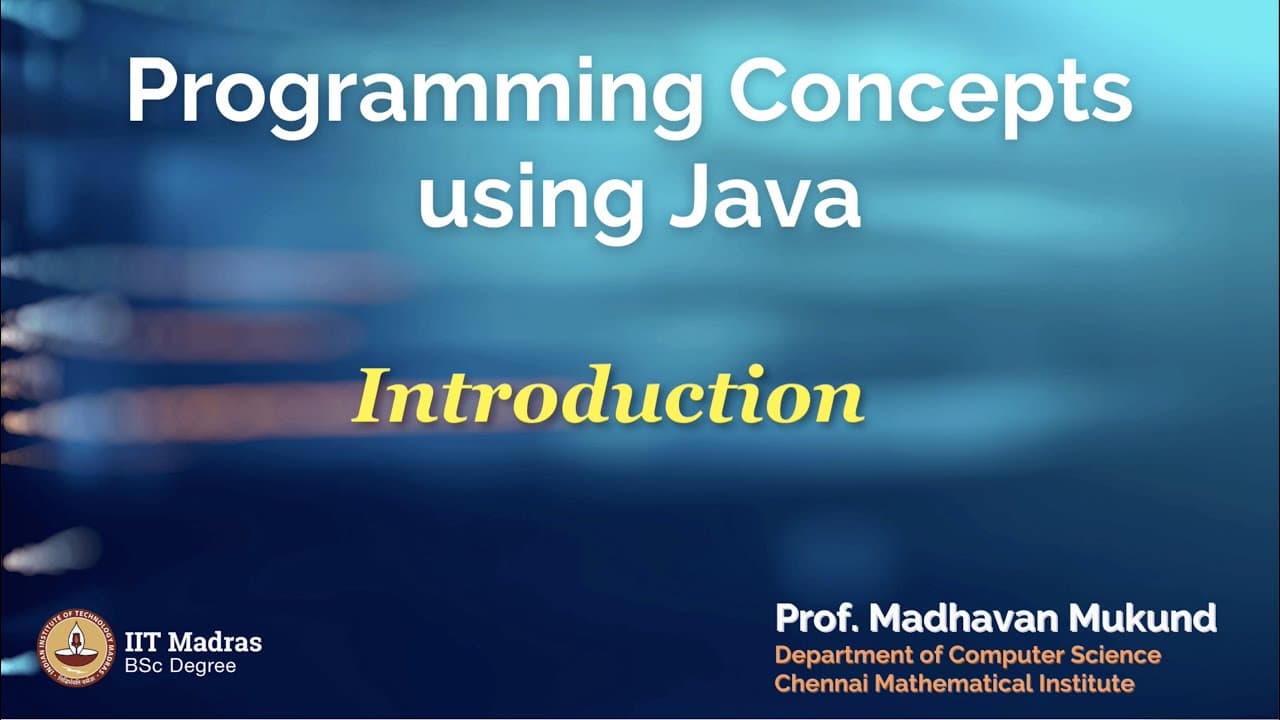
Programming languages allow us to communicate computational ideas to machines. They evolved from low-level instructions to high-level expressions like variables and loops, increasing expressiveness but losing some efficiency. Java, an object-oriented language, exemplifies these concepts, focusing on data types and their operations. Understanding these principles helps in appreciating the diversity and evolution of programming languages.
Transcript
Welcome to the course programming concepts with java. So, as the title suggests we are going to be talking about programming concepts in general as well as a language java in particular. So, let us get started with understanding what a programming language is. So, a language in normal terms is a way with which we communicate. So, when we have t... Read More
Key Insights
- Programming languages enable communication of computational ideas to machines.
- Early programming languages were closely tied to computer architecture.
- High-level languages use variables, loops, and functions to abstract low-level operations.
- Compilers translate high-level code into machine instructions, balancing expressiveness and efficiency.
- Imperative programming specifies step-by-step instructions, while declarative programming describes outcomes.
- Abstract data types define data structures with interfaces, separating implementation details.
- Object-oriented programming centers around data types and associated functions.
- Java is an imperative, statically-typed, object-oriented language used to illustrate these concepts.
Install to Summarize YouTube Videos and Get Transcripts
Explore YouTube Video Summarizer or Get YouTube Transcript Extractor
Questions & Answers
Q: What is a programming language?
A programming language is a formal system used to communicate computational ideas to machines. It allows programmers to express instructions that a machine can execute, transforming abstract concepts into machine-understandable code. Programming languages have evolved from low-level, architecture-tied instructions to high-level constructs like variables and loops, facilitating easier reasoning and error detection.
Q: How do compilers and interpreters differ?
Compilers and interpreters both translate high-level programming languages into machine code, but they differ in execution approach. A compiler translates the entire program into machine code before execution, producing a standalone executable. An interpreter, however, translates and executes code line-by-line, without producing a separate machine-language program. This distinction affects execution speed and flexibility.
Q: What is the difference between imperative and declarative programming?
Imperative programming involves specifying step-by-step instructions to achieve a result, focusing on how tasks are performed. Declarative programming, on the other hand, describes the desired outcome without explicitly detailing the steps to achieve it. It emphasizes what the program should accomplish, often using inductive structures, and is suitable for tasks with clear logical dependencies.
Q: What are abstract data types?
Abstract data types (ADTs) are data structures defined by their behavior from the point of view of a user, described by the operations they support and the type of data they hold. ADTs separate the interface from the implementation, allowing changes in data representation without affecting the user's code. This abstraction facilitates modularity and flexibility in programming.
Q: Why is object-oriented programming important?
Object-oriented programming (OOP) is important because it organizes software design around data, or objects, rather than functions and logic. OOP focuses on defining data types and their associated operations, promoting code reuse, modularity, and scalability. It aligns closely with real-world modeling, making it easier to conceptualize and manage complex software systems.
Q: What role does Java play in programming concepts?
Java plays a significant role in programming concepts as a widely-used, object-oriented language that exemplifies key programming principles. It is statically typed and imperative, providing a robust framework for understanding data types, control structures, and object-oriented design. Java's comprehensive features and cross-platform capabilities make it a staple in education and industry for teaching and implementing programming concepts.
Q: How does Java handle data types and operations?
Java handles data types and operations through its statically-typed system, requiring explicit declaration of variable types. This ensures type safety and facilitates error detection at compile time. Java supports primitive data types (e.g., int, float) and complex data types (e.g., objects, arrays), providing a wide range of operations for arithmetic, logical, and data manipulation tasks, all within its object-oriented framework.
Q: Why are there so many programming languages?
There are many programming languages because each is designed to address specific needs, preferences, and contexts. Historical languages persist due to legacy systems, while new languages emerge to incorporate novel features, improve efficiency, or enhance usability. The diversity reflects the varied requirements of different applications, platforms, and developer communities, with no single language being universally optimal for all tasks.
Summary & Key Takeaways
-
Programming languages have evolved to increase expressiveness by abstracting low-level machine operations into high-level constructs like variables and loops. This evolution allows for easier reasoning and error detection, albeit with some efficiency trade-offs. Java exemplifies these principles as an object-oriented language, focusing on data types and their operations.
-
The distinction between imperative and declarative programming lies in how instructions are specified: imperative programming uses explicit steps, while declarative programming describes desired outcomes. Abstract data types and object-oriented programming emphasize defining data structures and their interfaces, allowing for implementation flexibility.
-
Java, as an object-oriented language, serves as a basis for understanding programming concepts, including exception handling, concurrency, and event-driven programming. Through Java, the course explores the diversity and evolution of programming languages, highlighting their strengths and compromises.
Read in Other Languages (beta)
Share This Summary 📚
Summarize YouTube Videos and Get Video Transcripts with 1-Click
Try YouTube Summary with ChatGPT & Claude or YouTube Transcript Generator
Explore More Summaries from IIT Madras - B.S. Degree Programme 📚
Summarize YouTube Videos and Get Video Transcripts with 1-Click
Try YouTube Summary with ChatGPT & Claude or YouTube Transcript Generator