How to Find Shortest Path Using Dijkstra's Algorithm
TL;DR
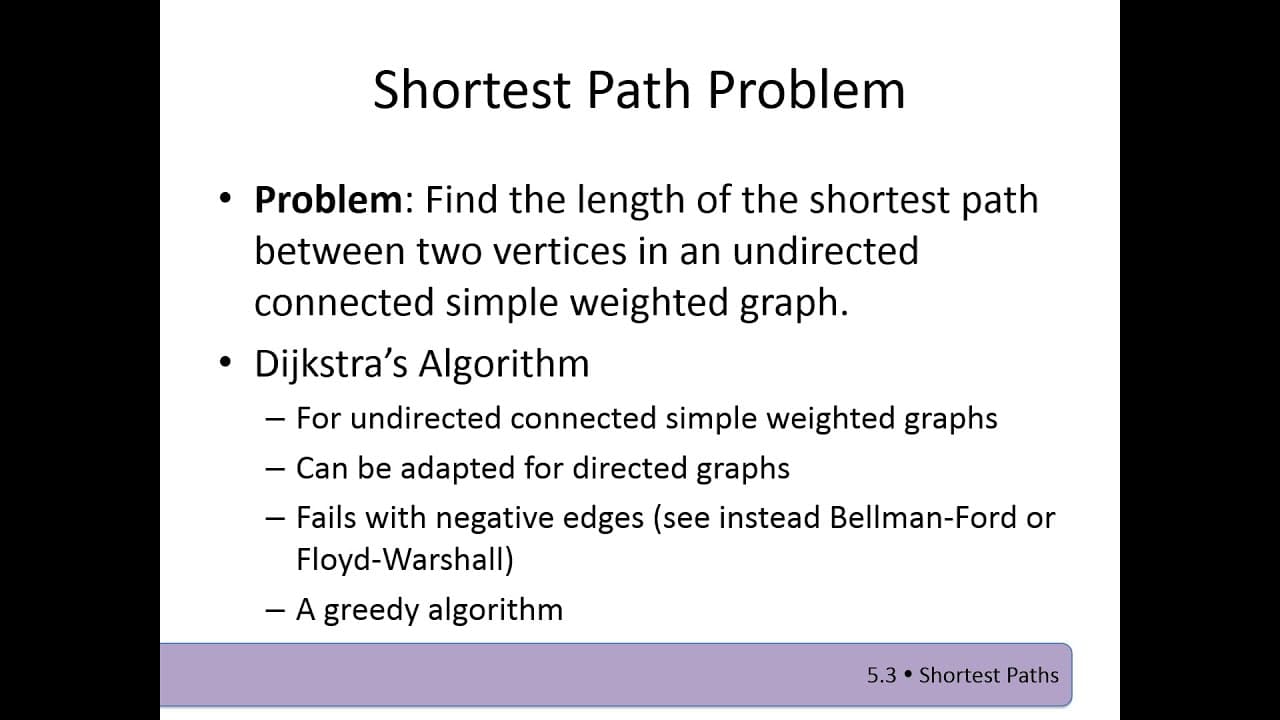
Dijkstra's algorithm is used to find the shortest path between vertices in a weighted graph, but it doesn't work with negative edges. It involves labeling vertices with distances, boxing the smallest numbers, and updating paths iteratively until the destination is reached. The shortest path is then retraced from the destination to the starting point.
Transcript
A shortest path problem involves finding the length of the shortest path between two vertices in an undirected connected simple weighted graph. Here, we will solve such a problem using the so-called Dijkstra's algorithm. The algorithm works with undirected connected simple weighted graphs and it can be adapted for directed graphs. However, it fails... Read More
Key Insights
- Dijkstra's algorithm finds shortest paths in weighted graphs without negative edges.
- The algorithm is a greedy approach, choosing the most immediate benefit at each step.
- Vertices are labeled with distances from the starting point, and the smallest is boxed.
- Distances are updated if a shorter path is found through another vertex.
- The process repeats until the destination vertex is boxed, indicating the shortest path.
- The final path is retraced from the destination to the start, revealing the shortest route.
- Dijkstra's algorithm can be adapted for directed graphs but not for graphs with negative edges.
- The Traveling Salesman and Chinese Postman problems are related but distinct from the shortest path problem.
Install to Summarize YouTube Videos and Get Transcripts
Explore YouTube Video Summarizer or Get YouTube Transcript Extractor
Questions & Answers
Q: How does Dijkstra's algorithm find the shortest path?
Dijkstra's algorithm finds the shortest path by iteratively labeling vertices with their distances from the starting point, boxing the smallest distance, and updating paths if shorter routes are found through other vertices. This process continues until the destination vertex is boxed, indicating the shortest path has been determined.
Q: What is a key limitation of Dijkstra's algorithm?
A key limitation of Dijkstra's algorithm is that it cannot handle graphs with negative edge weights. The algorithm assumes that once a vertex's shortest path is determined, it cannot be improved, which is not the case when negative edges are present, potentially leading to incorrect results.
Q: What type of graphs can Dijkstra's algorithm be used on?
Dijkstra's algorithm can be used on undirected or directed simple weighted graphs without negative edges. It is versatile in handling various graph structures but requires all edge weights to be non-negative to function correctly and produce accurate shortest path results.
Q: What is the first step in Dijkstra's algorithm?
The first step in Dijkstra's algorithm is to label the initial vertex with a distance of zero. This step establishes the starting point for the algorithm, from which distances to connected vertices are calculated and updated iteratively to find the shortest path to the destination vertex.
Q: How are distances updated in Dijkstra's algorithm?
In Dijkstra's algorithm, distances are updated by comparing the current distance at a vertex with a newly calculated distance through another vertex. If the new distance is shorter, the current distance is crossed out and replaced with the new value, ensuring the shortest path is maintained.
Q: What is the role of 'boxing' in Dijkstra's algorithm?
In Dijkstra's algorithm, 'boxing' refers to marking the smallest distance among labeled vertices, indicating that the shortest path to that vertex has been determined. This step is crucial for progressing the algorithm, as it identifies which vertex to explore next for potential path updates.
Q: Can Dijkstra's algorithm handle negative edges?
No, Dijkstra's algorithm cannot handle negative edges. The algorithm relies on the assumption that once a vertex's shortest path is established, it cannot be improved, which is violated by negative edges. Alternative algorithms, like the Bellman-Ford algorithm, are used for graphs with negative edges.
Q: What distinguishes the Traveling Salesman problem from the shortest path problem?
The Traveling Salesman problem differs from the shortest path problem in that it seeks to find a Hamiltonian circuit with the minimum total weight, visiting each vertex exactly once before returning to the starting point. In contrast, the shortest path problem focuses on finding the minimum path between two specific vertices.
Summary & Key Takeaways
-
Dijkstra's algorithm is a method for finding the shortest path between vertices in a weighted graph, provided there are no negative edges. It operates by labeling vertices with distances, boxing the smallest distance, and updating paths iteratively. The shortest path is determined once the destination vertex is boxed, and the path is retraced from end to start.
-
The algorithm begins by labeling the initial vertex with a distance of zero and proceeds by considering connected vertices, updating their distances if a shorter path is found. This process continues until the destination vertex is reached and boxed, signifying the shortest path has been found.
-
Dijkstra's algorithm is characterized by its greedy nature, making optimal choices at each step to ensure the shortest path is found efficiently. It is applicable to undirected and directed graphs without negative edges, distinguishing it from problems like the Traveling Salesman and Chinese Postman, which require different approaches.
Read in Other Languages (beta)
Share This Summary 📚
Summarize YouTube Videos and Get Video Transcripts with 1-Click
Try YouTube Summary with ChatGPT & Claude or YouTube Transcript Generator
Explore More Summaries from Zaldi Nocon 📚
Summarize YouTube Videos and Get Video Transcripts with 1-Click
Try YouTube Summary with ChatGPT & Claude or YouTube Transcript Generator