4.2.2 Useful Logic Gates
TL;DR
Learn how to build AND and OR gates with many inputs using a chain or tree approach.
Transcript
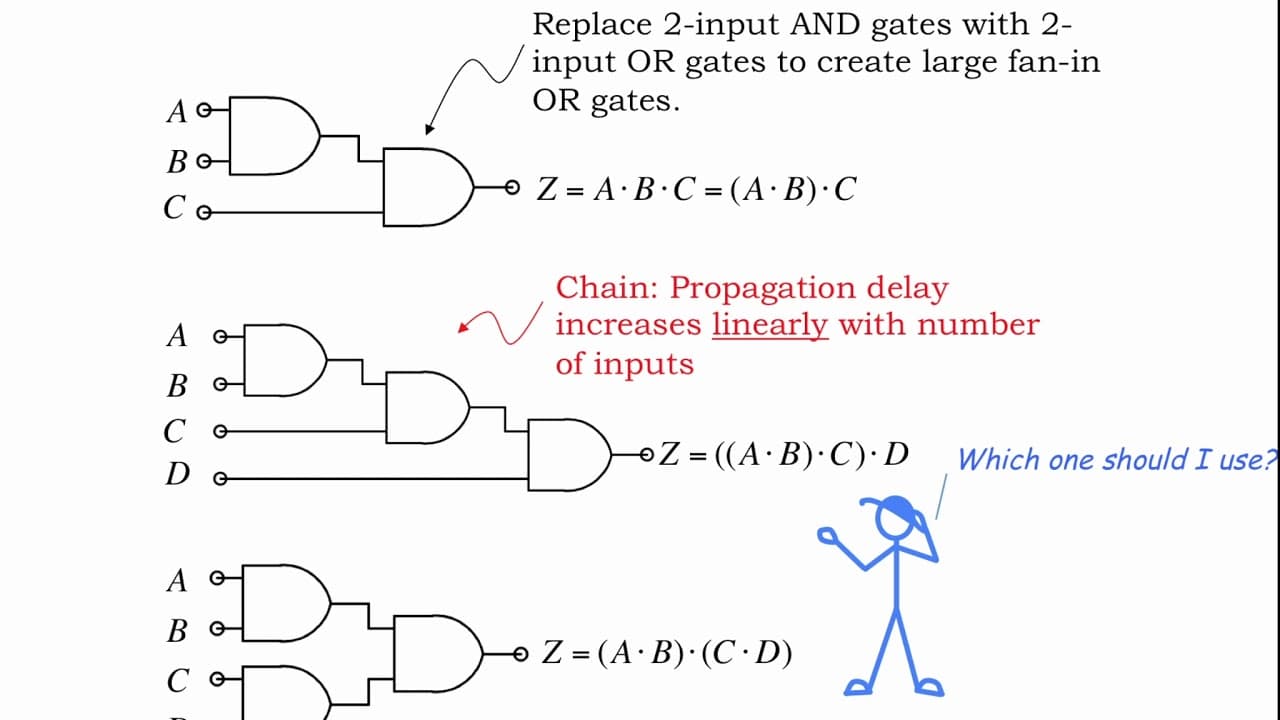
On our to-do list from the previous section is figuring out how to build AND and OR gates with many inputs. These will be needed when creating circuit implementations using a sum-of-products equation as our template. Let’s assume our gate library only has 2-input gates and figure how to build wider gates using the 2-input gates as building blocks. ... Read More
Key Insights
- 🏛️ Building wide gates with many inputs is possible using the associative property of the AND, OR, and XOR operations.
- 🌲 The choice between chain and tree approaches depends on the cost and performance requirements of the circuit.
- 🧑🏭 Propagation delay is an important factor to consider in circuit design, as it affects the overall performance.
- 🔬 NAND and NOR gates are preferred in CMOS circuit design due to their single-gate implementation and better performance.
- 🔬 XOR gates require more components compared to NAND and NOR gates but are useful for arithmetic and parity calculations.
- 🔬 2-INPUT NAND and NOR gates are universal gates that can be used to implement sum-of-products circuits.
Install to Summarize YouTube Videos and Get Transcripts
Explore YouTube Video Summarizer or Get YouTube Transcript Extractor
Questions & Answers
Q: How can we build AND and OR gates with many inputs using 2-input gates?
By utilizing the associative property of these operations, we can perform pair-wise operations in any order, allowing us to create wide gates.
Q: What is the difference between the chain and tree approach to building wide gates?
The chain approach involves connecting 2-input gates in a linear manner, while the tree approach creates a hierarchical structure with 2-input gates at each level.
Q: Which approach is better: chains or trees?
The choice depends on the desired cost and performance. Chains have linear propagation delay, while trees have logarithmic propagation delay with the number of inputs.
Q: What is the significance of propagation delay in circuit design?
Propagation delay measures the worst-case delay from inputs to outputs and affects the overall performance of the circuit.
Summary & Key Takeaways
-
The associative property of the AND, OR, and XOR operations allows us to create wide gates by performing pair-wise operations in any order.
-
There are two approaches to building wide gates: using a chain of 2-input gates or building a tree of 2-input gates.
-
The choice between chains and trees depends on the desired cost and performance of the circuit.
Read in Other Languages (beta)
Share This Summary 📚
Summarize YouTube Videos and Get Video Transcripts with 1-Click
Try YouTube Summary with ChatGPT & Claude or YouTube Transcript Generator
Explore More Summaries from MIT OpenCourseWare 📚



Summarize YouTube Videos and Get Video Transcripts with 1-Click
Try YouTube Summary with ChatGPT & Claude or YouTube Transcript Generator