How Can 3D Printing Revolutionise Antenna Design?
TL;DR
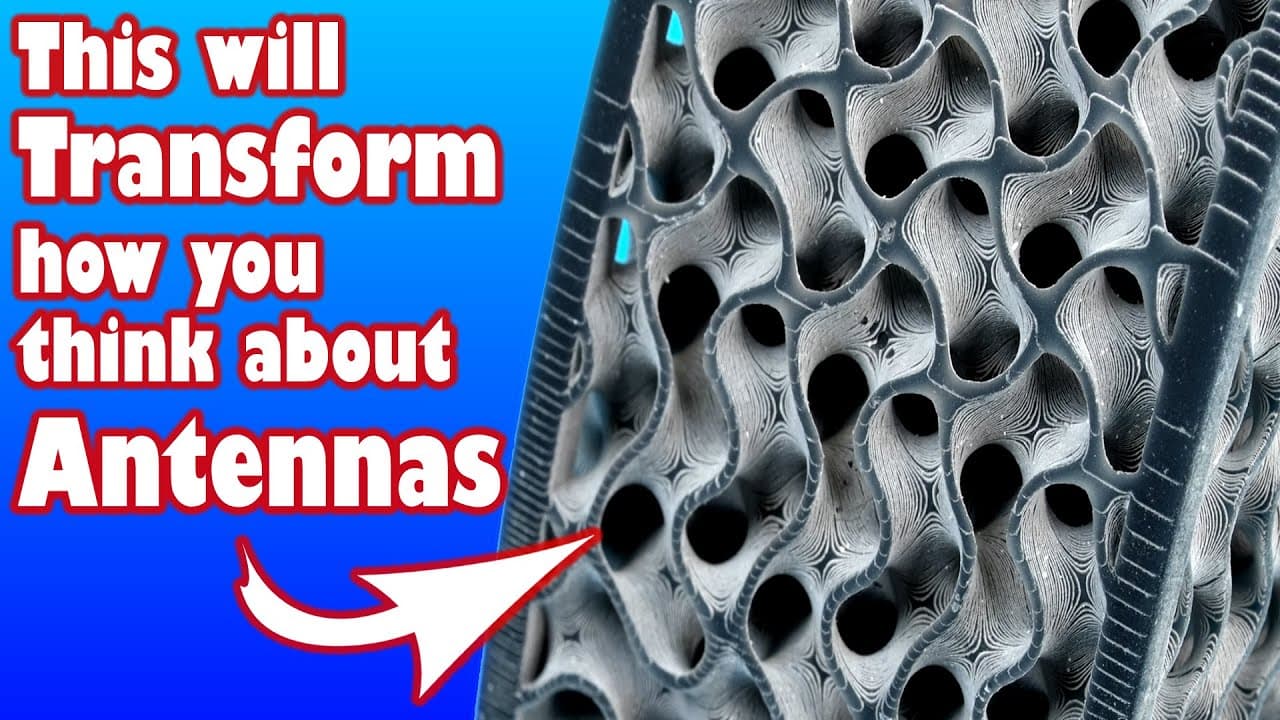
3D printing, using Rogers Radix™ resin, is transforming antenna design, enabling the creation of high-performance microwave components and complex geometries. This video showcases the collaboration between Rogers Corporation and Fortify, highlighting the innovative processes and materials that support RF engineers in developing cutting-edge solutions.
Transcript
Ever since 3D printers hit the mainstream, I dreamed of being able to print high-performance Microwave antenna components. It was still mostly a dream until I saw the announcement about Rogers Radix™ 3D printable dielectric UV resin material I got all over-excited and made a video asking if I could have a sample to try my own printer I was... Read More
Key Insights
- 🔬 The collaboration between Rogers Corporation and Fortify allows the creation of high-performance microwave antenna components using 3D printing technology.
- 🌐 Rogers' Radix resin material enables designers to create low-K substrates, complex geometry 3D parts, and gradient index structures, expanding the possibilities for RF engineers.
- 🏭 Fortify's continuous kinetic mixing technology ensures that the cured material remains homogeneous and isotropic throughout the printing process, improving quality control.
- 📐 Designers can incorporate metalized elements into their 3D printed parts using Radix, allowing for greater flexibility in antenna design and integration.
- 🧪 Rigorous quality control testing on the resin and testing of printers' parameters ensure the reliability and performance of finished antennas.
- 🔍 Rogers Labs utilizes split post dielectric resonators and Fabry-Perot Open Resonators to measure the characteristics of dielectric materials and verify performance.
- 💡 By printing test rods, blocks, and coupons alongside the parts, RF engineers can validate the relative permittivity zones and ensure accuracy in their designs.
- 🖨️ Fortify's printing process, from resin preparation to curing, allows for precise and efficient production of 3D printed dielectric lenses with excellent texture and finish.
Install to Summarize YouTube Videos and Get Transcripts
Explore YouTube Video Summarizer or Get YouTube Transcript Extractor
Questions & Answers
Q: How does Rogers Radix™ enable the creation of low-K substrates with complex structures that foam cannot achieve?
Rogers Radix™ allows the printing of low-K substrates with complex structures by providing a printable resin material that can be used to create structural rigidity and even incorporate plated through holes directly into the substrate, which is not possible with traditional foam materials.
Q: What is the role of Fortify's continuous kinetic mixing (CKM) technology in maintaining the homogeneity of the resin material during the printing process?
Fortify's CKM technology circulates, mixes, and heats the resin throughout the printing process, preventing settling of any fiber additives and ensuring a consistent and homogeneous mixture, resulting in high-quality printed parts.
Q: How does Radix enable the printing of gradient index structures like the Luneburg lens for antenna applications?
Radix allows for the printing of gradient index structures by providing a resin material with a variable dielectric constant. The Luneburg lens, for example, starts with a dielectric constant of 2 at the center and gradually decreases to 1 at the outside, allowing for antenna steering by changing the feeding point.
Q: How does Radix enable the incorporation of 3D metallization in antenna components?
Radix provides a resin material that allows for the direct printing of pure copper on the surface, eliminating the need for a separate metallization step. This enables the creation of antenna components that can be directly mounted to surfaces with metallization, improving performance and simplifying the manufacturing process.
Summary & Key Takeaways
-
The video showcases the collaboration between Rogers Corporation and Fortify to explore the use of Rogers Radix™ 3D printable dielectric resin material for creating gradient index antenna lenses and other complex 3D antenna components.
-
The video highlights the capabilities of Radix, such as the ability to print low-K substrates, gradient index structures like the Luneburg lens, and complex geometries with metallization.
-
The process of printing with Radix is demonstrated, including resin preparation, printing, post-processing, and testing/validation of the printed components.
Read in Other Languages (beta)
Share This Summary 📚
Summarize YouTube Videos and Get Video Transcripts with 1-Click
Try YouTube Summary with ChatGPT & Claude or YouTube Transcript Generator