THIS is the REAL DEAL 🤯 for local LLMs
TL;DR
Explore parallelism and Docker for faster local LLMs.
Transcript
Read and summarize the transcript of this video on Glasp Reader (beta).
Key Insights
- The video demonstrates the use of Quen 3 Coder, a 30 billion parameter model, for real-time coding assistance, highlighting its efficiency in coding and autocomplete scenarios.
- LM Studio, while popular, supports only one concurrent request, limiting its scalability. This is contrasted with Docker's ability to handle multiple concurrent requests effectively.
- Docker Model Runner supports GPU utilization and parallel processing, significantly improving the speed and efficiency of handling multiple requests simultaneously.
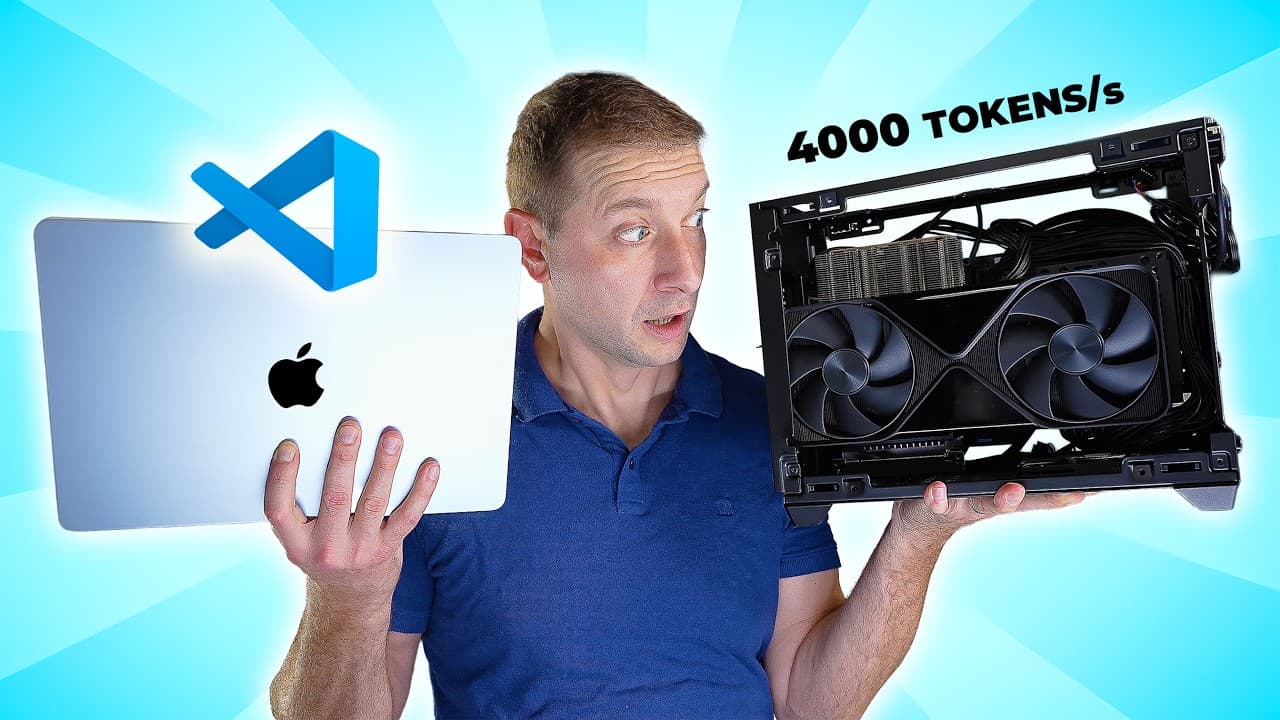
- The integration of VLM with Docker allows for enhanced parallelism and GPU utilization, showcasing the potential for high throughput in local LLM setups.
- FP8 quantization is introduced as a method to enhance model performance on Nvidia GPUs, offering faster processing by reducing precision requirements without sacrificing accuracy.
- The video discusses the limitations of Mac systems in supporting parallelism, noting that they only support specific model types and quantizations optimized for Apple silicon.
- A comprehensive setup using Docker, VLM, and Nvidia GPUs achieves impressive speeds, reaching up to 5,800 tokens per second, demonstrating the potential for local LLMs.
- The presenter emphasizes the importance of parallelism in code completion tasks, where multiple requests are processed simultaneously to improve developer productivity.
Install to Summarize YouTube Videos and Get Transcripts
Explore YouTube Video Summarizer or Get YouTube Transcript Extractor
Questions & Answers
Q: What model is used for real-time coding assistance in the video?
The video uses the Quen 3 Coder, a 30 billion parameter model, for real-time coding assistance. This model is particularly effective for coding and autocomplete scenarios due to its fill-in-the-middle capabilities. It provides real-time feedback and suggestions, enhancing the coding experience by offering fast and efficient assistance.
Q: How does Docker improve the handling of concurrent requests?
Docker improves the handling of concurrent requests by supporting parallelism and GPU utilization, allowing multiple requests to be processed simultaneously. Unlike LM Studio, which queues requests, Docker can run multiple queries in parallel, significantly enhancing speed and efficiency. This is crucial for tasks like code completion, where multiple data points are processed concurrently.
Q: What role does FP8 quantization play in model performance?
FP8 quantization plays a crucial role in enhancing model performance by reducing the precision of weights to eight bits, allowing for faster processing on Nvidia GPUs. This reduction in precision does not significantly impact accuracy but enables higher throughput and speed. FP8 quantization is supported natively by Nvidia's tensor cores, making it an effective method for optimizing large language models.
Q: Why is parallelism important for code completion tasks?
Parallelism is important for code completion tasks because it allows multiple requests to be processed simultaneously, reducing latency and improving response times. In coding scenarios, where numerous data points are sent to the model for processing, parallelism ensures that the system can handle these requests efficiently, providing faster and more accurate code suggestions and completions.
Q: What are the limitations of using LM Studio for concurrent requests?
LM Studio is limited in handling concurrent requests as it supports only one request at a time, queuing additional requests. This lack of parallel processing capability restricts its scalability and efficiency, particularly in scenarios requiring multiple simultaneous interactions, such as coding assistance or high-demand applications. This limitation is addressed by using Docker, which supports parallelism.
Q: How does the video demonstrate the use of Nvidia GPUs?
The video demonstrates the use of Nvidia GPUs by showcasing their role in enhancing the performance of local LLMs through parallel processing and quantization techniques. By integrating VLM with Docker, the presenter highlights the GPU's ability to handle multiple concurrent requests, significantly increasing throughput and achieving impressive token generation speeds, showcasing the GPU's computational power.
Q: What is the significance of Docker Model Runner in the setup?
Docker Model Runner is significant in the setup as it facilitates the deployment of models with support for GPU utilization and parallel processing. It allows developers to run applications alongside models efficiently, handling multiple requests simultaneously. This capability is crucial for achieving high throughput and optimizing the performance of local large language models in various applications.
Q: What challenges are associated with using Macs for parallelism?
Using Macs for parallelism presents challenges due to their limited support for concurrent processing and specific model types. Macs support only GGUF models and Apple's own quantizations optimized for Apple silicon, which may not leverage the full potential of parallelism. This limitation affects their ability to efficiently handle multiple simultaneous requests, impacting performance in high-demand scenarios.
Summary & Key Takeaways
-
The video explores the use of Quen 3 Coder, a 30 billion parameter model, for real-time coding assistance, demonstrating its efficiency in coding and autocomplete scenarios. The presenter highlights the limitations of LM Studio in handling concurrent requests and introduces Docker as a more scalable solution.
-
By leveraging Docker Model Runner, the presenter demonstrates improved GPU utilization and parallel processing capabilities, achieving higher speeds and efficiency in handling multiple requests. The video showcases the integration of VLM with Docker, allowing for enhanced parallelism and GPU utilization.
-
FP8 quantization is introduced as a method to enhance model performance on Nvidia GPUs, offering faster processing by reducing precision requirements. The video discusses the limitations of Mac systems in supporting parallelism and highlights the potential for high throughput in local LLM setups using Docker and Nvidia GPUs.
Read in Other Languages (beta)
Share This Summary 📚
Summarize YouTube Videos and Get Video Transcripts with 1-Click
Try YouTube Summary with ChatGPT & Claude or YouTube Transcript Generator
Explore More Summaries from Alex Ziskind 📚

Summarize YouTube Videos and Get Video Transcripts with 1-Click
Try YouTube Summary with ChatGPT & Claude or YouTube Transcript Generator