EfficientML.ai Lecture 7 - Neural Architecture Search Part I (MIT 6.5940, Fall 2024)
TL;DR
Explores neural architecture search, focusing on efficiency and accuracy trade-offs.
Transcript
Read and summarize the transcript of this video on Glasp Reader (beta).
Key Insights
- Neural architecture search is crucial for optimizing models to balance trade-offs between latency, accuracy, energy, and storage.
- Primitive operations such as fully connected layers, convolutional layers, and depthwise convolution are foundational to building neural architectures.
- Bottleneck architectures like ResNet and MobileNet optimize computational efficiency while maintaining model expressiveness.
- The design space for neural architecture search can be vast, requiring strategies to narrow it down for efficient search.
- Automated design methods outperform manual design by efficiently exploring large design spaces to find optimal models.
- Search strategies include grid search, random search, reinforcement learning, gradient descent, and evolutionary search.
- Differentiable search methods allow for the integration of latency and other constraints into the architecture design process.
- Evolutionary search mimics biological evolution to iteratively improve model architectures based on fitness functions.
Install to Summarize YouTube Videos and Get Transcripts
Explore YouTube Video Summarizer or Get YouTube Transcript Extractor
Questions & Answers
Q: What are the key trade-offs in neural architecture search?
The key trade-offs in neural architecture search involve balancing latency, accuracy, energy, and storage. Achieving low latency and energy consumption is crucial for real-time applications like self-driving cars and mobile devices. However, these must be balanced with maintaining high accuracy and reasonable storage requirements, which can be challenging.
Q: What are some primitive operations used in neural network design?
Primitive operations in neural network design include fully connected layers, convolutional layers (1D and 2D), group convolution, and depthwise convolution. These operations serve as the foundational building blocks for constructing complex neural architectures and are essential for optimizing model performance and efficiency.
Q: How does the bottleneck architecture improve efficiency?
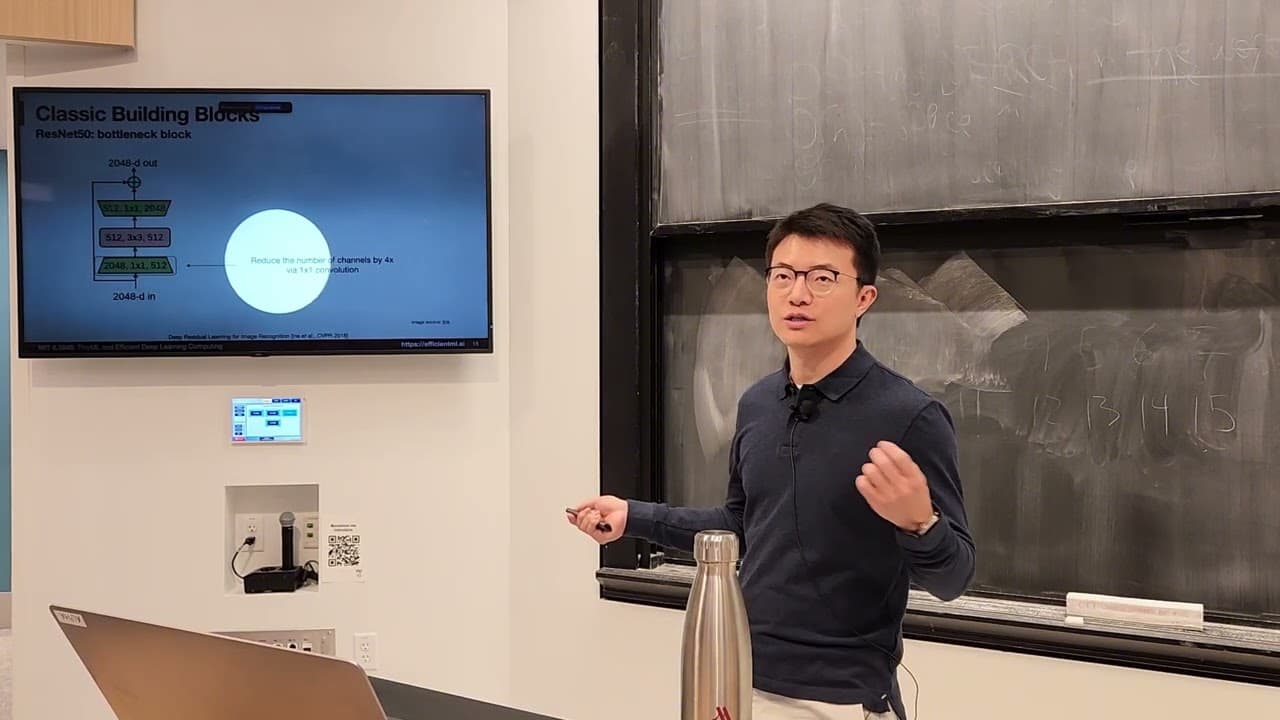
Bottleneck architectures, like those used in ResNet and MobileNet, improve efficiency by reducing the number of channels in computationally expensive layers, such as 3x3 convolutions, while maintaining or expanding channels where computation is cheaper. This approach minimizes the number of operations required, optimizing both the number of parameters and computational resources.
Q: What is the role of search strategies in neural architecture search?
Search strategies in neural architecture search are crucial for efficiently exploring the vast design space to identify optimal model architectures. Strategies like grid search, random search, reinforcement learning, gradient descent, and evolutionary search help automate the selection process, balancing various constraints like latency, accuracy, and resource utilization.
Q: How does evolutionary search work in neural architecture search?
Evolutionary search mimics biological evolution, using a population of models and a fitness function to select the best-performing architectures. It involves mutation and crossover operations to create new model variants, which are then evaluated and selected based on their performance, iteratively improving the population over time.
Q: What is the significance of making latency differentiable in architecture search?
Making latency differentiable in architecture search allows for the integration of latency constraints directly into the optimization process. By incorporating expected latency into the loss function, models can be trained to balance accuracy and latency, ensuring that the resulting architecture meets performance requirements while operating within resource constraints.
Q: Why is automated design often superior to manual design in neural architecture search?
Automated design is often superior to manual design because it can efficiently explore large design spaces and identify optimal architectures that meet specific performance and resource constraints. Automated methods leverage machine learning and optimization techniques to evaluate numerous configurations, often achieving better results than human designers who rely on intuition and experience.
Q: What are the challenges of designing models for different hardware constraints?
Designing models for different hardware constraints involves balancing competing requirements such as memory, latency, and energy consumption. For instance, mobile devices require efficient models that conserve battery life and fit within limited memory, while data centers prioritize high throughput and energy efficiency. The challenge lies in optimizing models to meet these diverse constraints without sacrificing accuracy.
Summary & Key Takeaways
-
This lecture introduces neural architecture search, emphasizing the importance of balancing efficiency metrics like latency and energy with accuracy. It reviews foundational operations in neural network design and discusses the complexity of achieving optimal trade-offs.
-
Primitive operations and building blocks such as bottleneck layers are essential for constructing efficient neural architectures. The lecture explains how these components can be combined and optimized for various applications, such as mobile and large-scale data centers.
-
Different search strategies, including grid search, random search, and evolutionary search, are explored to automate the design of neural architectures. These methods aim to efficiently navigate large design spaces to identify models that meet specific performance and resource constraints.
Read in Other Languages (beta)
Share This Summary 📚
Summarize YouTube Videos and Get Video Transcripts with 1-Click
Try YouTube Summary with ChatGPT & Claude or YouTube Transcript Generator
Explore More Summaries from MIT HAN Lab 📚






Summarize YouTube Videos and Get Video Transcripts with 1-Click
Try YouTube Summary with ChatGPT & Claude or YouTube Transcript Generator