How to Analyze a Pulley System with Two Blocks
TL;DR
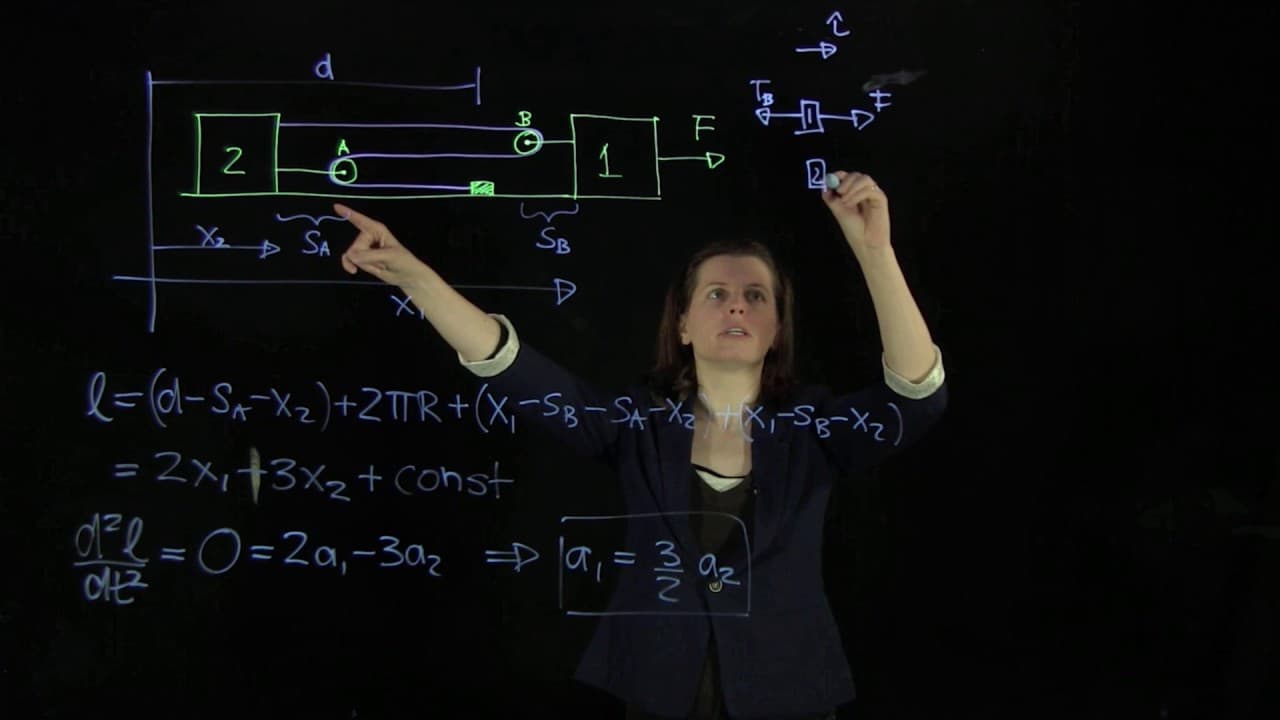
To analyze a pulley system with two blocks and two pulleys, start by determining the fixed string length and simplifying the string length equation. Derive the acceleration constraint by differentiating the string length twice, leading to the relationship between the accelerations of the two blocks. Free body diagrams facilitate understanding of the forces and tensions at play.
Transcript
We want to look at this pulley system. We want to find out what this force here is, for example, with which this block is being pulled. Now we have two massless pulleys here and two moving parts. And one key component of this problem is to derive the acceleration constraint. How are we going to do that? Well, we have to look at this string here. Fi... Read More
Key Insights
- 🖐️ The fixed string length plays a crucial role in determining the acceleration constraint of the pulley system.
- 💄 Introducing a constant and simplifying the string length equation makes the differentiation process easier.
- 🫡 The derivative of the string length equation with respect to time is set to zero since it represents a fixed value.
- 🥳 The derived acceleration constraint reveals the relationship between the accelerations of the moving parts.
- 🥶 Free body diagrams for each object in the system aid in setting up the equations of motion.
- 🧑🏭 The equations of motion reveal the forces and tensions acting on each object.
- 🍉 The massless nature of the pulleys affects the equations, resulting in certain terms equating to zero.
Install to Summarize YouTube Videos and Get Transcripts
Explore YouTube Video Summarizer or Get YouTube Transcript Extractor
Questions & Answers
Q: What is the key component in deriving the acceleration constraint of the pulley system?
The key component is analyzing the fixed string length and its relationship to the objects' positions. By differentiating the string length equation, the acceleration constraint can be determined.
Q: How does the analysis simplify the string length equation?
To simplify the equation, a constant is introduced and added to all the constants in the equation. This simplification helps eliminate the constants when differentiating the equation.
Q: What is the constraint condition derived from the acceleration equation?
The constraint condition is that a1 (the acceleration of the first block) is equal to 3/2 times a2 (the acceleration of the second block).
Q: How can the equations of motion be derived for the pulley system?
By considering the free body diagrams of each object in the system and applying Newton's Second Law (F = ma), the equations of motion can be established.
Summary & Key Takeaways
-
The analysis focuses on a pulley system with two massless pulleys and two moving parts.
-
The first step is to determine the fixed string length by considering the distances between the objects and fixed points.
-
The next step involves simplifying the string length equation and introducing a constant to make the differentiation process easier.
-
The derivative of the string length with respect to time is then obtained, leading to the acceleration constraint equation.
Read in Other Languages (beta)
Share This Summary 📚
Summarize YouTube Videos and Get Video Transcripts with 1-Click
Try YouTube Summary with ChatGPT & Claude or YouTube Transcript Generator
Explore More Summaries from MIT OpenCourseWare 📚


Summarize YouTube Videos and Get Video Transcripts with 1-Click
Try YouTube Summary with ChatGPT & Claude or YouTube Transcript Generator