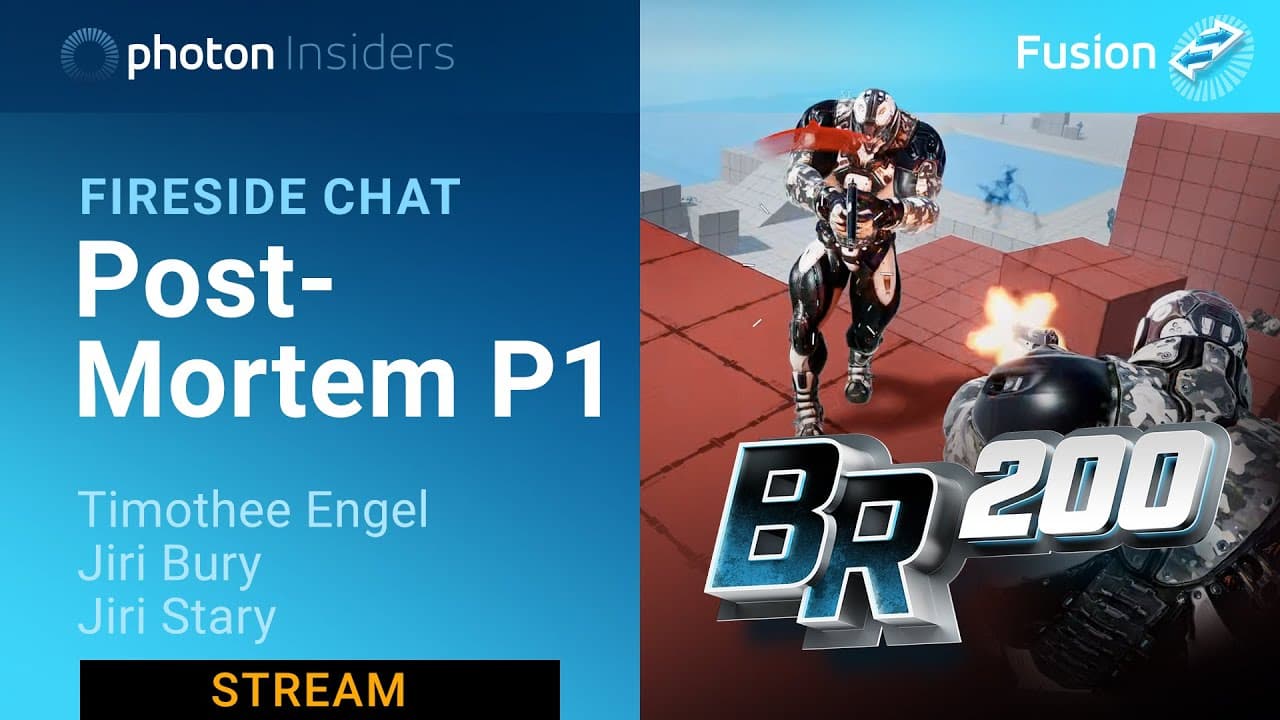
Photon Insiders - Fusion BR200 Postmortem - Part 1
TL;DR
Fusion BR200's development journey from concept to release.
Transcript
Read and summarize the transcript of this video on Glasp Reader (beta).
Key Insights
- Photon Fusion BR200 began as a unique project with a different concept, initially planned as a non-shooter with bows and arrows.
- The project faced challenges in creating a networked animation system that could handle 200 players at 60 hertz, pushing the limits of performance.
- The development team utilized prefabricated blocks and connectors to generate large maps efficiently, balancing performance and visual appeal.
- The game initially used hitscan weapons for performance reasons, later evolving to include kinematic projectiles in a separate sample project.
- Public playtests revealed critical issues with player connections and disconnections, leading to significant code rewrites for improved robustness.
- The team leveraged the Playables API to create a custom animation controller, ensuring tick-accurate animations for precise lag compensation.
- The project was a testing ground for Photon Fusion SDK improvements, leading to enhancements in network culling and other features.
- Partnership with Unity and incorporation of Multiplay for dedicated server hosting expanded the project's capabilities for large-scale multiplayer gameplay.
Install to Summarize YouTube Videos and Get Transcripts
Explore YouTube Video Summarizer or Get YouTube Transcript Extractor
Questions & Answers
Q: What was the original concept for Photon Fusion BR200?
The original concept for Photon Fusion BR200 was not a shooter. It started as a project featuring bows, arrows, and sports battles, with a focus on networking and engineering challenges. The team aimed to create a unique multiplayer experience with 200 players, which later evolved into a battle royale shooter.
Q: How did the team handle the challenge of animating 200 players?
To animate 200 players at 60 hertz, the team developed a custom animation controller using the Playables API. This allowed for performance optimization and tick-accurate animations, which are crucial for precise lag compensation in a multiplayer environment. The approach ensured that all animations were synchronized across clients and the server.
Q: What was the significance of public playtests for the project?
Public playtests were crucial for identifying issues with player connections and disconnections. They revealed that the server crashed under certain conditions, prompting the team to rewrite parts of the code for better robustness. These tests provided valuable insights into real-world usage, helping to refine the game's networking capabilities.
Q: How did the team approach map generation for the game?
The team used a procedural approach to map generation, utilizing prefabricated blocks and connectors. This method allowed for efficient creation of large maps with varying verticality and hideouts, balancing performance and visual appeal. The generated maps were tested for gameplay quality and optimized for multiplayer performance.
Q: What role did Photon Fusion SDK improvements play in the project?
Photon Fusion BR200 served as a testing ground for Photon Fusion SDK improvements. The project highlighted areas for enhancement, such as network culling and tick-accurate animations. These insights led to SDK updates that benefited other developers using Photon Fusion for multiplayer game development.
Q: How did the project integrate kinematic projectiles?
While the main game used hitscan weapons for performance reasons, the team explored kinematic projectiles in a separate sample project. This allowed for more complex projectile behavior, such as grenades and arrows, while maintaining performance. The separate project provided a playground for testing advanced projectile concepts.
Q: What was the impact of the partnership with Unity and Multiplay?
The partnership with Unity and Multiplay expanded the project's capabilities by providing dedicated server hosting for large-scale multiplayer gameplay. This integration demonstrated how to orchestrate and manage game sessions effectively, offering a scalable solution for developers aiming to create competitive multiplayer experiences.
Q: What challenges did the team face with asset licensing and visuals?
The team faced challenges with asset licensing and visuals, requiring them to replace and strip assets to ensure compliance and optimize performance. This process was time-consuming but necessary to create a visually appealing and performant game. The use of asset store content allowed the team to focus on networking and gameplay features.
Summary & Key Takeaways
-
Photon Fusion BR200 started as a non-shooter concept, evolving into a battle royale with innovative networking solutions. The project pushed the limits of performance with 200 players and 60 hertz simulation.
-
The development team used prefabricated blocks and connectors for map generation, balancing performance and aesthetics. Hitscan weapons were initially used, with kinematic projectiles explored in a separate project.
-
Public playtests exposed connection issues, prompting code rewrites for robustness. The project contributed to Photon Fusion SDK improvements, and a partnership with Unity expanded its multiplayer capabilities.
Read in Other Languages (beta)
Share This Summary 📚
Summarize YouTube Videos and Get Video Transcripts with 1-Click
Try YouTube Summary with ChatGPT & Claude or YouTube Transcript Generator
Explore More Summaries from Photon Engine 📚
Summarize YouTube Videos and Get Video Transcripts with 1-Click
Try YouTube Summary with ChatGPT & Claude or YouTube Transcript Generator