The Sun Isn't Normal. This Telescope Learned the Hard Way.
TL;DR
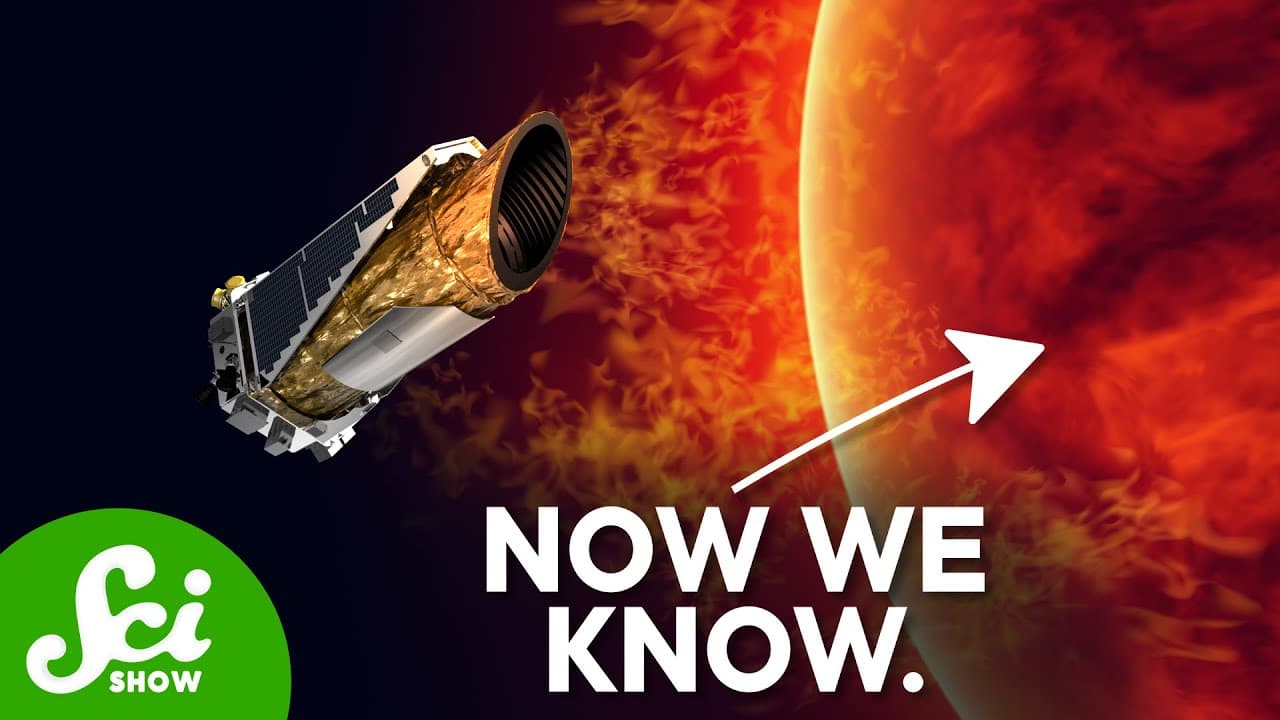
The Sun is not a typical star: Sun-like G stars are relatively rare, and the Sun is quieter than most G stars Kepler observed. That unexpected stellar noise made Earth-sized planets harder to detect, so astronomers gathered more data to average out brightness fluctuations. Kepler still discovered Kepler-22b and thousands of other exoplanets, but an Earth twin remains unconfirmed. Read on to see how the telescope adapted.
Transcript
This SciShow video is supported by Linode! You can get a $100 60-day credit on a new Linode account at linode.com/scishow. In 2018, the Kepler Space Telescope retired as the MVP of exoplanet hunters. When it launched nine years earlier, we only knew of about 300 planets beyond our solar system. Kepler found more than two and a half thousand. Over ... Read More
Key Insights
- 🌍 The Kepler Space Telescope exceeded expectations by discovering over 60% of confirmed exoplanets, but finding an Earth-like twin remains a challenge.
- 🤩 Assumptions about the Sun's typicality and noise levels of other stars proved incorrect, complicating the search for habitable exoplanets.
- 🤩 Red dwarf stars, which are more common, have narrower habitable zones closer to the star, making habitability difficult due to radiation and potential atmospheric stripping.
- ❓ Kepler overcame the obstacle of stellar noise by collecting more data and utilizing solar radiation for stabilization.
- ❓ Kepler-22b was a significant discovery, but its composition and habitability are still unknown.
Install to Summarize YouTube Videos and Get Transcripts
Explore YouTube Video Summarizer or Get YouTube Transcript Extractor
Questions & Answers
Q: Why did Kepler discover that the Sun is not a typical star?
Sun-like G stars make up only 6% of stars in the galaxy, while red dwarfs account for 73%. Kepler also found that most G stars flickered more than scientists expected, revealing that the Sun is unusually quiet.
Q: How did the Sun assumption affect Kepler's search for Earth's twin?
Kepler's designers expected other G stars to have noise levels similar to the Sun's. When those stars proved much noisier, their brightness fluctuations made the tiny signals from Earth-sized planets harder to distinguish.
Q: How did Kepler detect exoplanets?
Kepler watched 150,000 stars simultaneously and searched for small dips in brightness. Such a dip could indicate that a planet was crossing in front of its star and blocking part of its light.
Q: Why was an Earth-like planet difficult for Kepler to detect?
From a distant viewpoint, Earth passing in front of the Sun would reduce its brightness by about 0.0085%, or 85 parts per million. That dip would last for 10 hours and occur once per year, requiring long and sensitive observations to confirm it was not a random fluctuation.
Q: What did Kepler reveal about noise in G stars?
After examining the first 18 months of data, astronomers found that G-star flickering was double the mission's expected noise limit. Almost no G stars had less than 10 parts per million of noise, and about 30% exceeded 50 parts per million.
Q: How did astronomers respond to Kepler's stellar-noise problem?
They planned to watch stars longer so additional data could average out random brightness fluctuations. NASA approved an extension of the Kepler mission, although failing stabilization components later prevented the telescope from continuing its original observing program.
Q: How did scientists stabilize Kepler after its hardware began failing?
Scientists used radiation from the Sun to help brace and stabilize the telescope, following the same principle as a solar sail. This allowed Kepler to monitor stars for shorter periods during its later mission.
Q: Why was Kepler-22b important, and was it Earth's twin?
Kepler-22b was the first discovered exoplanet combining a size just twice Earth's with an orbit in the habitable zone of a Sun-like star. It cannot yet be called Earth's twin because its composition, atmosphere, surface water, and even whether it is terrestrial remain unknown.
Summary & Key Takeaways
-
The Kepler Space Telescope retired in 2018 after successfully discovering over 60% of confirmed exoplanets, but its mission to find Earth's twin faced challenges.
-
Assumptions that the Sun was a typical star and that other G stars were as noisy as the Sun proved incorrect.
-
Red dwarf stars, which are more common, have a narrower habitable zone, and the proximity to the star may result in the stripping of the planet's atmosphere.
-
Kepler found promising exoplanet candidates, including some around G stars, but the definitive discovery of an Earth-like twin is yet to be confirmed.
Read in Other Languages (beta)
Share This Summary 📚
Summarize YouTube Videos and Get Video Transcripts with 1-Click
Try YouTube Summary with ChatGPT & Claude or YouTube Transcript Generator
Explore More Summaries from SciShow 📚


Summarize YouTube Videos and Get Video Transcripts with 1-Click
Try YouTube Summary with ChatGPT & Claude or YouTube Transcript Generator