What Are Bidirectional Sampling Gates and How Do They Work?
TL;DR
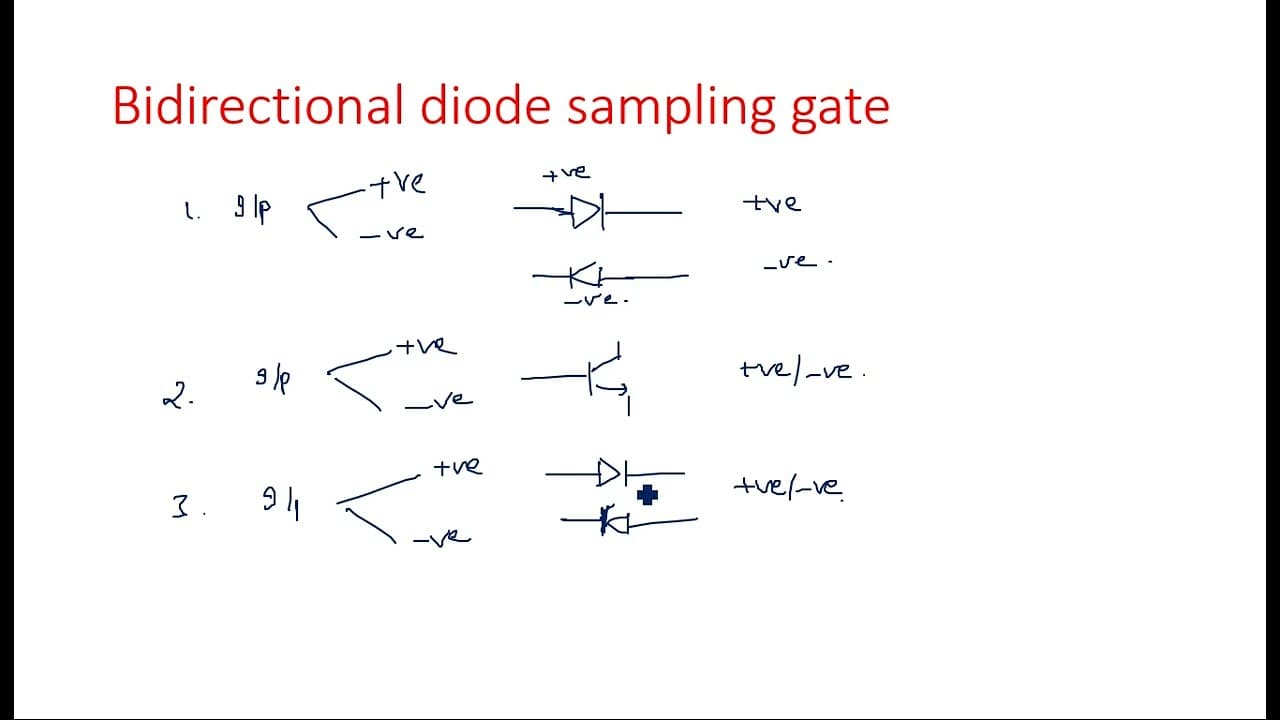
Bidirectional sampling gates utilize two diodes to allow simultaneous transmission of both positive and negative input signals. This arrangement enables the output to reproduce the full range of signal polarities, unlike unidirectional gates. Control signals with opposite polarities are essential for the diodes to switch on and off correctly, affecting circuit performance and voltage calculations.
Transcript
hi everyone in this video I'm going to explain about the bidirectional sampling Gates but this time bidirectional sampling gates are made up of diodes in the previous videos we came across unidirectional sampling GES with diodes and Bal sampling GES with transistors the meaning of bidirectional or unidirectional is what type of signal that can be r... Read More
Key Insights
- 🔬 Bidirectional sampling gates can reproduce both positive and negative signal polarities at output using two diodes.
- 🎮 The arrangement of control signals with opposite polarities is essential for switching diodes on and off properly.
- 💦 Resistors replace capacitors in the circuit, contributing to voltage drop calculations necessary for output determination.
- ⚡ The effective functioning of the bidirectional sampling gate relies on controlling diode states with alternating voltage signals.
- ⚡ Gain and control voltage calculations provide valuable metrics for assessing the performance of the sampling gate circuit.
- 📡 Designing circuits with diodes can simplify implementation while ensuring comprehensive signal handling capabilities.
- 🤩 Analyzing resistance and diode orientation is key to optimizing circuit performance in various sampling scenarios.
Install to Summarize YouTube Videos and Get Transcripts
Explore YouTube Video Summarizer or Get YouTube Transcript Extractor
Questions & Answers
Q: What is the main difference between unidirectional and bidirectional sampling gates?
The main difference lies in their ability to handle signal polarity. A unidirectional sampling gate, using a single diode, only allows positive or negative signals at the output depending on the diode's orientation. In contrast, a bidirectional sampling gate can transmit both positive and negative signals simultaneously at the output by utilizing multiple diodes or transistors.
Q: How do control signals affect the operation of diodes in a bidirectional sampling gate?
Control signals dictate whether the diodes are in the on or off states. For instance, one control signal can be positive, turning on one diode, while the opposing signal turns on another diode with a negative potential. This switching enables the gate to handle both polarities of the input signal and ultimately affects the output voltage across the load resistor.
Q: What role do resistors play in the bidirectional sampling gate circuit?
Resistors are used in place of capacitors in this configuration to determine current flow and output voltage across the load resistor (RL). Their values affect the voltage drop experienced when current passes through them, which is essential for calculating the output based on the input signals and operational conditions.
Q: Can you explain the concept of gain in the context of the sampling gate circuit?
Gain in this context refers to the ratio of the output voltage (V0) to the input voltage (VS). It’s calculated using the equivalent circuit's resistance values and illustrates how effectively the circuit amplifies the input signal based on various arrangements of resistors and their impact on the overall circuit behavior.
Q: How are two diodes arranged in the bidirectional sampling circuit for optimal operation?
Two diodes are arranged in a way that allows one diode to operate in forward bias while the other is in reverse bias to control which signals pass through. This arrangement ensures that both positive and negative peaks of the input signal can be effectively sampled and transmitted to the output.
Q: What are the implications of using diodes compared to transistors in sampling gates?
Diodes generally offer simpler designs and can effectively handle signal polarities, but may not provide the same level of control and amplification as transistors. Transistors allow for more complex operational characteristics but may complicate the circuit design compared to the simplicity offered by diode-based sampling gates.
Q: Why is it's important to analyze both control voltage and load resistor values in the operation of the sampling gate?
Analyzing control voltage and load resistor values is crucial because they directly influence the output behavior of the sampling circuit. Properly understanding these components can lead to more efficient designs, improved signal handling, and accurate calculations of output gain, ensuring desired performance of the sampling system.
Summary & Key Takeaways
-
The video defines bidirectional and unidirectional sampling gates, highlighting how diodes can influence signal polarity in output.
-
It presents a circuit diagram demonstrating how two diodes are used together to simultaneously allow both positive and negative input signal transmission.
-
The explanation includes control signals, output characteristics, and calculations regarding gain and control voltage, focusing on performance comparisons between diodes and transistors.
Read in Other Languages (beta)
Share This Summary 📚
Summarize YouTube Videos and Get Video Transcripts with 1-Click
Try YouTube Summary with ChatGPT & Claude or YouTube Transcript Generator