Detection of Blood Flow
TL;DR
Technique to visualize and estimate blood flow velocities in facial videos.
Transcript
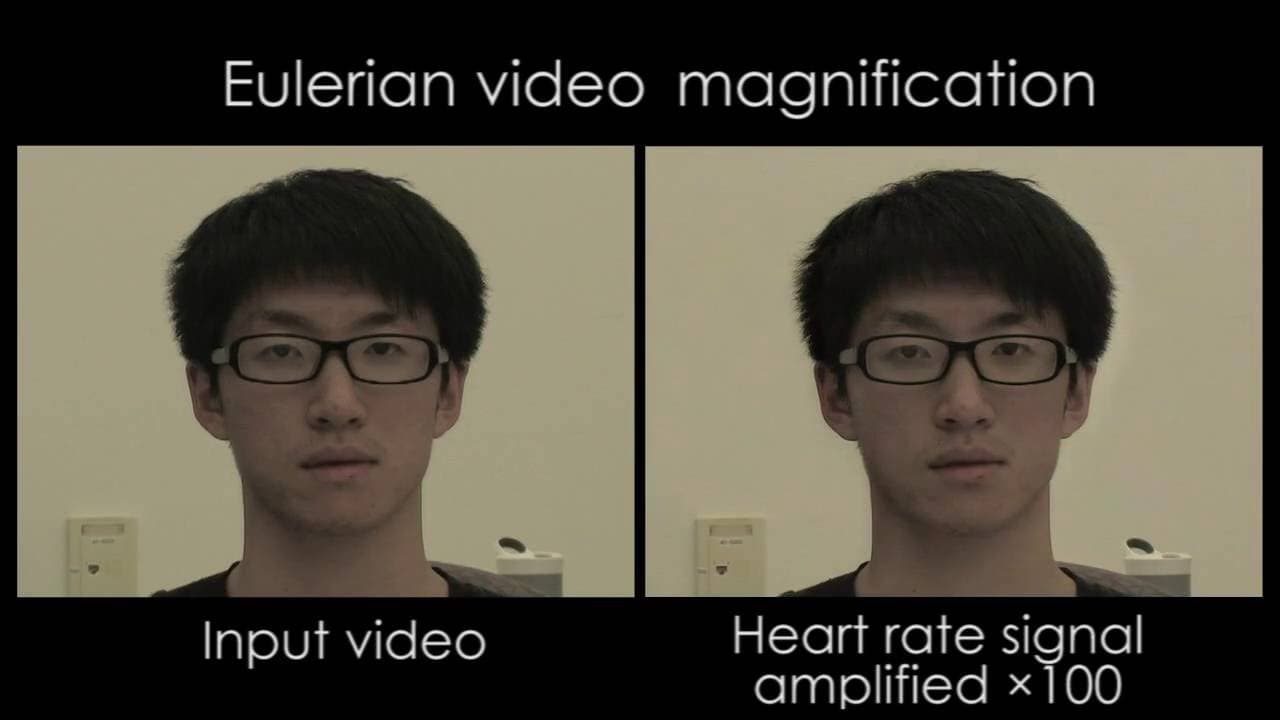
this submission presents the estimation of two-dimensional blood flow velocities for videos our skin color constantly changes over time as a result of blood flowing through it this change is too subtle to be visible to us using a technique called Euler in video magnification we are able to make this variation visible in this example the heart rate ... Read More
Key Insights
- The technique uses Eulerian video magnification to make subtle changes in skin color due to blood flow visible, enhancing the heart rate signal by 100 times.
- The process involves low-pass filtering, spatial domain processing, and color intensity analysis for each pixel to detect periodic signals representing heartbeats.
- Fourier transformation is used to identify frequency peaks, allowing extraction of the frequency of interest through band-pass filtering.
- Amplitude maps are created by calculating the magnitude of color variation, indicating blood vessel abundance, with high intensity suggesting more blood flow.
- Phase maps are generated using the hue component of the HSV color space, showing smooth blood flow correlation among neighboring skin pixels.
- Time shifts in pixel intensity reveal blood flow information, calculated using a super filter to determine two-dimensional blood flow velocity fields.
- Head motion introduces halo artifacts, which can be reduced by subtracting neighboring band amplitude maps, isolating blood flow-related high amplitudes.
- Noise reduction involves identifying and ignoring noisy regions by calculating variance in phase values, focusing on areas with consistent blood flow signals.
Install to Summarize YouTube Videos and Get Transcripts
Explore YouTube Video Summarizer or Get YouTube Transcript Extractor
Questions & Answers
Q: How does Eulerian video magnification contribute to the analysis?
Eulerian video magnification plays a crucial role by amplifying subtle changes in skin color caused by blood flow, which are normally invisible to the naked eye. This amplification makes the heart rate signals detectable and allows for further analysis of blood flow dynamics. By enhancing the visibility of these changes, it provides a foundation for subsequent processing steps such as filtering and Fourier transformation.
Q: What is the significance of using Fourier transformation in this method?
Fourier transformation is significant as it transforms the time-domain signals into the frequency domain, allowing for the identification of frequency peaks corresponding to heartbeats. By isolating these frequencies through band-pass filtering, the method can extract the heart rate signal from the video data, which is essential for estimating blood flow velocities. This transformation provides a clear representation of periodic signals related to blood flow.
Q: How are amplitude and phase maps used in blood flow estimation?
Amplitude maps are used to visualize the intensity of color variation, indicating areas with abundant blood vessels, while phase maps show the smooth correlation of blood flow among neighboring skin pixels. By analyzing these maps, regions with consistent blood flow patterns can be identified, and noisy areas are ignored. The maps provide a detailed view of blood flow dynamics, helping to isolate and estimate blood flow velocities accurately.
Q: What challenges does head motion introduce, and how are they addressed?
Head motion introduces halo artifacts around strong edges, complicating the analysis of blood flow. These artifacts are addressed by subtracting amplitude maps of neighboring frequency bands, which helps isolate the high amplitude signals related to blood flow. This subtraction reduces the impact of motion artifacts, allowing for a clearer focus on the true blood flow dynamics, thereby improving the accuracy of the velocity estimation.
Q: How is noise reduced in the phase and amplitude maps?
Noise reduction is achieved by calculating the variance of phase values in small neighborhoods around each pixel. Regions with high variance are considered noise and are ignored in the analysis. This approach ensures that only areas with consistent and reliable blood flow signals are considered, enhancing the accuracy of the blood flow velocity estimation and providing a clearer visualization of the blood flow dynamics.
Q: What role does spatial preprocessing play in this method?
Spatial preprocessing enhances the signal-to-noise ratio (SNR) and computational efficiency by preparing the video data for subsequent analysis steps. This preprocessing includes low-pass filtering and spatial domain processing, which help to isolate the relevant signals related to blood flow. By improving the quality of the input data, spatial preprocessing ensures that the subsequent Fourier transformation and amplitude/phase map generation are more accurate and effective.
Q: Why is it important to calculate the variance of phase values?
Calculating the variance of phase values is important for identifying and eliminating noisy regions in the video data. High variance indicates inconsistency in the blood flow signal, which is likely due to noise. By focusing on areas with low variance, the method ensures that only reliable and consistent blood flow signals are considered, improving the accuracy and reliability of the blood flow velocity estimation.
Q: How does the method ensure accurate blood flow velocity estimation?
The method ensures accurate blood flow velocity estimation by combining several techniques: Eulerian video magnification to enhance visibility, Fourier transformation to extract relevant frequencies, and amplitude/phase map analysis to visualize blood flow. Noise reduction strategies, such as variance calculation and artifact subtraction, further refine the analysis. Together, these techniques provide a comprehensive approach to accurately estimate blood flow velocities from video data.
Summary & Key Takeaways
-
This study presents a method for estimating two-dimensional blood flow velocities from facial videos. By applying Eulerian video magnification, subtle changes in skin color due to blood flow are amplified, making heart rate signals visible. The process involves spatial preprocessing, Fourier transformation, and band-pass filtering to extract relevant frequencies.
-
Amplitude and phase maps are generated to visualize blood flow, with high intensity in amplitude maps indicating areas rich in blood vessels. Phase maps use the hue component of the HSV color space, showing smooth blood flow correlations among neighboring pixels while ignoring noisy regions through variance calculation.
-
Head motion artifacts are addressed by subtracting neighboring band amplitude maps, focusing on high amplitude areas related to blood flow. The method effectively isolates and estimates blood flow velocities, providing a comprehensive visualization of blood flow dynamics in the face through video analysis.
Read in Other Languages (beta)
Share This Summary 📚
Summarize YouTube Videos and Get Video Transcripts with 1-Click
Try YouTube Summary with ChatGPT & Claude or YouTube Transcript Generator