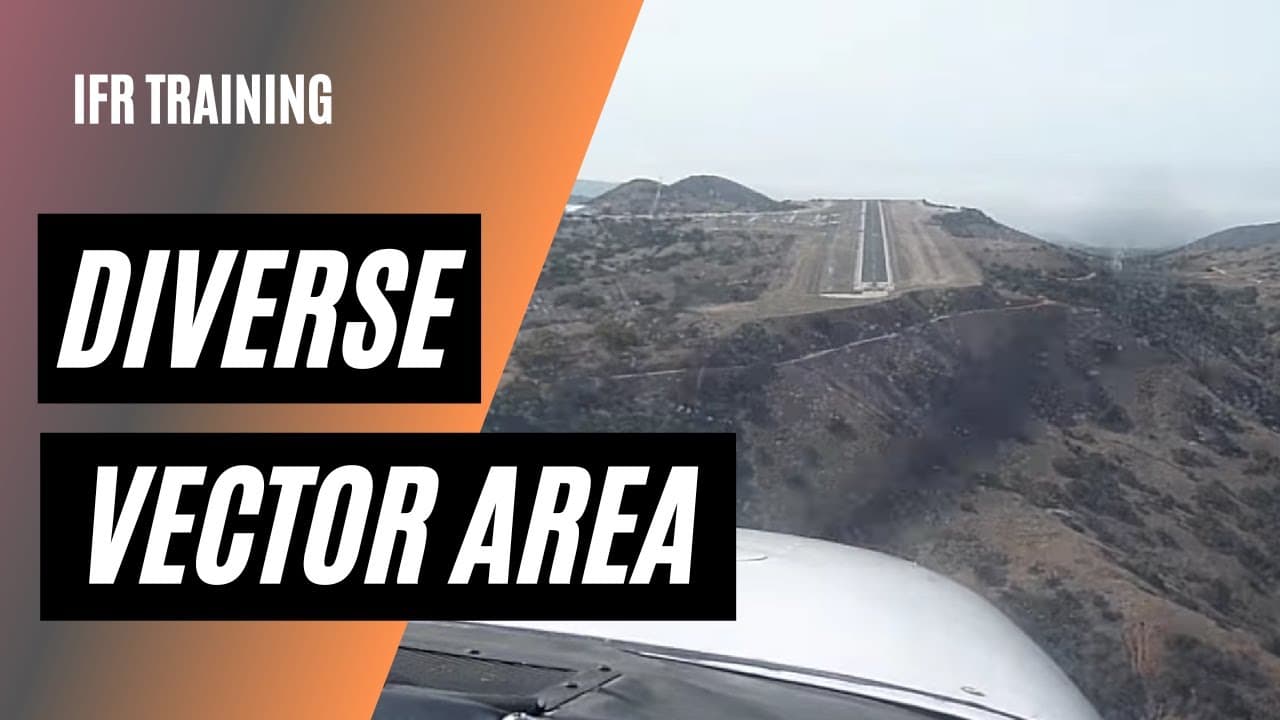
Diverse Vector Area | IFR Departures with Obstructions | Obstacle Departure Procedure
TL;DR
When aircraft depart under Instrument Flight Rules (IFR), they use obstacle departure procedures and vectoring to ensure safety and avoid obstructions during climb out.
Transcript
when aircraft depart IFR how do we know they'll be safe to climb out in the clouds without smacking and deterring in our obstructions careful study is made of airport terminal areas as stated in the instrument procedures handbook among other places if no obstacles penetrate an imaginary line with a 40 to 1 gradient then a standard departure can be ... Read More
Key Insights
- 🛫 When aircraft depart IFR, careful study of airport terminal areas is conducted to ensure safe climb out without obstacles.
- 🛬 Obstacle Departure Procedures (ODPs) are designed by the FAA using the Terps process to navigate around obstacles in specific areas.
- 🔢 ODPs provide guaranteed obstacle clearance if followed according to root restrictions and minimum climb gradients.
- 📍 At busy Tower controlled airports, controllers assign different vectors to aircraft for spacing reasons, maintaining safety.
- 🌄 In mountainous areas like Bristol Tennessee, ODPs are necessary to navigate towards specific VORs and avoid mountains.
- 🗺️ Terminal Procedures Publication provides details on ODPs, minimum climb gradients, and diverse vector areas (DVAs) for obstacle clearance.
- ⬆️ Minimum vectoring altitude (MVA) ensures safe vectoring above a certain altitude to prevent obstructions.
- 🚀 Diverse vector areas (DVAs) can be used by ATC to provide obstacle clearance on random vectors, even in lieu of published ODPs.
Install to Summarize YouTube Videos and Get Transcripts
Explore YouTube Video Summarizer or Get YouTube Transcript Extractor
Questions & Answers
Q: What is the purpose of an obstacle departure procedure?
Obstacle Departure Procedures (ODPs) are designed to guide aircraft safely around obstructions during departure, ensuring obstacle clearance and providing a standardized route.
Q: How do controllers maintain safe spacing between departing aircraft?
Controllers assign radar vectors to aircraft, especially in busy airports, to maintain safe spacing and ensure they stay clear of obstacles above the minimum vectoring altitude.
Q: What are Diverse Vector Areas (DVAs) and when are they used?
DVAs are defined in the Aeronautical Information Manual (AIM) and can be used in place of published departure procedures. They provide obstacle clearance on random vectors and allow for flexibility in departures.
Q: How do controllers ensure terrain clearance when issuing vectors below the minimum vectoring altitude?
Controllers use DVAs, which assume responsibility for terrain clearance on random vectors. The minimum climb gradient is specified within the DVA, ensuring obstacle avoidance.
Q: Are climb gradients mandatory for aircraft departing under Part 91 operations?
While Part 91 operations are not legally obligated to follow climb gradients, controllers typically assume that aircraft will comply with the minimum climb gradient specified in the departure procedures.
Q: What should pilots do if they are unsure about the departure procedure or climb gradients?
Pilots can request the published ODP on departure if available, or refer to the operational guidance at the specific airport. It is crucial to meet the minimum climb gradients for safe obstacle clearance.
Q: Do all airports have DVAs for providing random vectors?
Not all airports have DVAs, but controllers can still issue vectors as long as certain criteria outlined in operational guidance are met. The standards for protection may be lower in these cases, as controllers rely on local terrain knowledge.
Q: How can pilots ensure they have obstacle clearance during departure?
Pilots should carefully study the instrument procedures for their departure airport, follow the specified route restrictions and minimum climb gradients, and be aware of any available ODPs or DVAs for obstacle clearance.
Summary & Key Takeaways
-
Obstacle Departure Procedures (ODPs) are carefully designed by the FAA to navigate aircraft safely around obstructions during departure.
-
Controllers assign radar vectors to aircraft to maintain safe spacing, ensuring they stay clear of obstacles above the minimum vectoring altitude.
-
Diverse Vector Areas (DVAs) can be used in place of published departure procedures, providing obstacle clearance on random vectors and allowing for flexibility in departures.
Read in Other Languages (beta)
Share This Summary 📚
Summarize YouTube Videos and Get Video Transcripts with 1-Click
Try YouTube Summary with ChatGPT & Claude or YouTube Transcript Generator
Explore More Summaries from FlightInsight 📚


Summarize YouTube Videos and Get Video Transcripts with 1-Click
Try YouTube Summary with ChatGPT & Claude or YouTube Transcript Generator