How to Reflect Shapes in Maths
TL;DR
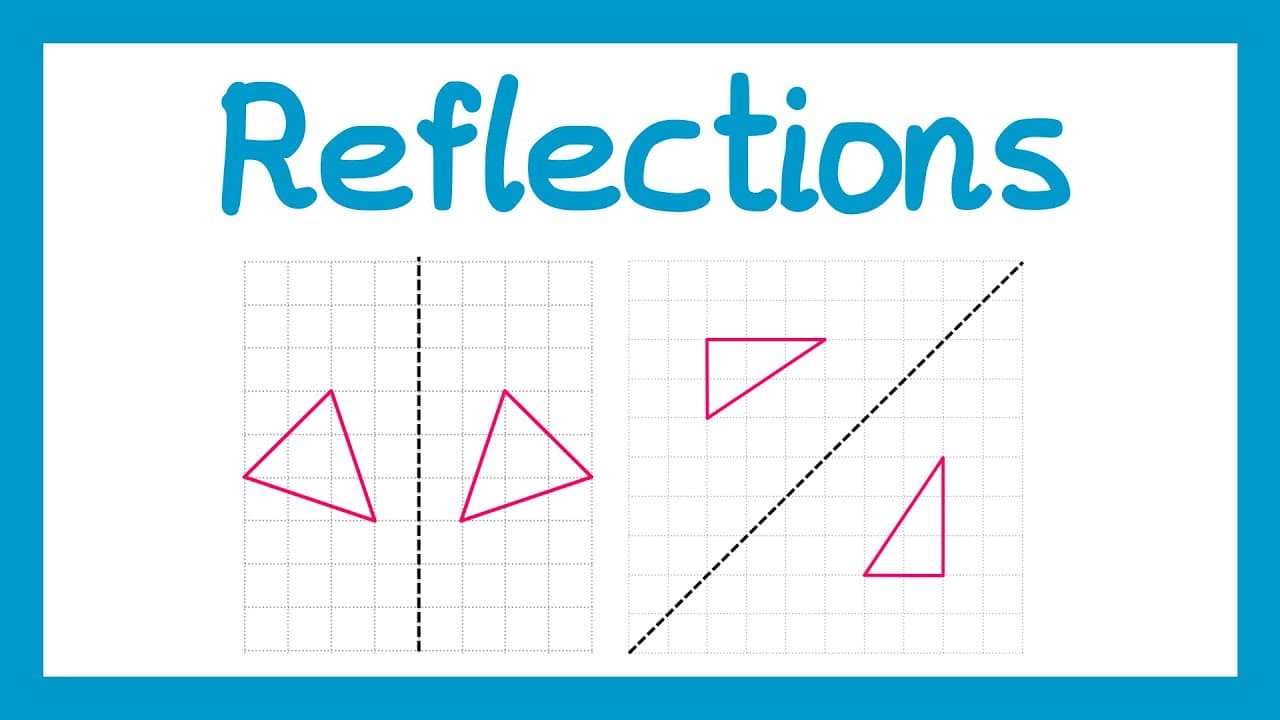
Reflections in geometry involve flipping a shape over a mirror line, maintaining equal distance from the line for corresponding points. The original shape is called the object, and the reflected shape is the image. Understanding the equations of lines, such as x=a or y=b, is crucial for accurately performing reflections on coordinate grids.
Transcript
in this video we're going to learn about Reflections let's start by reflecting this triangle here in this line we give this line a name and it's called the mirror line if we reflected this triangle in this mirror line the triangle would flip over the mirror line and create a reflection that looks like this if we move the original triangle up for do... Read More
Key Insights
- Reflections involve flipping a shape over a mirror line, keeping corresponding points equidistant from the line.
- The original shape in a reflection is called the object, and the reflected shape is the image.
- To reflect a shape, determine the distance of each point from the mirror line and replicate it on the opposite side.
- Horizontal and vertical mirror lines have equations like x=a or y=b, indicating where they intersect the axes.
- Diagonal mirror lines, such as y=x or y=-x, require turning 90 degrees at the line for accurate reflections.
- In reflections, points on the mirror line remain unchanged, while others are mirrored across it.
- Reflections can be described as transformations, alongside rotations, translations, and enlargements.
- Describing a reflection involves identifying the mirror line's equation and stating the transformation type.
Install to Summarize YouTube Videos and Get Transcripts
Explore YouTube Video Summarizer or Get YouTube Transcript Extractor
Questions & Answers
Q: How to perform a reflection in geometry?
To perform a reflection, identify the mirror line and measure the distance from each point of the shape to the line. Replicate this distance on the opposite side of the line for each point. The original shape is the object, and the mirrored shape is the image. This method ensures the image is an accurate reflection of the object.
Q: What is the equation of a mirror line?
The equation of a mirror line in geometry depends on its orientation. Vertical mirror lines have equations like x=a, where 'a' is the x-coordinate where the line crosses the x-axis. Horizontal mirror lines have equations like y=b, where 'b' is the y-coordinate where the line crosses the y-axis. Diagonal lines can have equations like y=x or y=-x.
Q: Why do points on the mirror line remain unchanged?
Points on the mirror line remain unchanged during a reflection because they are equidistant from themselves on either side of the line. Since they lie directly on the line, there is no distance to replicate on the opposite side, resulting in no change in their position after the reflection.
Q: What are the types of transformations in geometry?
In geometry, there are four main types of transformations: reflection, rotation, translation, and enlargement. Reflection involves flipping a shape over a mirror line. Rotation involves turning a shape around a fixed point. Translation involves sliding a shape from one position to another. Enlargement involves resizing a shape by a scale factor.
Q: How to describe a reflection transformation?
To describe a reflection transformation, state that it is a reflection and provide the equation of the mirror line. For example, you might say 'This is a reflection in the line x=3.' This description identifies the type of transformation and the specific line over which the shape is reflected.
Q: What is the role of diagonal mirror lines in reflections?
Diagonal mirror lines, such as those with equations y=x or y=-x, require a unique approach in reflections. When reflecting over these lines, after measuring the distance to the line, you must turn 90 degrees upon reaching the line and continue the same distance in the new direction to accurately reflect the shape.
Q: How do you reflect a shape on a coordinate grid?
To reflect a shape on a coordinate grid, first determine the mirror line's equation, such as x=a or y=b. Measure the distance of each point of the shape from the mirror line and replicate this distance on the opposite side. This ensures the reflected shape, or image, is accurately positioned relative to the object.
Q: What happens to the image in a reflection?
In a reflection, the image is a mirror version of the object, flipped over the mirror line. Each point on the image is equidistant from the line as its corresponding point on the object. This transformation maintains the shape's size and proportions, ensuring the image is an accurate reflection of the original object.
Summary & Key Takeaways
-
Reflections in geometry involve flipping a shape over a mirror line, ensuring all points are equidistant from the line. The original shape is known as the object, and the flipped shape is the image. Understanding equations of lines, such as x=a or y=b, is essential for accurately reflecting shapes on coordinate grids.
-
To reflect a shape, measure the distance of each point from the mirror line and replicate it on the opposite side. Horizontal and vertical mirror lines have straightforward equations, while diagonal lines like y=x or y=-x require a 90-degree turn at the line for accurate reflection.
-
Reflections are one of four transformation types in geometry, alongside rotations, translations, and enlargements. Describing a reflection requires identifying the mirror line's equation and stating that the transformation is a reflection. Points on the mirror line remain unchanged, while others mirror across it.
Read in Other Languages (beta)
Share This Summary 📚
Summarize YouTube Videos and Get Video Transcripts with 1-Click
Try YouTube Summary with ChatGPT & Claude or YouTube Transcript Generator
Explore More Summaries from 1st Class Maths 📚
Summarize YouTube Videos and Get Video Transcripts with 1-Click
Try YouTube Summary with ChatGPT & Claude or YouTube Transcript Generator