What Is Branch and Bound in Optimization Problems?
TL;DR
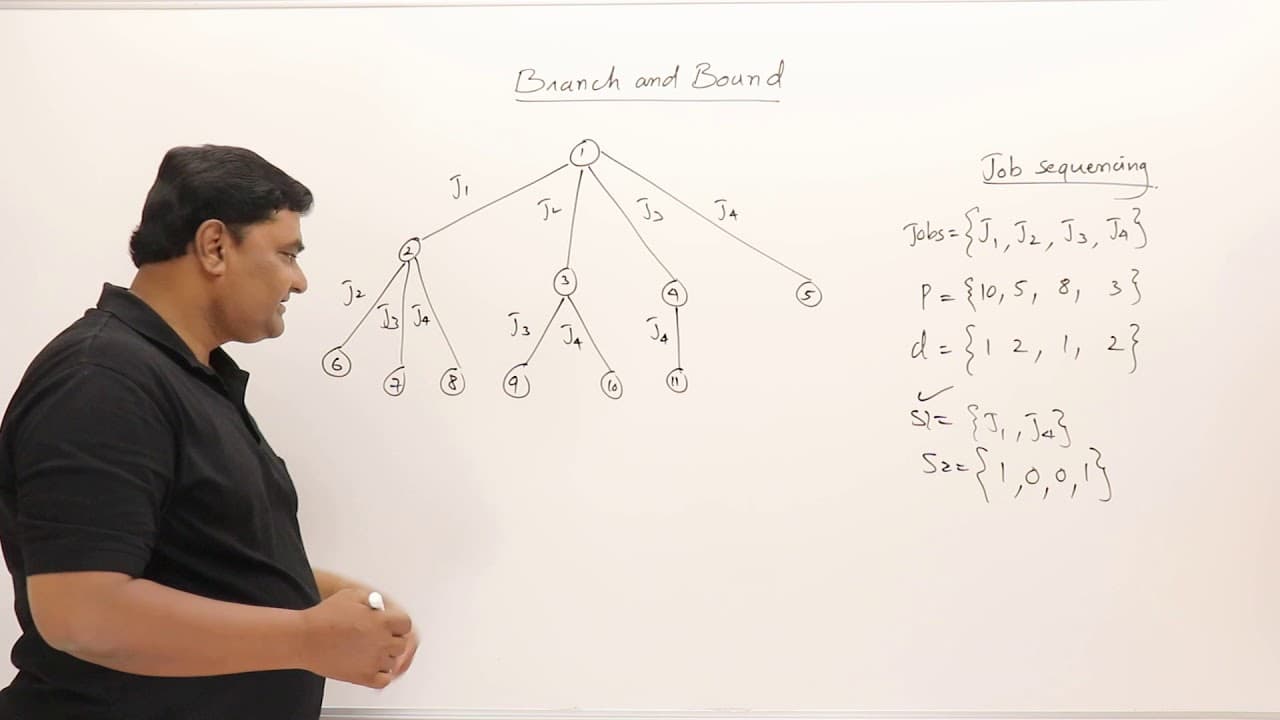
Branch and Bound is a problem-solving method for optimization that employs a state-space tree and focuses on minimization problems. It is characterized by a breadth-first search approach, exploring all levels simultaneously, and can be enhanced with cost calculations to prioritize nodes for exploration. This differentiation from backtracking allows for more efficient finding of optimal solutions.
Transcript
the topic is branch-and-bound this is one more problem solving strategy a method by which we can solve a problem this is similar to backtracking in the sense that it also uses a state-space stream for solving the problem solution is represented like a state space tree but it is useful for solving optimization problem and only minimization problem n... Read More
Key Insights
- 🔍 Branch-and-bound is a problem-solving strategy similar to backtracking that uses a state-space tree to represent solutions. It is useful for solving optimization problems, specifically minimization problems.
- 🌳 The state space tree can be generated using different methods, such as representing the solution as a subset of jobs or as a fixed-size solution. The size of the solution can vary depending on the problem.
- 🔄 In branch-and-bound, the tree is explored in a breadth-first search manner, considering multiple levels at once. This is in contrast to backtracking, which follows a depth-first search approach.
- 📊 One method of generating the state space tree involves considering each job one by one and exploring the possible combinations at each level. The tree is expanded based on the choices made for each job.
- 📉 Another method for generating the tree involves assigning costs to each node and selecting the node with the minimum cost for exploration. This is known as the least cost branch-and-bound method and allows for quick convergence to the solution.
- ⚙️ FIFO and LIFO (stack) are two options for selecting the next node to explore in branch-and-bound. FIFO explores nodes in a queue-like manner, while LIFO explores nodes in a stack-like manner.
- 💡 The choice of exploration method (FIFO or LIFO) does not affect the overall breadth-first search approach followed in branch-and-bound.
- 🚀 Branch-and-bound, when combined with the least cost approach, offers a faster way to solve optimization problems by selectively exploring nodes with lower costs and converging to the solution more efficiently.
Install to Summarize YouTube Videos and Get Transcripts
Explore YouTube Video Summarizer or Get YouTube Transcript Extractor
Questions & Answers
Q: What is the difference between backtracking and branch and bound?
Backtracking and branch and bound are both problem-solving strategies, but they differ in their approach. Backtracking follows a depth-first search, exploring one path at a time and backtracking when a dead end is reached. In contrast, branch and bound follows a breadth-first search, exploring all possible nodes at each level. This makes branch and bound more efficient for solving optimization problems.
Q: How is a solution represented in branch and bound?
In branch and bound, a solution is represented as a state space tree. There are two methods of generating the tree: the subset method and the variable size solution method. In the subset method, the solution is represented as a subset of jobs, while in the variable size solution method, the solution can have a variable number of jobs.
Q: What is the significance of the cost function in branch and bound?
The cost function plays a vital role in branch and bound. For each node in the state space tree, the cost function is used to calculate the cost of that particular solution. The node with the minimum cost is selected for exploration, allowing for a more efficient search and quicker convergence to the optimal solution.
Q: What is the difference between FIFO and LIFO branch and bound methods?
FIFO (First-In, First-Out) and LIFO (Last-In, First-Out) are two variations of the branch and bound method. In FIFO branch and bound, a queue is used to determine the next node for exploration, while in LIFO branch and bound, a stack is used. The choice of FIFO or LIFO depends on the specific problem at hand and the desired exploration strategy.
Q: How does least cost branch and bound differ from other branch and bound methods?
Least cost branch and bound is a variation of the branch and bound method that focuses on exploring nodes with the minimum cost. For each node in the state space tree, a cost function is used to calculate the cost of the solution. The node with the least cost is selected for exploration. This approach allows for a more targeted and efficient search, leading to faster convergence to the optimal solution.
Summary & Key Takeaways
-
Branch and Bound is a problem-solving strategy similar to backtracking, but it is used for solving optimization problems.
-
The solution is represented as a state space tree, and there are two methods of generating the tree: subset method and variable size solution method.
-
The key difference between backtracking and branch and bound is that branch and bound follows a breadth-first search approach, exploring all possible nodes at each level.
Read in Other Languages (beta)
Share This Summary 📚
Summarize YouTube Videos and Get Video Transcripts with 1-Click
Try YouTube Summary with ChatGPT & Claude or YouTube Transcript Generator
Explore More Summaries from Abdul Bari 📚



Summarize YouTube Videos and Get Video Transcripts with 1-Click
Try YouTube Summary with ChatGPT & Claude or YouTube Transcript Generator