What Is Undecidability in Automata Theory?
TL;DR
Undecidability highlights the limits of computation, proven through the diagonalization method. This method demonstrates that languages can exist which are unrecognizable or cannot be decided by any Turing machine, emphasizing challenges in automata theory and the acceptance problem.
Transcript
[SQUEAKING] [RUSTLING] [CLICKING] PROFESSOR: OK, why don't I get started? So OK, what have we been doing? So last time, we considered a bunch of procedures for testing properties of various automata and grammars, the acceptance problem for DFAs, for NFAs, the acceptance problem, which is really degeneration problem for context-free grammars, and em... Read More
Key Insights
- 👍 The diagonalization method is a powerful technique used to prove problems as undecidable or unrecognizable.
- ❓ The complement of a recognizable language is not necessarily recognizable.
Install to Summarize YouTube Videos and Get Transcripts
Explore YouTube Video Summarizer or Get YouTube Transcript Extractor
Questions & Answers
Q: How does Cantor's diagonalization method apply to automata theory?
Cantor's diagonalization method is used in automata theory to prove certain problems as undecidable or unrecognizable. It is a powerful tool that shows there are limits to what can be achieved in automata theory.
Q: Why is A,TM unrecognizable?
A,TM is undecidable, but it is recognizable because there is a Turing machine that can accept an input and halt if the input is a valid Turing machine description. However, its complement, A,TM-complement, is unrecognizable because if both A,TM and A,TM-complement were recognizable, A,TM would be decidable, leading to a contradiction.
Q: How can the complement of a recognizable language be unrecognizable?
If both a language and its complement are recognizable, then the language is decidable. Therefore, if we know that a language is recognizable and undecidable, its complement must be unrecognizable. These results are based on the properties and limitations of automata theory.
Summary & Key Takeaways
-
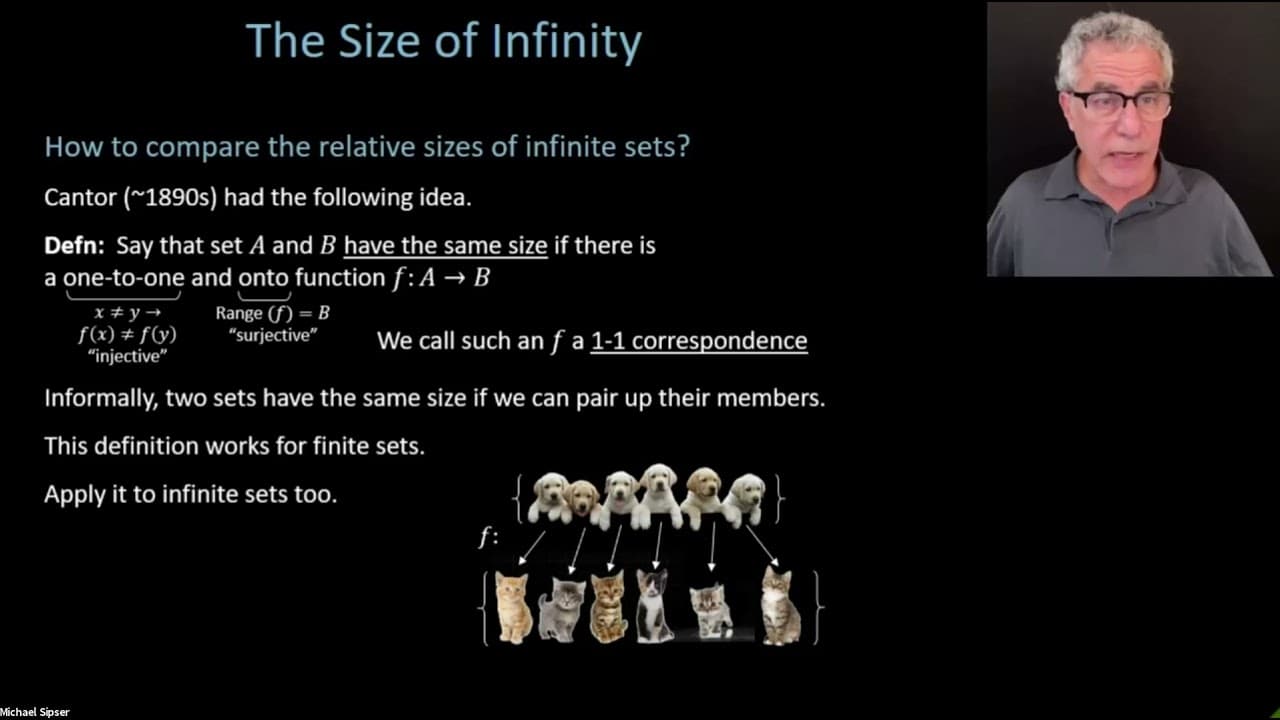
The diagonalization method, proposed by Georg Cantor, is introduced as a way to compare the sizes of infinite sets.
-
The acceptance problem for Turing Machines is proven to be undecidable using the diagonalization method.
-
The complement of the acceptance problem for Turing Machines (A,TM) is shown to be unrecognizable, further highlighting the limitations of automata theory.
Read in Other Languages (beta)
Share This Summary 📚
Summarize YouTube Videos and Get Video Transcripts with 1-Click
Try YouTube Summary with ChatGPT & Claude or YouTube Transcript Generator
Explore More Summaries from MIT OpenCourseWare 📚


Summarize YouTube Videos and Get Video Transcripts with 1-Click
Try YouTube Summary with ChatGPT & Claude or YouTube Transcript Generator