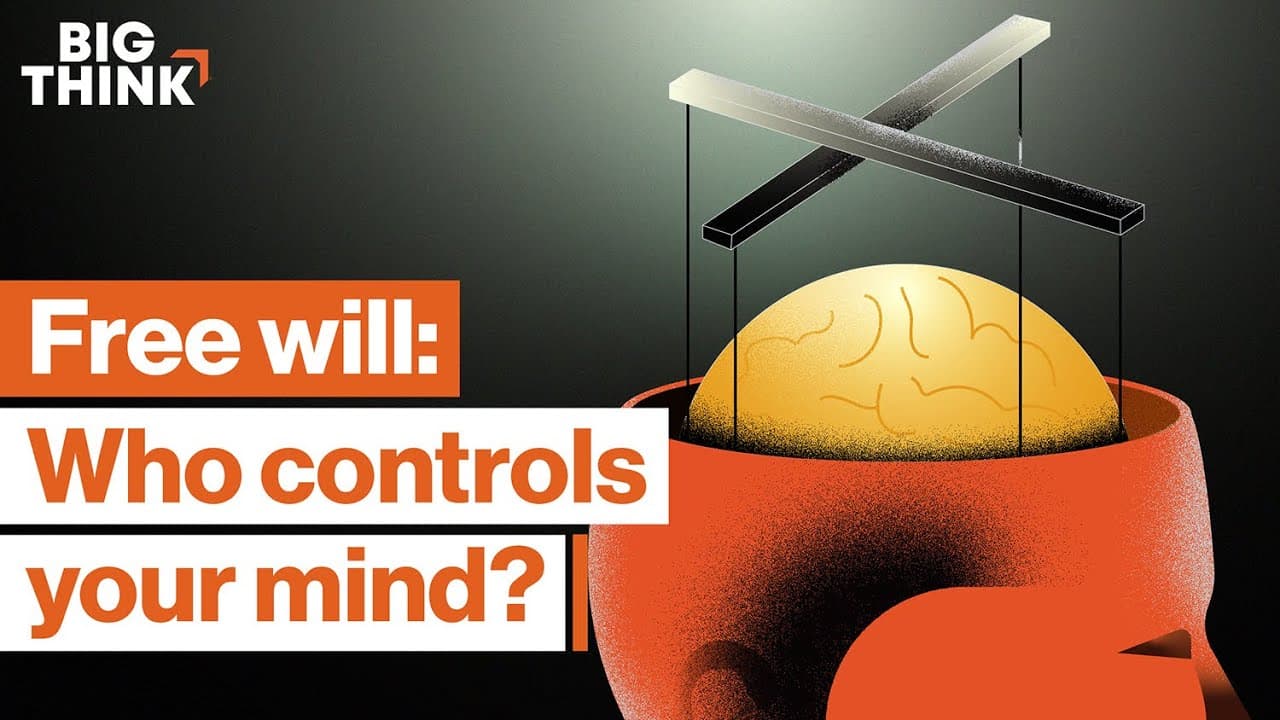
The great free will debate | Bill Nye, Michio Kaku, Robert Sapolsky, Steven Pinker & more
TL;DR
Neuroscience challenges the concept of free will, suggesting that our behavior is determined by physical processes in the brain, but our sense of responsibility and the ability to make choices remains intact.
Transcript
- Well, you ask one of the deepest philosophical questions of physics. The question of free will. - For billions of years on this planet, there was life, but no free will. Physics hasn't changed, but now we have free will. - The brains are automatic, but people are free. - Our ability to choose is often confused. - Human choices will not be pr... Read More
Key Insights
- 😫 Evolutionary biology has played a crucial role in the development of humans' superior cognitive competence, which sets us apart from other species.
- 🥶 The complexity of the brain and its various subsystems contributes to the illusion of free will and the individual's sense of agency.
- 🧠 While the brain functions deterministically, the unpredictability of human choices arises from the brain's complexity and the incorporation of mental models and consequences.
- 👷 Free will is a social construct that depends on personal responsibility and decision-making within a societal framework.
Install to Summarize YouTube Videos and Get Transcripts
Explore YouTube Video Summarizer or Get YouTube Transcript Extractor
Questions & Answers
Q: Can humans make choices that are not influenced by their environment, experiences, and biochemistry?
No, research suggests that our ability to make choices is influenced by various factors, such as our environment, experiences, and biochemistry. These factors can impact our decision-making process and can limit our true freedom of choice.
Q: How does the concept of free will relate to determinism?
Determinism suggests that the universe functions according to fixed rules and that every event, including human actions, is predetermined. However, the Heisenberg uncertainty principle introduces uncertainty and randomness into the equation, allowing for the possibility of free will within a complex system.
Q: How does responsibility factor into the discussion of free will?
Responsibility is a social construct that holds individuals accountable for their actions within a societal framework. While neuroscience may challenge the idea of free will, it does not negate the importance of personal responsibility and the need for ethical decision-making.
Q: Can reading about the illusion of free will affect our behavior?
Studies have shown that exposure to the belief that free will is an illusion can influence behavior, leading individuals to be more prone to unethical actions or negligent decision-making. This highlights the impact of belief systems on our perception of responsibility and decision-making.
Summary & Key Takeaways
-
Evolutionary biology has allowed humans to develop superior cognitive competence, leading to the ability to make choices based on conscious representations of reasons to ourselves and others.
-
The brain consists of different subsystems with varying access to information and competes to execute actions, contributing to the illusion of free will.
-
The brain's complexity and the unpredictability of human choices make them difficult to predict based on stimuli alone, distinguishing them from involuntary reflexes.
-
The idea of free will is a social construct that depends on personal responsibility and decision-making within a societal framework.
Read in Other Languages (beta)
Share This Summary 📚
Summarize YouTube Videos and Get Video Transcripts with 1-Click
Try YouTube Summary with ChatGPT & Claude or YouTube Transcript Generator
Explore More Summaries from Big Think 📚



Summarize YouTube Videos and Get Video Transcripts with 1-Click
Try YouTube Summary with ChatGPT & Claude or YouTube Transcript Generator