We Really Need a Far-Infrared Space Interferometer. Here's Why
TL;DR
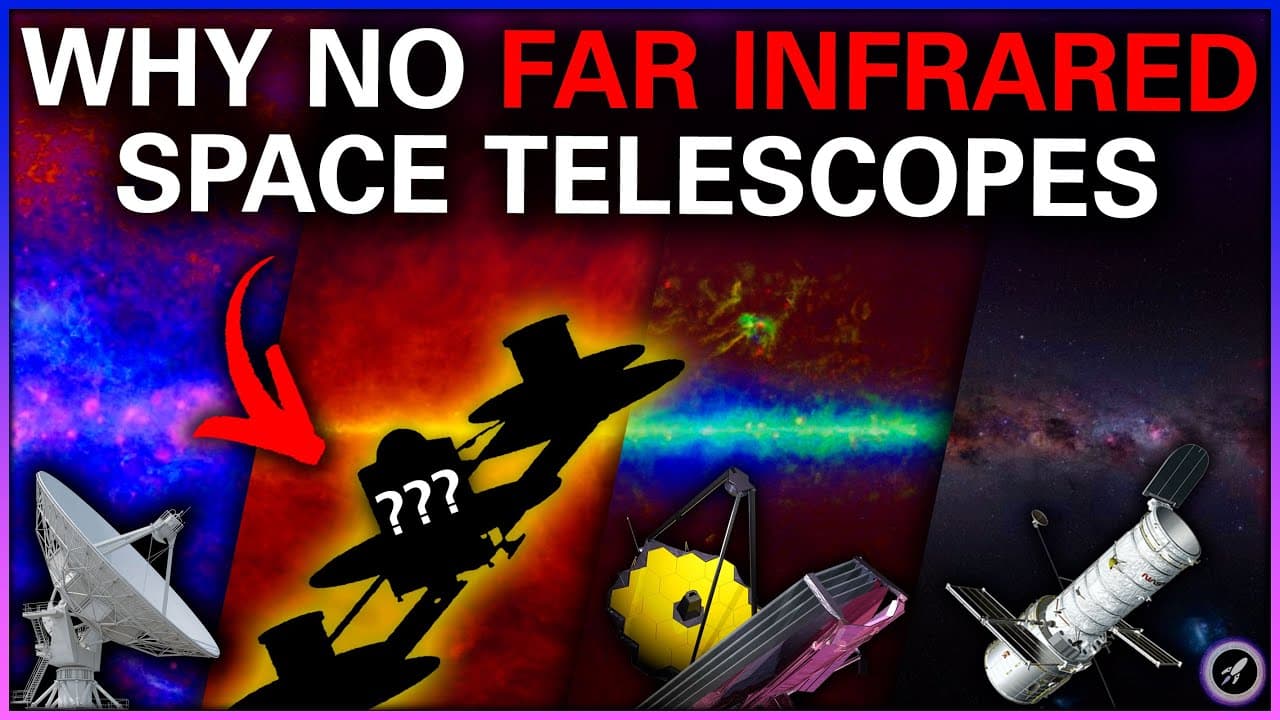
A far-infrared space interferometer is needed to close the observational gap between near- and mid-infrared telescopes such as JWST and microwave facilities such as ALMA. Covering roughly 25 to 450 micrometers, it could combine multiple telescopes for high angular resolution while operating near 4 to 4.5 Kelvin for greater sensitivity. Read on to see what it could reveal about planets, protoplanetary disks, and early galaxies.
Transcript
thanks to jwst we're getting an amazing view of the early Universe we're being able to see through the gas and dust to see newly forming planets and that's because it is an infrared Observatory it's able to see in the mid and near versions of infrared and then of course we've got other ground-based telescopes like Alma which are in the microwave an... Read More
Key Insights
- 🤩 Far infrared telescopes are crucial for understanding early universe phenomena, star and planet formation, and galaxy evolution.
- 🧑🌾 The far infrared range remains unobserved due to the absence of suitable telescopes, and the development of a far infrared interferometer would fill this gap.
- ⚡ Interferometers can combine the light from multiple telescopes to achieve high-angular resolution, enabling the observation of individual galaxies and fine structures within celestial objects.
Install to Summarize YouTube Videos and Get Transcripts
Explore YouTube Video Summarizer or Get YouTube Transcript Extractor
Questions & Answers
Q: Why do we need a far-infrared space interferometer?
There are currently no telescopes observing the far-infrared gap between facilities such as JWST and ALMA. An interferometer could combine light from multiple separated telescopes to achieve high angular resolution, helping distinguish planets, protoplanetary structures, and individual galaxies in the early universe.
Q: What wavelengths are considered far infrared?
Dr. David Leisawitz places the far-infrared range at approximately 25 to 450 micrometers. Beyond that range, wavelengths may be described as submillimeter, millimeter, microwave, and then radio.
Q: Why must a far-infrared telescope operate in space?
Far-infrared light generally does not penetrate Earth’s atmosphere and reach ground-based observatories. A few narrow windows, including one around 350 micrometers, are accessible, but observing the broader 25-to-450-micrometer range requires a space telescope.
Q: Why must far-infrared telescopes be extremely cold?
A warm telescope produces its own far-infrared emission, creating a fog through which faint celestial objects must be observed. Cooling the telescope suppresses that emission, and its sensitivity rises sharply as its temperature falls.
Q: How cold should a future far-infrared telescope be?
The Herschel Space Observatory operated at about 80 Kelvin, which matched the detector sensitivity available at the time. Cooling a telescope to about 4 to 4.5 Kelvin could make its own far-infrared emission effectively invisible and permit much greater sensitivity.
Q: How does a space interferometer improve angular resolution?
An interferometer combines light collected by multiple telescopes separated from one another. Their separation creates the effect of a virtual telescope spanning the gap, producing the high angular resolution needed to distinguish fine structures and individual objects.
Q: Which earlier missions observed far-infrared wavelengths?
The transcript identifies the Herschel Space Observatory and the Spitzer Space Telescope as previous far-infrared observatories. It also traces the history back to IRAS, the Infrared Astronomical Satellite, in the early 1980s.
Q: Why is there no far-infrared space telescope operating now?
Dr. Leisawitz attributes the present absence to cost constraints and scientific-community priorities rather than to a lack of useful science. He argues that a future observatory can be much more capable than earlier missions, but that development has not yet occurred.
Summary & Key Takeaways
-
The far infrared range, which lies between about 25 to 450 micrometers, is currently not observed due to the absence of suitable telescopes.
-
Far infrared telescopes must be cooled to extremely low temperatures to minimize interference from their own emission and detect faint celestial objects.
-
Building an interferometer in the far infrared range would provide high-angular resolution and enable the observation of individual galaxies, protoplanetary disks, and early universe phenomena.
Read in Other Languages (beta)
Share This Summary 📚
Summarize YouTube Videos and Get Video Transcripts with 1-Click
Try YouTube Summary with ChatGPT & Claude or YouTube Transcript Generator
Explore More Summaries from Fraser Cain / Universe Today Podcast 📚




Summarize YouTube Videos and Get Video Transcripts with 1-Click
Try YouTube Summary with ChatGPT & Claude or YouTube Transcript Generator