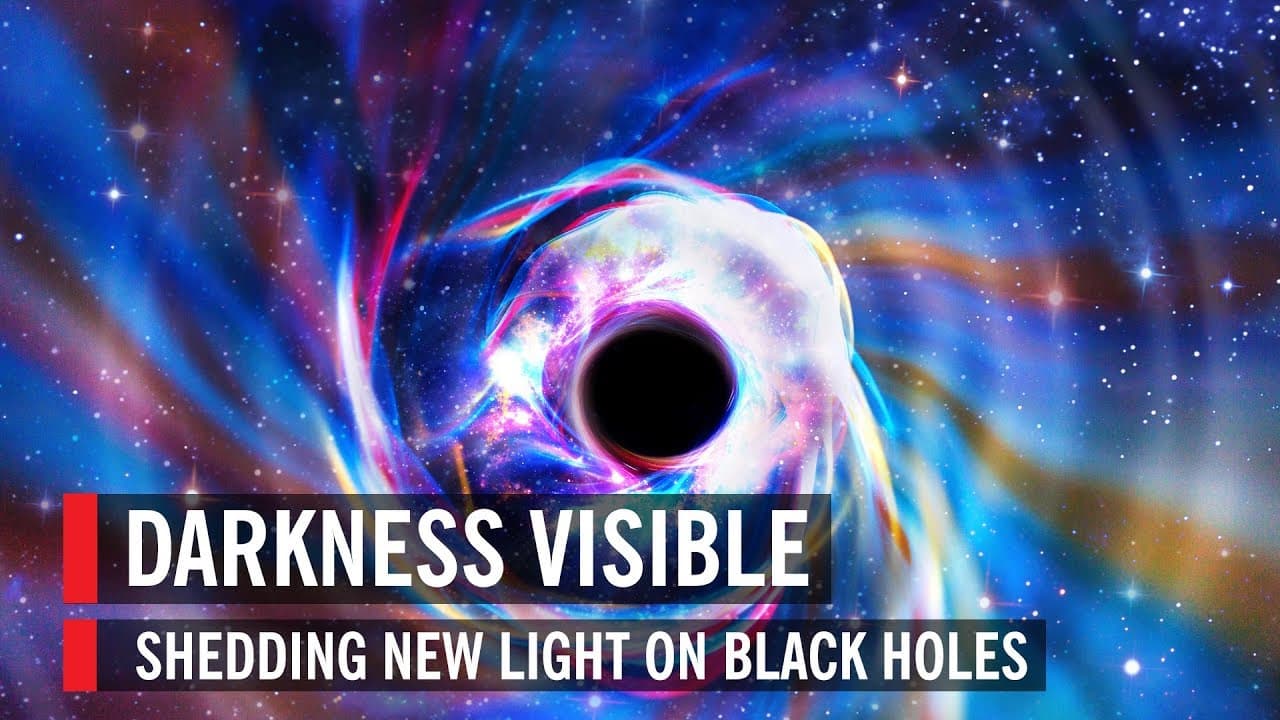
Darkness Visible: Shedding New Light on Black Holes
TL;DR
Black holes, extreme physical objects in the universe, are being studied through the concept of escape velocity and the detection of gravitational waves through advanced telescopes.
Transcript
so thank you for being here this evening this conversation about black holes and you know you'll find online that Einstein himself is often quoted as having said that black holes are what happens when God divides by zero he never said that he couldn't have the phrase black holes was coined about 10 years after Einstein died but poetically that's ac... Read More
Key Insights
- 🖤 Black holes are extreme physical objects that cannot be directly observed, but their existence and properties can be inferred through their gravitational effects on surrounding matter.
- 👾 Gravitational waves, ripples in the fabric of space-time caused by the motion of massive objects, provide a new way to study and understand the universe.
- 🤗 LIGO's detection of gravitational waves confirmed a major prediction of Einstein's general theory of relativity and opened up a new field of astrophysics.
Install to Summarize YouTube Videos and Get Transcripts
Explore YouTube Video Summarizer or Get YouTube Transcript Extractor
Questions & Answers
Q: How are black holes formed?
Black holes are formed when massive stars collapse under their own gravity, causing their core to implode and creating a dense object where gravity is so strong that not even light can escape.
Q: How are black holes detected?
Black holes are detected through indirect methods, such as observing their gravitational effects on surrounding matter or through the detection of gravitational waves, which are disturbances in the fabric of space-time caused by the motion of massive objects.
Q: What is escape velocity?
Escape velocity is the speed necessary for an object to overcome the gravitational pull of a celestial body and escape its gravitational field. For black holes, the escape velocity exceeds the speed of light, resulting in a point of no return known as the event horizon.
Q: How are gravitational waves detected?
Gravitational waves are detected through the use of advanced telescopes, such as the Laser Interferometer Gravitational-Wave Observatory (LIGO), which measures the minute stretching and squeezing of space caused by passing gravitational waves.
Summary & Key Takeaways
-
Black holes are extreme physical objects in the universe created by the collapse of massive stars, where light cannot escape due to the extreme gravitational pull.
-
The escape velocity needed to overcome a black hole's gravitational pull increases with its mass, and if the speed of light is surpassed, light cannot escape, resulting in a "dark star."
-
Einstein's general theory of relativity provided a new understanding of gravity as the warping and curving of space and time, with the work of Karl Schwarzschild in 1915 predicting the existence of black holes based on this theory.
-
The Laser Interferometer Gravitational-Wave Observatory (LIGO) was able to detect the collision of two black holes, leading to the groundbreaking confirmation of gravitational waves in 2015.
Read in Other Languages (beta)
Share This Summary 📚
Summarize YouTube Videos and Get Video Transcripts with 1-Click
Try YouTube Summary with ChatGPT & Claude or YouTube Transcript Generator
Explore More Summaries from World Science Festival 📚



Summarize YouTube Videos and Get Video Transcripts with 1-Click
Try YouTube Summary with ChatGPT & Claude or YouTube Transcript Generator