How Did the Universe Start and What Came First?
TL;DR
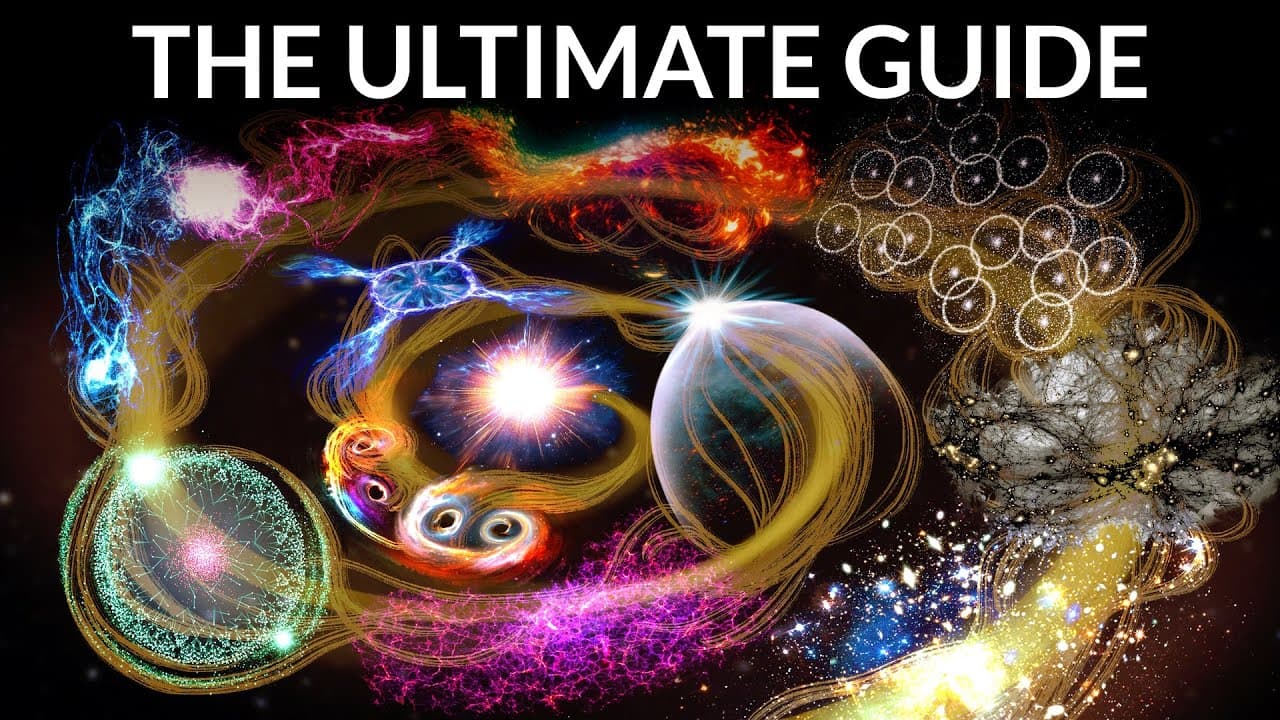
The universe began 13.8 billion years ago, transitioning from a state of nothingness to everything we observe today. Key theories like inflation propose a rapid expansion immediately after the Big Bang, which helps explain the universe's large-scale structure and uniform temperature. The pursuit of understanding the universe's origins involves reconciling quantum mechanics and general relativity, alongside exploring concepts like the multiverse and cyclic models.
Transcript
Read and summarize the transcript of this video on Glasp Reader (beta).
Key Insights
- The universe began 13.8 billion years ago, transitioning from nothingness to existence, a concept explored through physics and philosophy.
- Stephen Hawking suggested the universe's beginning marked the start of time, making any 'before' concept irrelevant.
- Inflation theory posits a rapid expansion after the Big Bang, explaining the universe's large-scale structure and uniformity.
- The multiverse theory suggests ongoing inflation creates numerous bubble universes, challenging our understanding of reality.
- Big Bounce theory proposes a cyclical universe, with endless expansions and contractions, as an alternative to a singular beginning.
- The Planck temperature represents an upper limit of heat, beyond which particles disintegrate, offering insight into cosmic extremes.
- Quantum mechanics and general relativity are incompatible at the Planck Era, prompting the search for a unified theory of quantum gravity.
- Primordial black holes might have formed in the early universe, potentially explaining the existence of supermassive black holes today.
Install to Summarize YouTube Videos and Get Transcripts
Explore YouTube Video Summarizer or Get YouTube Transcript Extractor
Questions & Answers
Q: What is the significance of the Planck Era?
The Planck Era represents the very first moments of the universe, where quantum mechanics and general relativity are incompatible. During this era, the universe was incredibly hot and dense, and the fundamental forces had not yet separated. Understanding this era is crucial for developing a unified theory of quantum gravity, which could reconcile these two major theories and provide insight into the universe's birth.
Q: How does inflation theory resolve cosmological puzzles?
Inflation theory suggests a rapid expansion of the universe shortly after the Big Bang. This expansion explains the universe's large-scale uniformity and flatness, addressing the Horizon and Flatness problems. Inflation also accounts for the distribution of cosmic microwave background radiation and the formation of large-scale structures, providing a cohesive framework for understanding the universe's early development.
Q: What is the role of fine-tuning in the universe?
Fine-tuning refers to the precise values of the universe's fundamental constants, which allow for the existence of complex structures and life. These constants, such as the speed of light and gravitational strength, appear to be finely adjusted to support a stable universe. The reasons for this fine-tuning are debated, with theories ranging from multiverse scenarios to the possibility of a creator or inherent cosmic balance.
Q: What are primordial black holes, and why are they important?
Primordial black holes are hypothesized to have formed in the early universe due to density fluctuations. Unlike black holes formed from collapsing stars, these could have originated from the intense conditions shortly after the Big Bang. They are important because they might explain the existence of supermassive black holes observed in the early universe, which current models struggle to account for.
Q: How does the multiverse theory challenge our understanding of reality?
The multiverse theory proposes that our universe is just one of many, each with its own set of physical laws and constants. This challenges the notion of a singular reality and suggests that what we observe is just a small part of a much larger and more complex structure. It raises questions about the nature of existence and whether our universe is unique or part of a vast, interconnected system.
Q: What is the significance of the Higgs boson discovery?
The discovery of the Higgs boson in 2012 confirmed the existence of the Higgs field, which gives particles mass. This was a major breakthrough in particle physics, completing the Standard Model and enhancing our understanding of how fundamental particles acquire mass. It also supports theories about the universe's early moments, where the Higgs field played a crucial role in shaping the cosmos.
Q: How do quantum mechanics and general relativity differ?
Quantum mechanics governs the behavior of particles at the smallest scales, focusing on probabilities and uncertainties. General relativity, on the other hand, describes the large-scale structure of spacetime and gravity. These two theories are fundamentally different, with quantum mechanics dealing with the micro-world of particles and general relativity with the macro-world of stars and galaxies. Reconciling them is a major goal in theoretical physics.
Q: What is the Big Bounce theory?
The Big Bounce theory posits that the universe undergoes endless cycles of expansion and contraction, rather than having a singular beginning. This theory suggests that after the universe contracts to a small size, it bounces back in a new expansion phase, potentially explaining the universe's existence without invoking a singular Big Bang. It challenges the traditional view and offers an alternative perspective on cosmic history.
Summary & Key Takeaways
-
The video delves into the origins of the universe, examining various scientific theories and philosophical questions about how everything began. It discusses the role of inflation in shaping the cosmos and the possibility of a multiverse, offering insights into the complexities of spacetime.
-
Key concepts include the Planck Era, where quantum mechanics and general relativity clash, and the potential for primordial black holes formed in the universe's infancy. The role of inflation in resolving cosmological puzzles like the Horizon and Flatness problems is highlighted.
-
The video also explores the concept of fine-tuning in the universe's constants, the formation of elements in the Big Bang nucleosynthesis, and the search for a unified theory of quantum gravity. It emphasizes the ongoing quest to understand the universe's earliest moments.
Read in Other Languages (beta)
Share This Summary 📚
Summarize YouTube Videos and Get Video Transcripts with 1-Click
Try YouTube Summary with ChatGPT & Claude or YouTube Transcript Generator
Explore More Summaries from History of the Universe 📚
Summarize YouTube Videos and Get Video Transcripts with 1-Click
Try YouTube Summary with ChatGPT & Claude or YouTube Transcript Generator