Ex 1: Determine if a Function is Odd, Even, or Neither
TL;DR
Learn to identify odd or even functions graphically and algebraically.
Transcript
Read and summarize the transcript of this video on Glasp Reader (beta).
Key Insights
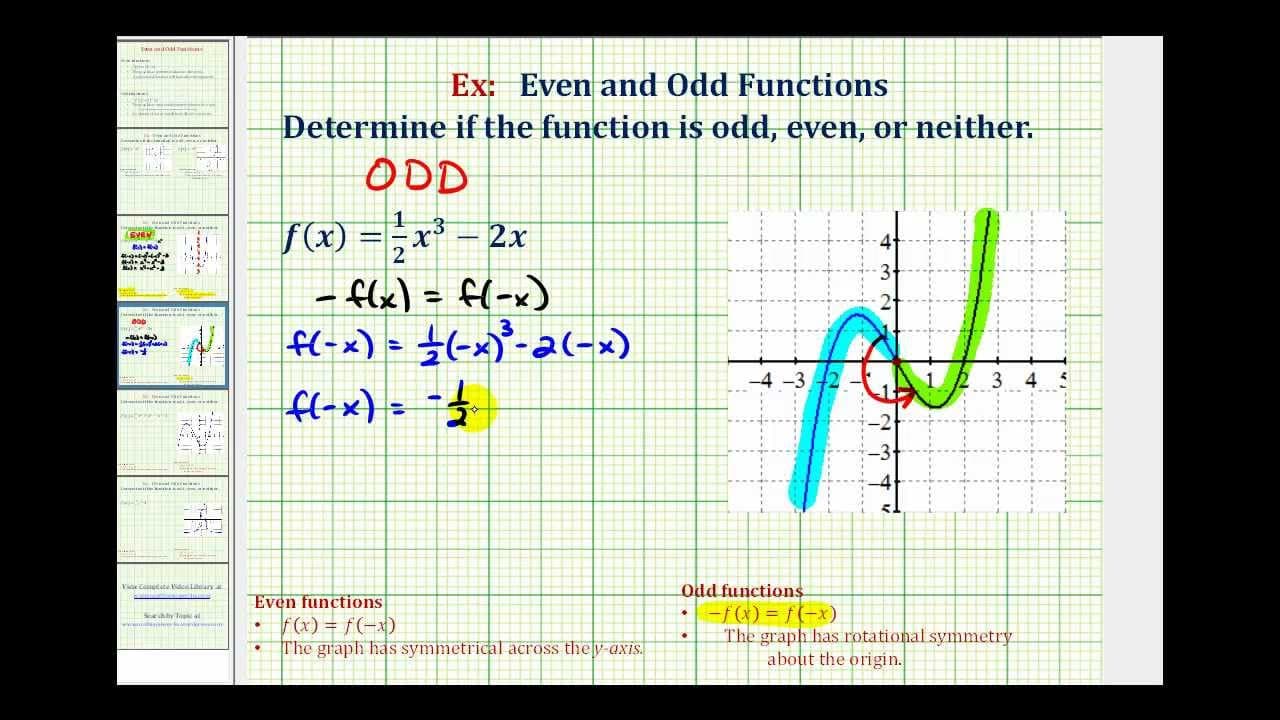
- An even function has symmetry across the y-axis, meaning f(x) equals f(-x). Graphically, folding the graph across the y-axis should match the halves perfectly.
- An odd function has rotational symmetry about the origin, meaning -f(x) equals f(-x). Rotating the graph 180 degrees around the origin should leave it unchanged.
- To determine if a function is even algebraically, substitute -x into the function and check if the result equals the original function.
- For odd functions, substitute -x into the function and verify if the result equals the negative of the original function.
- Polynomial functions can be identified as even if all exponents of the variables are even numbers, including zero.
- Polynomial functions are odd if all exponents of the variables are odd numbers.
- Graphical analysis provides a quick way to identify symmetry properties, but algebraic verification is essential for accuracy.
- Understanding symmetry in functions helps in predicting their behavior and properties without detailed calculations.
Install to Summarize YouTube Videos and Get Transcripts
Explore YouTube Video Summarizer or Get YouTube Transcript Extractor
Questions & Answers
Q: How can you determine if a function is even?
To determine if a function is even, check if f(x) equals f(-x). Graphically, this means the function's graph should be symmetrical across the y-axis. Algebraically, substitute -x into the function and verify if the resulting expression matches the original function.
Q: What characterizes an odd function?
An odd function is characterized by rotational symmetry about the origin, which means -f(x) equals f(-x). Graphically, rotating the graph 180 degrees around the origin should leave it unchanged. Algebraically, substituting -x into the function should yield the negative of the original function.
Q: What role do exponents play in identifying even or odd polynomial functions?
In polynomial functions, the exponents of the variables indicate symmetry. If all exponents are even numbers, the function is even. Conversely, if all exponents are odd numbers, the function is odd. Zero is considered an even exponent, and this rule helps predict function symmetry.
Q: Why is algebraic verification important in identifying function symmetry?
Algebraic verification is crucial because it provides a definitive method to confirm the symmetry properties of a function, beyond graphical analysis. Substituting -x into the function and comparing expressions ensures accuracy, especially when graphs may not clearly show symmetry.
Q: What is the significance of symmetry in mathematical functions?
Symmetry in mathematical functions allows for predictions about their behavior and properties without extensive calculations. Understanding symmetry helps in simplifying problem-solving processes, analyzing function graphs, and applying mathematical concepts effectively in various contexts.
Q: How does rotational symmetry about the origin work for odd functions?
Rotational symmetry about the origin for odd functions means that if you rotate the graph 180 degrees around the origin, it remains unchanged. This property is algebraically represented by -f(x) equaling f(-x), indicating that the function's values are mirrored across the origin.
Q: Can a function be neither odd nor even?
Yes, a function can be neither odd nor even if it does not exhibit symmetry across the y-axis or rotational symmetry about the origin. In such cases, neither f(x) equals f(-x) nor -f(x) equals f(-x) holds true, indicating a lack of symmetry.
Q: What method is recommended for identifying function types quickly?
For quickly identifying function types, start with graphical analysis to check for symmetry. Look for y-axis symmetry for even functions and rotational symmetry for odd functions. Follow up with algebraic verification by substituting -x into the function to confirm the results.
Summary & Key Takeaways
-
The video explains how to determine if a function is odd, even, or neither using graphical and algebraic methods. It provides examples illustrating symmetry across the y-axis for even functions and rotational symmetry about the origin for odd functions.
-
Graphical analysis is complemented by algebraic verification to ensure accuracy in identifying the symmetry properties of functions. The video emphasizes checking exponents in polynomial functions to predict their symmetry.
-
The video provides a clear, step-by-step guide on substituting -x into functions to verify symmetry properties, offering insights into simplifying the process of identifying function types in mathematics.
Read in Other Languages (beta)
Share This Summary 📚
Summarize YouTube Videos and Get Video Transcripts with 1-Click
Try YouTube Summary with ChatGPT & Claude or YouTube Transcript Generator
Explore More Summaries from Mathispower4u 📚
Summarize YouTube Videos and Get Video Transcripts with 1-Click
Try YouTube Summary with ChatGPT & Claude or YouTube Transcript Generator