vertex formula of a cubic curve
TL;DR
Learn how to find the vertex of a cubic curve using algebra and the concept of derivatives.
Transcript
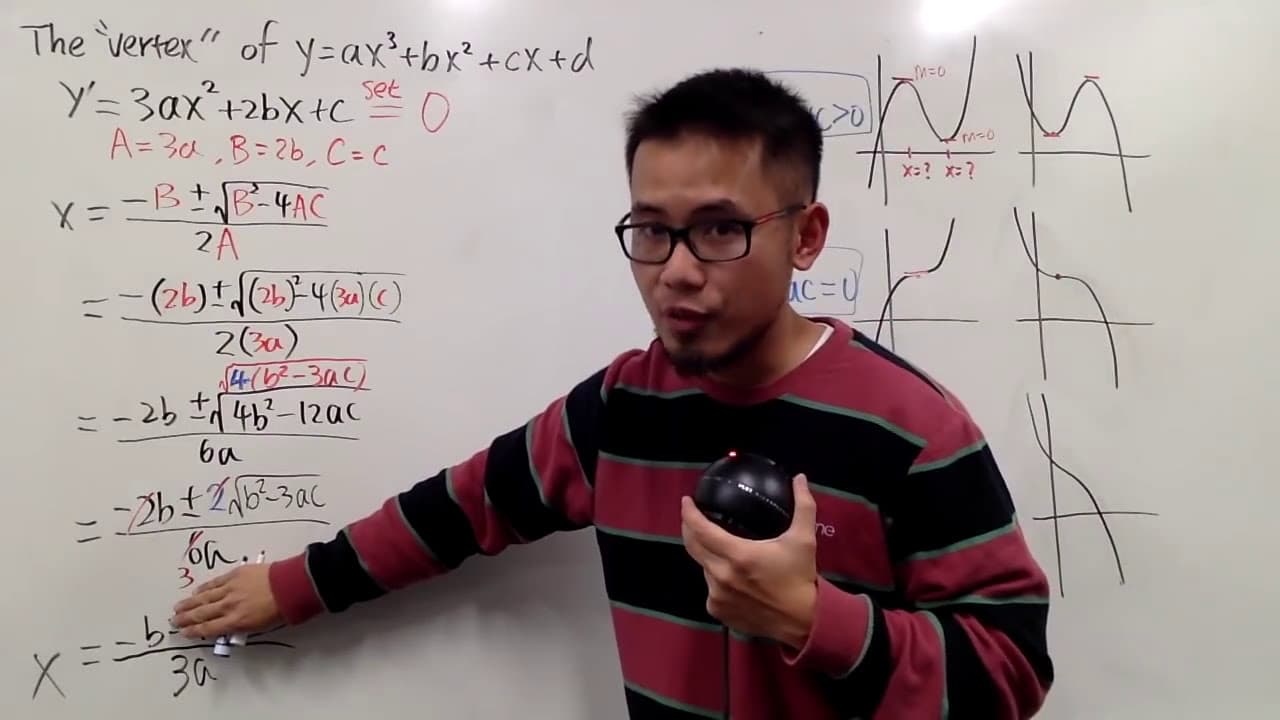
okay last I show you guys how to find the vertex of a parabola where we see algebra that we complete the square and we also talked about calculus where we took the derivative right this time let's talk about how to find the vertex of a cubic curve namely the vertex of the graph of y is equal to X to a third power plus BX squared plus CX Plus D and ... Read More
Key Insights
- ⚾ Cubic curves can be categorized into three types based on their behavior and the presence of local maxima and minima.
- ❓ The discriminant of the quadratic equation determines if the curve has local extrema or not.
- ☺️ The second derivative test helps identify whether a given x-value corresponds to a local minimum or maximum.
Install to Summarize YouTube Videos and Get Transcripts
Explore YouTube Video Summarizer or Get YouTube Transcript Extractor
Questions & Answers
Q: How can you determine the different categories of cubic curves?
The different categories of cubic curves can be determined by looking at the behavior of the curve and the number and location of local maxima and minima.
Q: What is the role of the discriminant in finding the vertex of a cubic curve?
The discriminant of the quadratic equation obtained from the first derivative of the cubic curve determines the type of local extrema or lack thereof in the curve, helping us identify the vertex.
Q: How does the second derivative test help in finding local minima and maxima?
By evaluating the second derivative at specific x-values obtained from the first derivative equation, we can determine if the curve is concave up or down and thus identify local minima or maxima.
Q: Can you explain the concept of a saddle point?
A saddle point occurs when the second derivative equals zero, indicating neither a local minimum nor maximum. It signifies a point on the curve where the slope is zero but does not result in a change in concavity.
Summary & Key Takeaways
-
There are three main categories of cubic curves: the "pretty curve" with local maxima and minima, the "saddle point" curve, and the curve that keeps going up or down without any local extrema.
-
To find the vertex of a cubic curve, you need to solve the quadratic equation obtained from the first derivative of the curve.
-
The discriminant of the quadratic equation determines the type of local extrema or lack thereof in the cubic curve.
Read in Other Languages (beta)
Share This Summary 📚
Summarize YouTube Videos and Get Video Transcripts with 1-Click
Try YouTube Summary with ChatGPT & Claude or YouTube Transcript Generator
Explore More Summaries from blackpenredpen 📚
Summarize YouTube Videos and Get Video Transcripts with 1-Click
Try YouTube Summary with ChatGPT & Claude or YouTube Transcript Generator