What Is Mean Shift Clustering and How Does It Work?
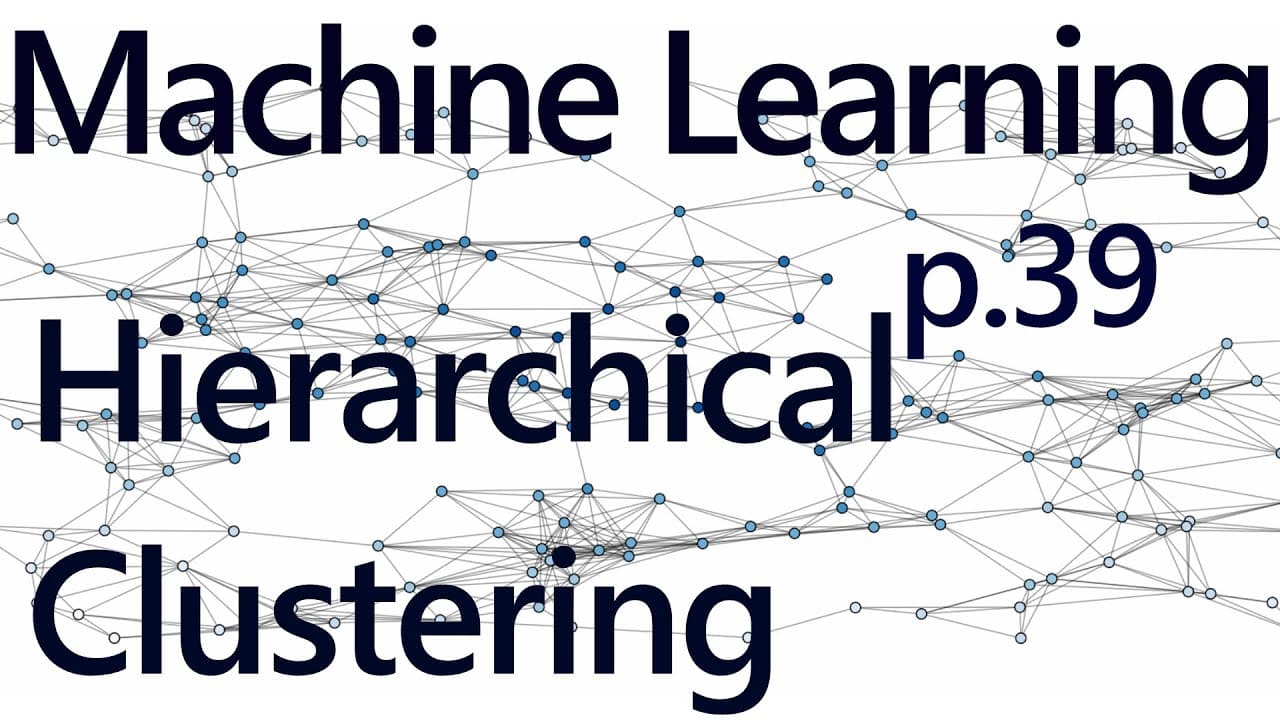
TL;DR
Mean shift clustering is a hierarchical algorithm that identifies clusters without pre-specifying their number. It begins with each data point as a cluster center and iteratively adjusts these centers towards areas with higher data density until convergence occurs, meaning no significant movement of cluster centers remains.
Transcript
what is going on everybody and welcome to part 39 of our machine learning tutorial Series in this video in the coming videos we're going to be talking about mean shift and mean shift is another clustering algorithm but this time rather than the flat clustering methodology of the K means clustering algorithm mean shift is what is known as a hierarch... Read More
Key Insights
- #️⃣ Mean shift is a hierarchical clustering algorithm that automatically determines the number of clusters.
- 😥 The algorithm starts with each data point as a cluster center and iteratively shifts them towards higher density regions.
- 😥 The bandwidth or radius determines the range within which data points are considered part of the same cluster.
- 🪘 Convergence occurs when the cluster centers no longer move significantly, indicating that the optimal clustering has been achieved.
- 👨🔬 Mean shift can be used for data structuring, visualization, and research purposes.
- 💠 The algorithm does not require prior knowledge of the data distribution and is suitable for datasets with unknown cluster shapes.
- 🅰️ Mean shift can be applied to various types of datasets, including the Titanic dataset, to uncover hidden patterns and relationships.
Install to Summarize YouTube Videos and Get Transcripts
Explore YouTube Video Summarizer or Get YouTube Transcript Extractor
Questions & Answers
Q: How does mean shift differ from the K-means clustering algorithm?
Unlike K-means, mean shift is a hierarchical clustering algorithm that does not require the user to specify the number of clusters. Mean shift automatically determines the number and location of clusters based on the data.
Q: What does the term "radius" refer to in mean shift clustering?
In mean shift, the radius refers to the bandwidth around each data point. It determines the range within which other data points are considered part of the same cluster. The size of the radius influences the shape and size of the resulting clusters.
Q: How does mean shift determine the cluster centers?
In mean shift, each data point is initially considered as a cluster center. The algorithm then iteratively shifts the cluster centers towards areas with higher density of data points. The shift is determined by computing the mean position of the data points within the current cluster.
Q: When does the mean shift algorithm converge?
The mean shift algorithm converges when the cluster centers no longer move significantly. At this point, the algorithm has found the optimal cluster centers and the clustering process is complete.
Summary & Key Takeaways
-
Mean shift is a hierarchical clustering algorithm that does not require the user to specify the number of clusters.
-
In mean shift, every data point is initially considered as a cluster center, and the algorithm iteratively shifts the cluster centers towards areas with higher density of data points.
-
The algorithm continues this process until convergence, where the cluster centers no longer move significantly.
Read in Other Languages (beta)
Share This Summary 📚
Summarize YouTube Videos and Get Video Transcripts with 1-Click
Try YouTube Summary with ChatGPT & Claude or YouTube Transcript Generator
Explore More Summaries from sentdex 📚

Summarize YouTube Videos and Get Video Transcripts with 1-Click
Try YouTube Summary with ChatGPT & Claude or YouTube Transcript Generator