What Is Schopenhauer's Herd Mind and Its Impact on Reason?
TL;DR
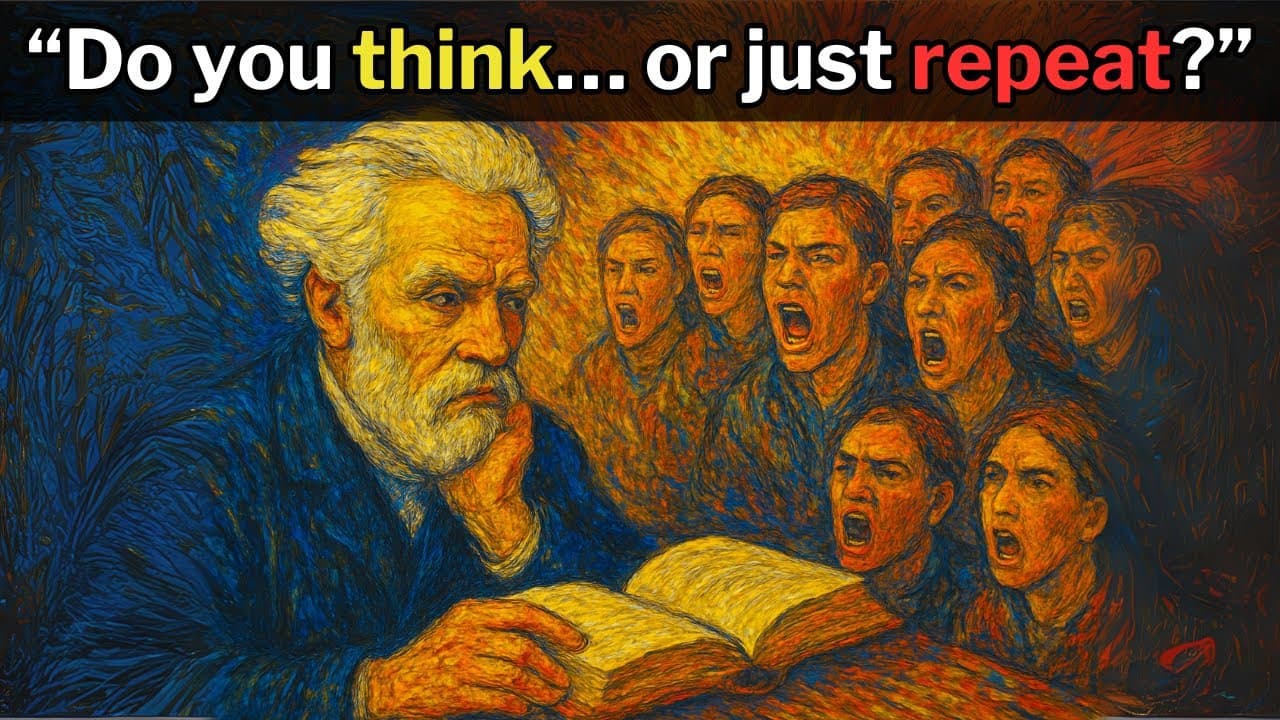
Schopenhauer's 'herd mind' concept suggests that individuals often conform to the beliefs and opinions of the majority, which can erode independent reasoning and truth. To resist this destructive force, one must cultivate solitude, courage, and compassion, fostering a willingness to face the discomfort of independence and discover authentic understanding.
Transcript
Read and summarize the transcript of this video on Glasp Reader (beta).
Key Insights
- Schopenhauer's 'herd mind' concept suggests that most people do not think independently but follow the majority, which can erode individuality and truth.
- The 'herd mind' is a destructive force that silences reason, as individuals often surrender their reasoning for acceptance and comfort.
- Psychological experiments, such as those by Solomon Asch and Milgram, demonstrate how easily people conform to group consensus, even against their own judgment.
- Conformity is rewarded in society from an early age, leading to a culture where silence and agreement are safer than questioning and honesty.
- Schopenhauer argues that true morality cannot be dictated by the majority but must arise from genuine compassion and awareness of human suffering.
- The herd mind distorts our pursuit of happiness, as people often chase goals like wealth and status because the herd values them, not because they bring fulfillment.
- Resisting the herd mind requires solitude, courage, and the willingness to endure misunderstanding and rejection for the sake of truth.
- Schopenhauer's philosophy emphasizes the importance of independent thought and compassion, urging individuals to see beyond societal illusions and embrace authentic existence.
Install to Summarize YouTube Videos and Get Transcripts
Explore YouTube Video Summarizer or Get YouTube Transcript Extractor
Questions & Answers
Q: What is Schopenhauer's 'herd mind' concept?
Schopenhauer's 'herd mind' concept suggests that most individuals do not engage in true reasoning but instead follow the majority's opinions and beliefs. This conformity is seen as a destructive force that erodes individuality, silences truth, and undermines human freedom by prioritizing acceptance and comfort over independent thought.
Q: How does the 'herd mind' affect independent reasoning?
The 'herd mind' affects independent reasoning by pressuring individuals to conform to the majority's views, often leading them to surrender their judgment for the comfort of acceptance. This results in a loss of individuality and the silencing of truth, as people prioritize belonging over questioning and reasoning.
Q: What role do psychological experiments play in understanding the 'herd mind'?
Psychological experiments, such as Solomon Asch's conformity experiments and Milgram's obedience studies, demonstrate how easily individuals conform to group consensus, even against their own judgment. These experiments provide evidence of the 'herd mind' in action, showing how social pressures can override reason and lead to conformity.
Q: Why does society reward conformity?
Society rewards conformity because it promotes social harmony and acceptance. From a young age, individuals are encouraged to fit in, leading to a culture where questioning and challenging the status quo are often discouraged. This creates an environment where silence and agreement are seen as safer and more desirable than independent thought.
Q: How does Schopenhauer view true morality?
Schopenhauer views true morality as arising from genuine compassion and awareness of human suffering, rather than conformity to societal norms. He argues that morality dictated by the majority is merely obedience, and true moral values must be based on an honest recognition of suffering and a commitment to compassion, independent of social approval.
Q: What is the relationship between the 'herd mind' and the pursuit of happiness?
The 'herd mind' distorts the pursuit of happiness by leading individuals to chase goals like wealth and status because they are valued by the majority, not because they bring true fulfillment. This results in people living borrowed lives, following scripts handed down by society rather than discovering genuine truth and authentic happiness.
Q: What does resisting the 'herd mind' require?
Resisting the 'herd mind' requires solitude, courage, and the willingness to endure misunderstanding and rejection for the sake of truth. It involves stepping back from societal pressures, questioning deeply held beliefs, and embracing independent thought and compassion, even when it means standing apart from the majority.
Q: Why is resisting the herd mind considered a moral and existential duty?
Resisting the herd mind is considered a moral and existential duty because it involves reclaiming one's humanity, freedom, and dignity in a world that tries to reduce individuals to echoes of the majority. By confronting suffering, embracing compassion, and living truthfully, individuals can rise above societal illusions and achieve authentic existence.
Summary & Key Takeaways
-
Schopenhauer's 'herd mind' concept challenges the notion that our beliefs and values are truly our own, suggesting they are often borrowed from the majority. This concept highlights the dangers of conformity and the importance of independent reasoning.
-
The video explores how the 'herd mind' destroys reason and truth, drawing on psychological experiments and philosophical insights to demonstrate the seductive nature of conformity and the societal pressures that reward it.
-
To resist the herd mind, individuals must cultivate solitude, courage, and compassion, embracing the discomfort of independence to discover truth and live authentically, as Schopenhauer and other philosophers have advocated.
Read in Other Languages (beta)
Share This Summary 📚
Summarize YouTube Videos and Get Video Transcripts with 1-Click
Try YouTube Summary with ChatGPT & Claude or YouTube Transcript Generator
Explore More Summaries from The Psyche 📚




Summarize YouTube Videos and Get Video Transcripts with 1-Click
Try YouTube Summary with ChatGPT & Claude or YouTube Transcript Generator