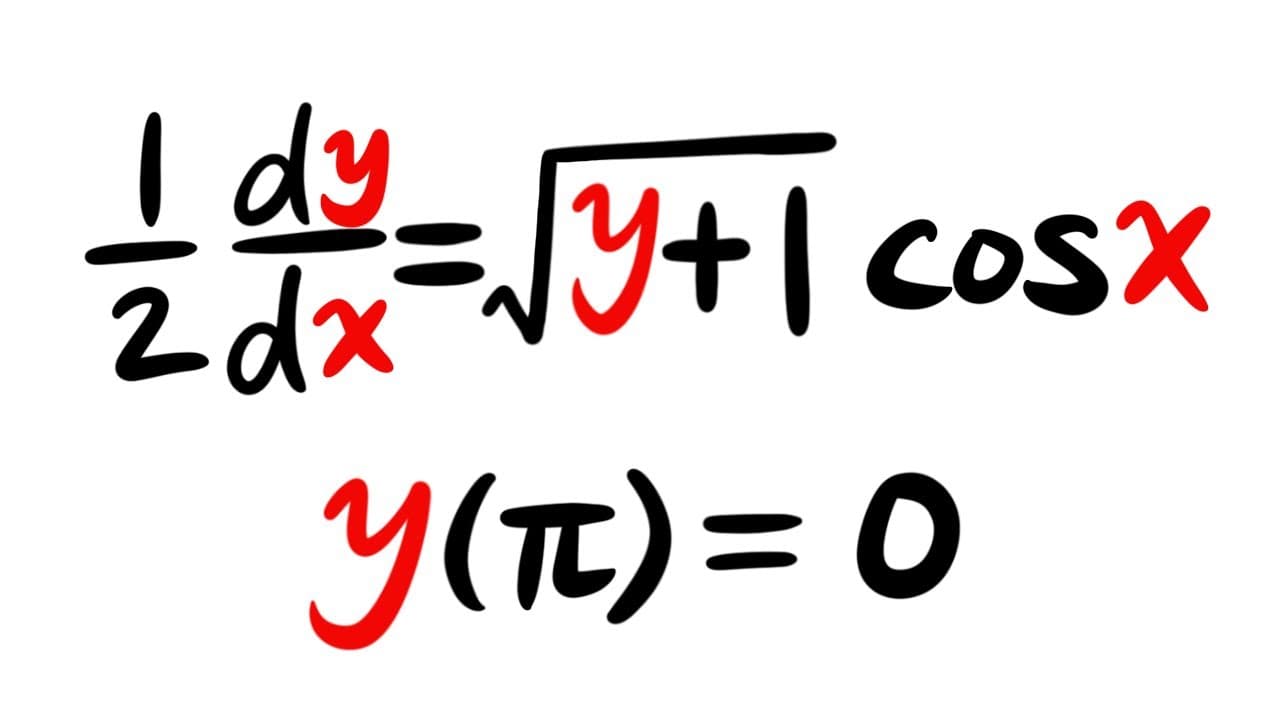
separable differential equation with an initial condition
TL;DR
This video explains how to solve a separable differential equation using integration and provides an example solution.
Transcript
let's solve this separable differential equation we have one-half dy/dx is equal to square root of y plus 1 times cos x and we also know why of pi is equal to 0 so be sure to suffer that constant and I won't have to talk about when I wish yourself with a constant in this video ok let's go ahead and do our usual business let's go ahead mult... Read More
Key Insights
- ❣️ Separable differential equations involve separating the variables (x and y) on opposite sides of the equation.
- 🙃 Integrating both sides of the equation allows us to find the general solution, while an initial value helps determine the specific solution.
- 🤕 The process of solving the differential equation can involve simplifications, such as integrating in your head and using known integration formulas.
- 😑 Isolating the y variable and expressing it in terms of x allows us to obtain the final solution to the differential equation.
Install to Summarize YouTube Videos and Get Transcripts
Explore YouTube Video Summarizer or Get YouTube Transcript Extractor
Questions & Answers
Q: What is a separable differential equation?
A separable differential equation is one that can be rearranged into the form dy/dx = f(x)g(y), where f(x) depends only on x and g(y) depends only on y.
Q: How do you solve a separable differential equation?
To solve a separable differential equation, you typically need to integrate both sides of the equation with respect to x and y and involve an arbitrary constant for the integration.
Q: What is the purpose of the initial value given in the example?
The initial value is used to find the specific value of the constant in the solution. It helps to determine the unique solution to the differential equation that satisfies the given condition.
Q: Why is the square root of y plus 1 integrated as simply square root of y plus 1?
The integration of 1/(2√(y+1)) becomes √(y+1) without any additional constants because the general form of integrating 1/(2√(something)) is simply 2√(something).
Summary & Key Takeaways
-
The video demonstrates the process of solving a separable differential equation step by step.
-
A specific example is given, where the equation involves the square root of y plus 1 times cos x.
-
The solution is obtained by integrating both sides of the equation and using an initial value to determine the constant term.
Read in Other Languages (beta)
Share This Summary 📚
Summarize YouTube Videos and Get Video Transcripts with 1-Click
Try YouTube Summary with ChatGPT & Claude or YouTube Transcript Generator
Explore More Summaries from blackpenredpen 📚


Summarize YouTube Videos and Get Video Transcripts with 1-Click
Try YouTube Summary with ChatGPT & Claude or YouTube Transcript Generator