What Is Commutation and How Does It Impact DC Machines?
TL;DR
Commutation refers to the timing of current reversal in electrical circuits, classified as ideal, over, or under commutation. Ideal commutation occurs when the reversal aligns with the commutation period, while over commutation happens too early, and under commutation takes longer, often due to reactance voltage and armature reaction effects. Understanding these types is crucial for optimizing performance in DC machines.
Transcript
hello everyone we are discussing about the commutation okay in the last session we discussed about the ideal computation what is ideal computation the current reversal will be within the commutation period it is known as the ideal commutation okay that means exacting two millisecond the current reversal means what what is the meaning of current rev... Read More
Key Insights
- 💐 Commutation is critical in controlling the flow of current in electrical systems, with implications for efficiency and stability.
- ❓ Ideal commutation represents the optimal scenario, where current reversal aligns with the expected timing perfectly.
- ❓ Over commutation and under commutation illustrate deviations from the ideal scenario, highlighting their impact on system functionality.
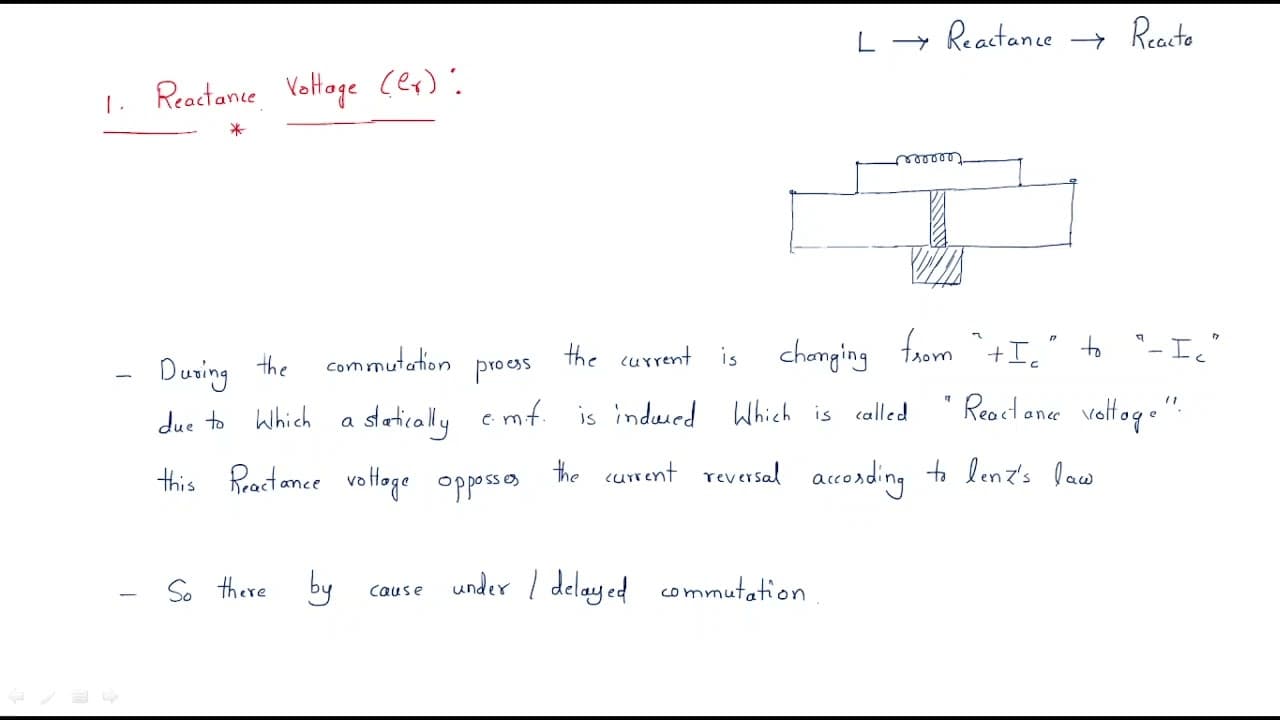
- 🧑🏭 Factors such as reactance voltage and armature reaction are vital in understanding delays in current reversal during commutation processes.
- ⚖️ Electrical devices rely on precise timing to maintain balance and prevent fluctuations in performance due to poor commutation.
- 🎨 The analysis of commutation can provide insights for improving electrical system designs and operational reliability.
- 💦 Understanding the dynamics of current changes is essential for engineers working with electrical circuits and machinery.
Install to Summarize YouTube Videos and Get Transcripts
Explore YouTube Video Summarizer or Get YouTube Transcript Extractor
Questions & Answers
Q: What is ideal commutation in electrical circuits?
Ideal commutation refers to the precise timing of current reversal during the designated commutation period. This means that the current reverses exactly at the predetermined time, ensuring stable operation in electrical devices. It is characterized by a synchronous change in current values, reaching both positive and negative states within an exact timeframe.
Q: What defines over commutation in electrical terminology?
Over commutation occurs when current reversal happens before the official commutation period ends, leading to quicker transitions between current states. This phenomenon can result in instability due to the premature shift, potentially affecting device performance if the mechanics of the reversal are not correctly timed or controlled.
Q: How does under commutation manifest in electrical systems?
Under commutation, or delayed commutation, happens when the current reversal takes longer than intended, exceeding the commutation period. Several factors may contribute to this delay, including the inherent reactance of coils and the armature's magnetic effects. This can lead to inefficiencies and interfere with the overall functioning of electrical systems.
Q: What roles do reactance voltage and armature reaction play in delayed commutation?
Reactance voltage and armature reaction significantly impact delayed commutation by introducing opposing forces against current changes. Reactance voltage, generated by the inductive nature of coils, resists current changes due to its reactance drop. Similarly, armature reaction modifies the magnetic field, causing further delays in reaching the requisite current reversal, thus complicating the commutation process.
Summary & Key Takeaways
-
Commutation involves the timing of current reversal in electrical circuits, classified as ideal, over, or under computation.
-
Ideal commutation occurs when current reversal aligns perfectly with the commutation period, while over commutation happens when the reversal occurs too early.
-
Under commutation arises when the reversal takes longer than the designated commutation period, often due to reactance voltage and armature reaction effects.
Read in Other Languages (beta)
Share This Summary 📚
Summarize YouTube Videos and Get Video Transcripts with 1-Click
Try YouTube Summary with ChatGPT & Claude or YouTube Transcript Generator