Copy My Secret n8n Automation Techniques (Beginner to Pro)
TL;DR
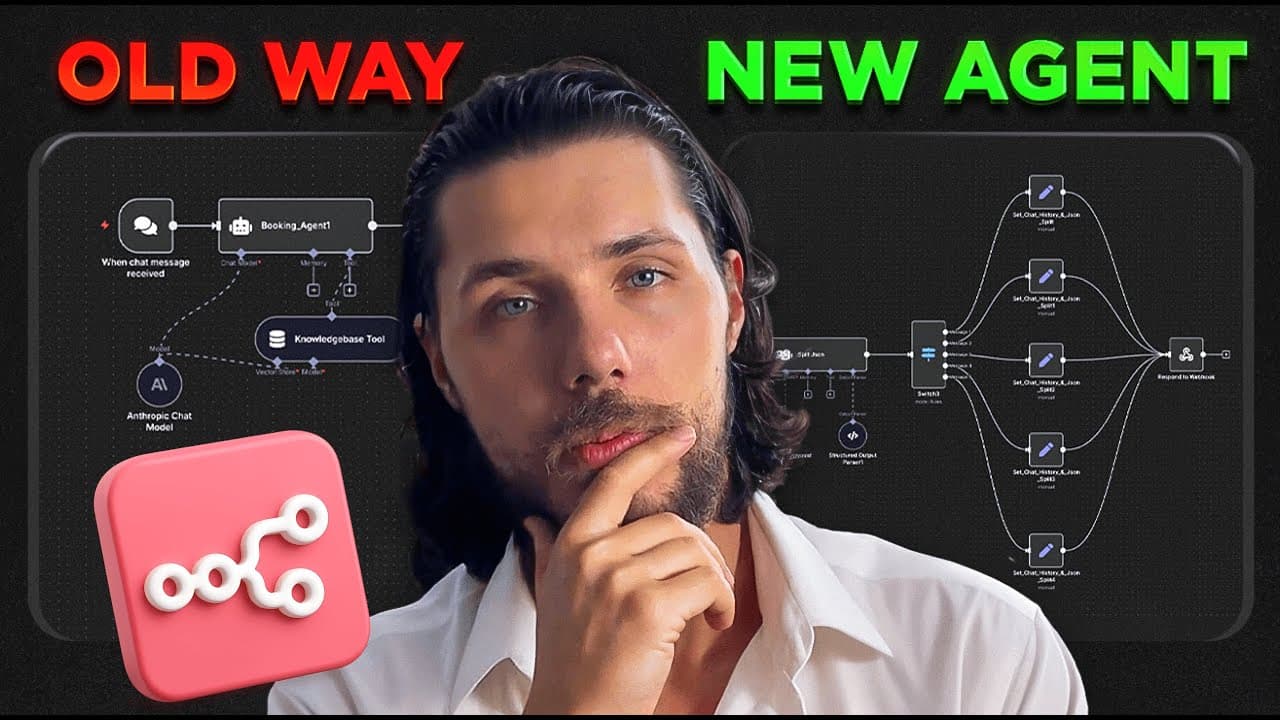
Eight essential n8n techniques for scalable automation solutions.
Transcript
Read and summarize the transcript of this video on Glasp Reader (beta).
Key Insights
- Variable setting simplifies workflow management by centralizing custom fields, making it easier to update credentials and prompts across multiple agents.
- Organizing workflows using folders and tags enhances project management, especially when dealing with multiple clients and diverse triggers.
- Multi-agent LLM handling involves connecting various nodes to an LLM model, streamlining complex workflows without individual memory or chat modules.
- Knowledge base management can be optimized by splitting data using metadata, allowing agents to access specific information without duplicating resources.
- Intent classification uses a master agent to determine user intent, efficiently routing queries to appropriate sub-agents for better workflow management.
- Error handling is crucial in production workflows, employing retries for API calls and error triggers for notifications to maintain service reliability.
- LLM model testing with OpenRouter allows for efficient evaluation of multiple models, ensuring the best fit for specific scenarios before final deployment.
- Self-hosting n8n offers cost savings and enhanced security, providing flexibility in deployment and compliance with data protection regulations.
Install to Summarize YouTube Videos and Get Transcripts
Explore YouTube Video Summarizer or Get YouTube Transcript Extractor
Questions & Answers
Q: How does variable setting enhance workflow management in n8n?
Variable setting centralizes custom fields, allowing for easy updates of credentials and prompts across multiple agents. This approach eliminates the need to manually change information under each agent, streamlining the management process and ensuring consistency across workflows.
Q: What is the significance of flow organization in n8n?
Flow organization in n8n involves using folders and tags to manage workflows efficiently. This system helps categorize projects by clients and trigger types, ensuring a structured approach to handling multiple workflows and facilitating easier navigation and management of automation processes.
Q: How does multi-agent LLM handling improve workflow efficiency?
Multi-agent LLM handling connects various nodes to a centralized LLM model, eliminating the need for individual memory or chat modules for each agent. This method reduces complexity and improves efficiency by maintaining a single point of connection for LLM interactions, streamlining the workflow.
Q: What role does knowledge base management play in n8n workflows?
Knowledge base management in n8n involves using metadata to split complex data, allowing agents to access specific information without duplicating resources. This approach ensures precise data retrieval and enhances the management of large, complex knowledge bases, improving workflow efficiency.
Q: How is intent classification used in n8n workflows?
Intent classification employs a master agent to determine user intent, routing queries to appropriate sub-agents based on predefined categories. This technique ensures that user inquiries are directed to the correct agent, improving the accuracy and efficiency of the workflow.
Q: Why is error handling crucial in n8n automation?
Error handling is vital in n8n automation to maintain service reliability and client satisfaction. Techniques such as retrying API calls and using error triggers for notifications ensure that workflows continue to function smoothly, even when errors occur, minimizing disruptions and maintaining workflow integrity.
Q: What is the benefit of LLM model testing with OpenRouter?
LLM model testing with OpenRouter allows users to efficiently evaluate multiple LLM models within a single workflow. This testing identifies the best model for specific scenarios before final deployment, ensuring optimal performance and cost-effectiveness in production workflows.
Q: How does self-hosting n8n provide advantages over other hosting options?
Self-hosting n8n offers cost savings and enhanced security, providing flexibility in deployment and compliance with data protection regulations. It allows for greater control over the automation environment, ensuring that workflows are secure and tailored to specific business needs.
Summary & Key Takeaways
-
n8n automation techniques focus on variable setting, which centralizes custom fields for easier management of credentials and prompts across workflows.
-
Flow organization and multi-agent LLM handling are essential for managing complex projects, using folders, tags, and centralized LLM connections.
-
Knowledge base management, intent classification, error handling, LLM testing, and self-hosting are key for scalable, efficient, and secure automation solutions.
Read in Other Languages (beta)
Share This Summary 📚
Summarize YouTube Videos and Get Video Transcripts with 1-Click
Try YouTube Summary with ChatGPT & Claude or YouTube Transcript Generator
Explore More Summaries from Eugene Kadzin 📚

Summarize YouTube Videos and Get Video Transcripts with 1-Click
Try YouTube Summary with ChatGPT & Claude or YouTube Transcript Generator