Everyone Is Using Claude Code Sub-agents Wrong
TL;DR
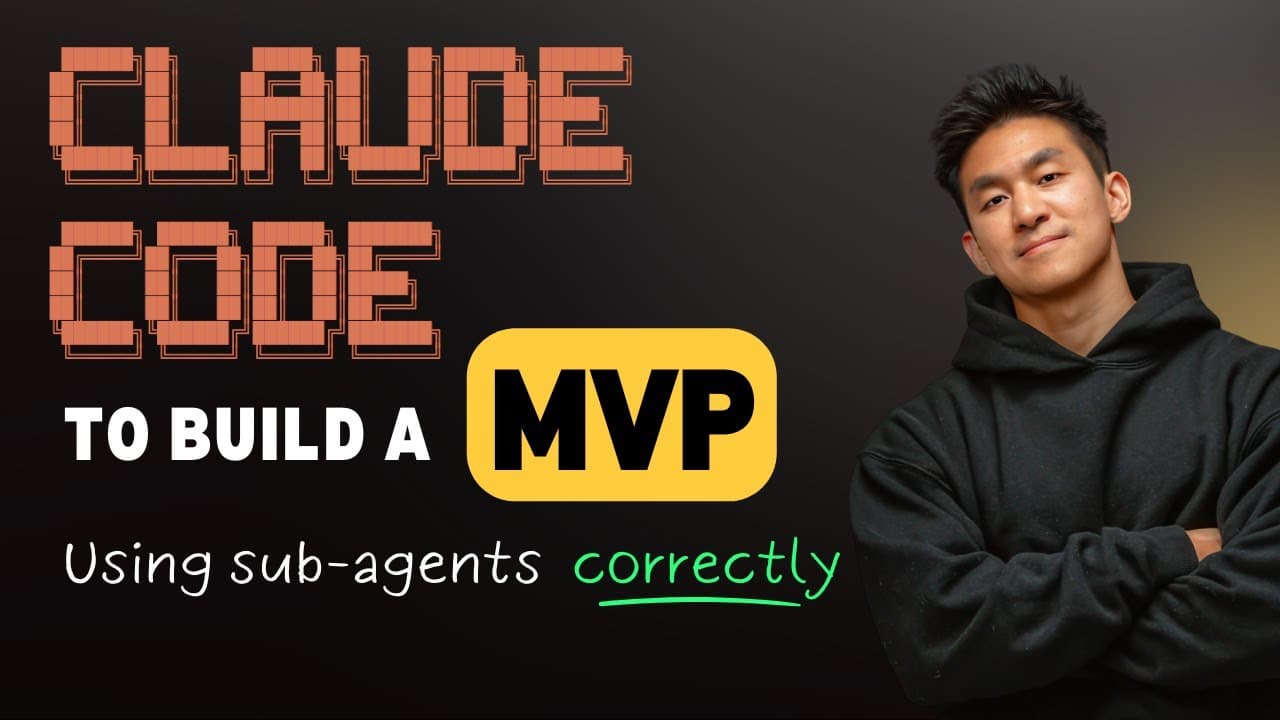
Learn effective use of Claude Code sub-agents for app development.
Transcript
Read and summarize the transcript of this video on Glasp Reader (beta).
Key Insights
- The video emphasizes the importance of using Claude Code sub-agents strategically for developing applications, highlighting a pattern that effectively utilizes orchestrators and specialized agents.
- A two-stage design and implementation strategy is recommended, separating the design phase from the implementation phase to manage memory and output efficiently.
- Orchestrators play a crucial role in coordinating outputs from various sub-agents, ensuring that the project structure is maintained and outputs are synthesized correctly.
- Running sub-agents in parallel, rather than sequentially, can significantly enhance efficiency, provided that outputs are managed to avoid conflicts.
- The video demonstrates the creation of a YouTube Social Proof Widget using Claude Code, integrating YouTube Data API and ChatGPT for sentiment analysis.
- Creating a PRD (Product Requirement Document) is optimized by first generating a prompt that can be iteratively refined before being passed to a PRD writer agent.
- Persistent memory strategy is essential in sub-agent architecture, achieved by writing outputs to the file system to maintain continuity across sessions.
- The tutorial stresses the iterative nature of refining prompts and sub-agents to improve application development, rather than expecting perfect results from the first attempt.
Install to Summarize YouTube Videos and Get Transcripts
Explore YouTube Video Summarizer or Get YouTube Transcript Extractor
Questions & Answers
Q: What is the main focus of the video?
The main focus of the video is to demonstrate an effective pattern for using Claude Code sub-agents in application development. It highlights the importance of orchestrators and specialized agents, the two-stage design-implement strategy, and provides a practical example of creating a YouTube Social Proof Widget with API integrations.
Q: How does the two-stage design-implement strategy work?
The two-stage design-implement strategy involves separating the design phase from the implementation phase. In the design phase, orchestrators and specialized agents work in parallel to generate outputs and manage memory efficiently. The implementation phase then uses these outputs to build the application, ensuring a structured and efficient development process.
Q: Why is an orchestrator important in using Claude Code sub-agents?
An orchestrator is crucial because it coordinates the outputs from various sub-agents, ensuring that the project structure is maintained and outputs are synthesized correctly. This coordination prevents conflicts and ensures that all components work together seamlessly, which is essential for efficient application development.
Q: What are the benefits of running sub-agents in parallel?
Running sub-agents in parallel enhances efficiency by allowing multiple tasks to be executed simultaneously. This approach reduces the time required for development and ensures that outputs are managed effectively to avoid conflicts. It is particularly beneficial when outputs are written to the file system, maintaining persistent memory across sessions.
Q: How is the YouTube Social Proof Widget created in the tutorial?
The YouTube Social Proof Widget is created using Claude Code, integrating the YouTube Data API and ChatGPT for sentiment analysis. The tutorial demonstrates the entire process, from creating a PRD to executing the design and implementation phases, resulting in a widget that provides social proof and sentiment analysis for YouTube videos.
Q: What is the process for creating a PRD in the video?
The process for creating a PRD involves generating a prompt that is iteratively refined before being passed to a PRD writer agent. This approach ensures that the PRD is comprehensive and robust, providing a solid foundation for application development. The video emphasizes the importance of refining the prompt to capture all necessary requirements.
Q: Why is a persistent memory strategy important in sub-agent architecture?
A persistent memory strategy is important because it maintains continuity across sessions by writing outputs to the file system. This approach ensures that sub-agents have access to previous outputs, enabling them to build upon past work and avoid starting from scratch, which enhances efficiency and consistency in application development.
Q: What is the importance of refining prompts and sub-agents iteratively?
Refining prompts and sub-agents iteratively is important because it allows for continuous improvement and adaptation to edge cases encountered during development. This iterative process ensures that prompts and sub-agents are optimized for efficiency and effectiveness, leading to better application outcomes and reducing errors in the development process.
Summary & Key Takeaways
-
The video provides a detailed tutorial on using Claude Code sub-agents to build applications efficiently. It emphasizes a pattern involving orchestrators and specialized agents to manage outputs and memory effectively. The tutorial guides viewers through creating a YouTube Social Proof Widget, demonstrating integration with APIs for sentiment analysis.
-
A two-stage strategy is advocated, separating design and implementation phases to enhance efficiency and manage resources. The video highlights the importance of orchestrators in coordinating sub-agent outputs and the benefits of running agents in parallel rather than sequentially.
-
The tutorial also covers optimizing PRD creation by generating and refining prompts, ensuring comprehensive and robust project documentation. The iterative approach to refining prompts and sub-agents is emphasized as crucial for successful application development, with practical demonstrations of the process.
Read in Other Languages (beta)
Share This Summary 📚
Summarize YouTube Videos and Get Video Transcripts with 1-Click
Try YouTube Summary with ChatGPT & Claude or YouTube Transcript Generator
Explore More Summaries from AI Oriented Dev 📚

Summarize YouTube Videos and Get Video Transcripts with 1-Click
Try YouTube Summary with ChatGPT & Claude or YouTube Transcript Generator