Laboratory Evidence of the Effects of Sponsorship on the Competitive Preferences of Men and Women
TL;DR
Laboratory evidence suggests that sponsorship can increase competitiveness and confidence, but the effects are greater for men than for women. The study examines belief signals and payment tying through experiments in which participants solve math problems, motivated by a career pipeline where women comprise 50% of public-accounting entry cohorts but only 19% of partners. Read on to understand the experiment, its findings, and how sponsorship differs from mentorship.
Transcript
welcome to the women and public policy program seminar series podcast at the Harvard Kennedy School okay I think I'll go ahead and get us started um my name is Hannah Riley BS I'm the I'm the uh faculty director or the research director here at the women in public policy program where we are committed to closing gender gaps in areas of Economic Opp... Read More
Key Insights
- 🖐️ Sponsorship programs can play a significant role in increasing competitiveness and confidence among participants.
- 🧔♀️ The impact of sponsorship programs varies between men and women, with men experiencing greater changes in competitiveness.
- 👔 The belief signal and payment tying features of sponsorship programs are important in motivating employees and fostering success.
Install to Summarize YouTube Videos and Get Transcripts
Explore YouTube Video Summarizer or Get YouTube Transcript Extractor
Questions & Answers
Q: What does the study find about sponsorship’s effects on men’s and women’s competitive preferences?
Sponsorship programs increased competitiveness and confidence, with greater effects among men than women. Men showed lower cutoffs and therefore a greater willingness to compete, while women’s cutoffs remained relatively unchanged.
Q: What was the main purpose of the sponsorship study?
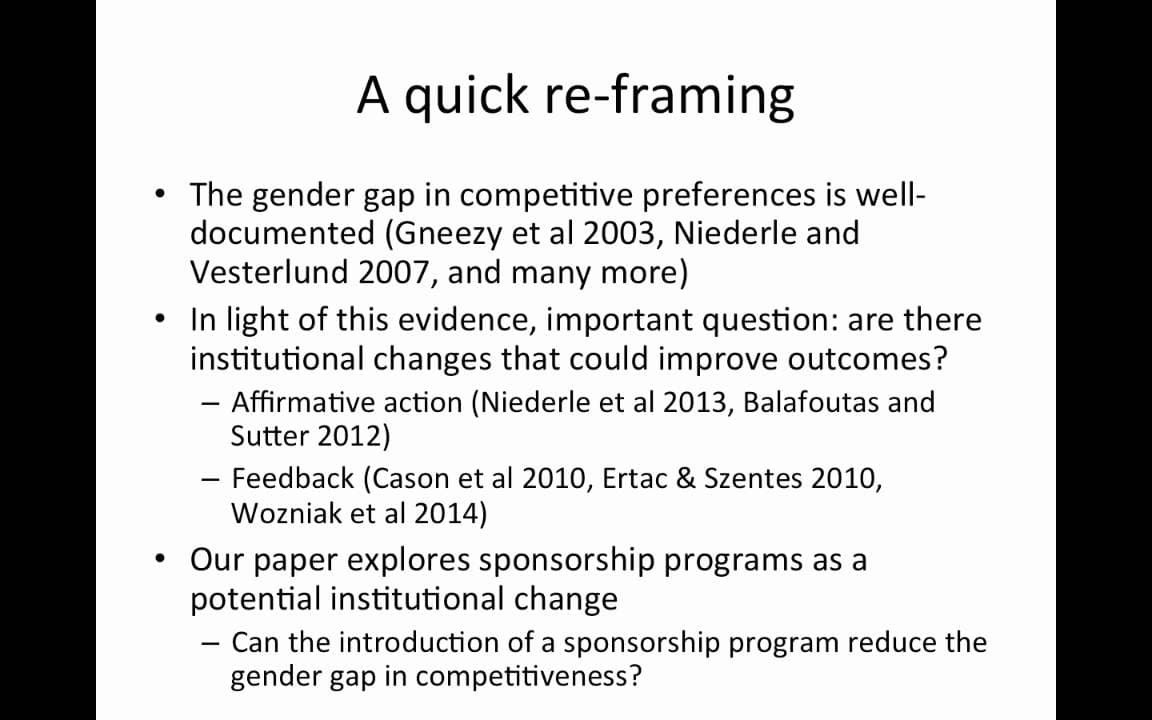
The study examined whether sponsorship programs could help close gender gaps in competitive careers such as academia and professional service firms. It focused specifically on how taking a stake in a protégé’s success affects competitiveness and performance.
Q: Why did the researchers focus on gender gaps in professional service firms?
Women represented about 50% of entry cohorts in public accounting firms but only 19% of partners. The researchers used this decline between entry and partnership as motivation for studying sponsorship programs.
Q: How does sponsorship differ from mentorship?
A sponsor advocates for a protégé and takes a stake in that person’s success, so the sponsor may benefit from success or face a penalty for failure. Mentorship is described as more focused on encouragement, nurturing, guidance, and connections.
Q: What sponsorship features did the laboratory experiment examine?
The experiment studied a belief signal and payment tying. The belief signal comes from selecting a protégé and expressing confidence, while payment tying links the sponsor’s compensation to the protégé’s performance.
Q: How was sponsorship tested in the laboratory?
Participants completed math problems while the researchers varied features of sponsorship. This design allowed the study to examine how belief signals and payment tying affected competitiveness, confidence, and performance.
Q: How did the experiment address selection into sponsorship?
The experiment used an algorithm to construct sponsors’ binary choices. This produced similar ability distributions among sponsored and unsponsored participants, helping the researchers separate sponsorship effects from selection.
Q: Who conducted and presented the research on sponsorship?
Katie Kaufman presented the laboratory evidence at the Women and Public Policy Program seminar at Harvard Kennedy School. The research was joint work with Nancy Baldiga, whose academic background includes work-life balance at professional service firms.
Summary & Key Takeaways
-
The study focuses on the impact of sponsorship programs on closing the gender gap in competitive careers, such as academia and professional service firms.
-
Different aspects of sponsorship programs, including belief signal and payment tying, are examined through lab experiments involving participants solving math problems.
-
The results show that sponsorship programs can increase competitiveness and confidence among participants, particularly men. However, the impact on women is less significant.
Read in Other Languages (beta)
Share This Summary 📚
Summarize YouTube Videos and Get Video Transcripts with 1-Click
Try YouTube Summary with ChatGPT & Claude or YouTube Transcript Generator
Explore More Summaries from Harvard University 📚






Summarize YouTube Videos and Get Video Transcripts with 1-Click
Try YouTube Summary with ChatGPT & Claude or YouTube Transcript Generator