Excess 3 adder | Logic diagram | STLD | Lec-68
TL;DR
Video explains how to perform addition using Excess-3 code.
Transcript
hi everyone in this video I'm going to explain about access3 order in the previous video I told you about BCD add binary coded decimal ER where if the result is greater than n after addition if the result is greater than 9 there we need to add six to the result okay this is access three add access three add is different whereas in BCD we are perfor... Read More
Key Insights
- ❓ Understanding the binary representation in Excess-3 is foundational for accurate addition calculations.
- ❓ The addition process in Excess-3 differs fundamentally from standard binary addition to incorporate error correction through adjustments of 3 or 13.
- 🇨🇫 Carry handling is a central theme in Excess-3 addition, affecting how results are interpreted and represented.
- 👨💻 Practical examples serve as an effective tool for grasping the nuances of Excess-3 code arithmetic.
- 🫦 A logic diagram is provided to support the implementation of the Excess-3 addition process using a 4-bit parallel adder IC.
- ❓ Excess-3 encoding emphasizes mathematical transformations to facilitate easier calculations while encoding decimal values.
- 🎭 The video offers crucial methods for converting results back to decimal from their binary forms after performing arithmetic operations.
Install to Summarize YouTube Videos and Get Transcripts
Explore YouTube Video Summarizer or Get YouTube Transcript Extractor
Questions & Answers
Q: What is Excess-3 code and how does it differ from BCD?
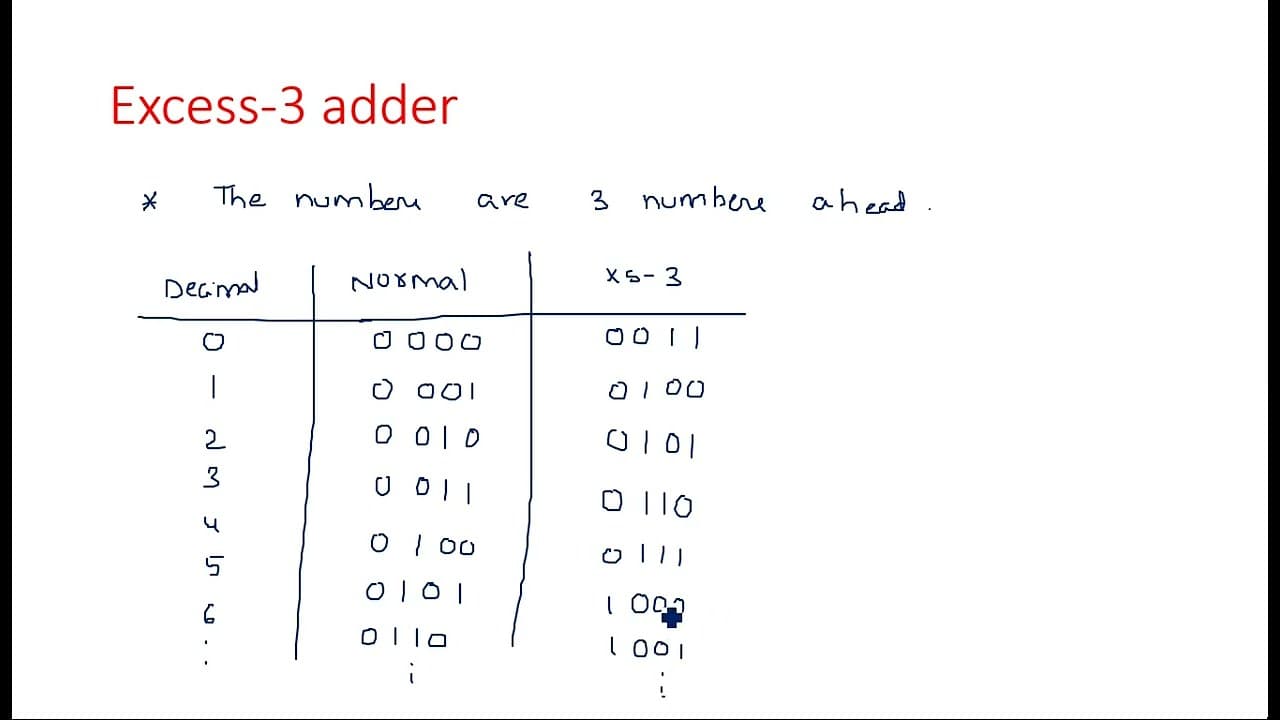
Excess-3 code is a non-weighted code used to express decimal numbers. Unlike Binary Coded Decimal (BCD), where decimal digits are directly represented by their binary equivalent, Excess-3 adds 3 to each decimal digit before converting it to binary, offsetting the representation. Thus, for example, the decimal value of 0 is represented as 0011 (3 added), contrasting with the binary representation of 0000 in BCD.
Q: How do you determine the adjustment needed during Excess-3 addition?
When adding two Excess-3 numbers, if a carry is generated during the addition of the binary equivalents, you add 3 to the result. Conversely, if no carry is generated, you can add 13 to the result. This ensures the correct representation of the decimal equivalent in Excess-3 format, aligning the binary result with its intended decimal output.
Q: Can you provide an example to clarify Excess-3 addition?
Certainly! For adding 9 and 5 in Excess-3, first convert these numbers to their Excess-3 representations (12 and 8, respectively). After performing binary addition, if you generate a carry, add 3 to your result. For this case, the initial binary outcome indicates carry, leading to adjustment and ultimately yielding the Excess-3 output that reflects the sum, which is 14.
Q: What are the rules for handle carry in Excess-3 addition?
In Excess-3 addition, if the initial binary addition results in a carry of one, add 3 to your result. If there's no carry, you should add 13 to ensure the outcome remains valid. This method of adjustment is critical to maintaining the integrity of the Excess-3 coded result.
Summary & Key Takeaways
-
The video outlines the process of Excess-3 addition, focusing on how to add two Excess-3 encoded numbers by first understanding their binary representations.
-
It emphasizes the need to handle carries during addition differently by introducing rules for when a carry is generated or not, leading to adjustments in the results.
-
Finally, the video offers practical examples demonstrating how to apply these rules, encapsulated with a logic diagram for a 4-bit parallel adder that operates in Excess-3.
Read in Other Languages (beta)
Share This Summary 📚
Summarize YouTube Videos and Get Video Transcripts with 1-Click
Try YouTube Summary with ChatGPT & Claude or YouTube Transcript Generator