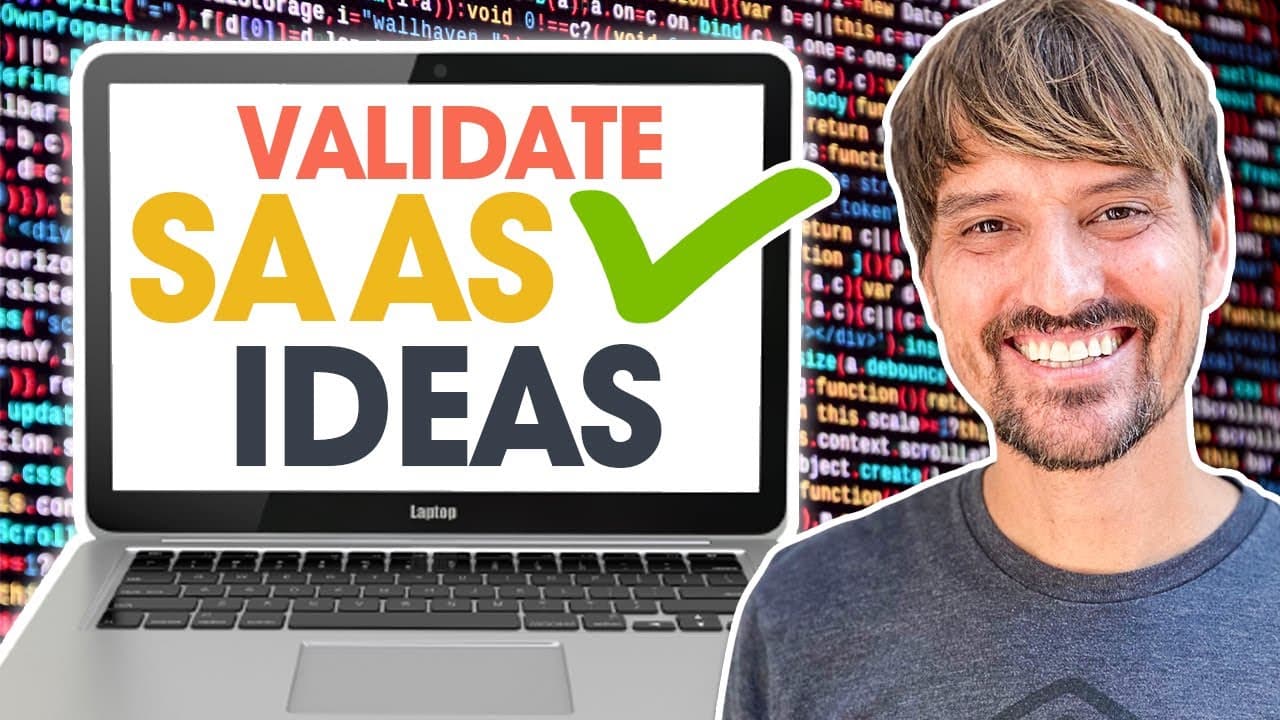
Validate Your SaaS Idea FAST (Step-by-Step SaaS Validation Process)💡✅
TL;DR
Learn how to validate your SaaS idea in under 30 days.
Transcript
Read and summarize the transcript of this video on Glasp Reader (beta).
Key Insights
- Validation involves gauging interest and potential success of a SaaS idea through specific strategies, differing from mere idea evaluation.
- Rob Walling emphasizes the importance of not relying solely on audience feedback due to potential bias and plateauing growth.
- Landing pages are effective for low-touch funnels, aiming to build an email list as a validation signal.
- Conversational validation, involving pre-sales or verbal commitments, suits medium to high-touch funnels and offers direct feedback.
- Combining landing pages and conversational validation can significantly bolster the validation process, as demonstrated by the success of Drip.
- Building a prototype or MVP is recommended only after initial interest is confirmed through other validation methods.
- Networking and leveraging existing connections can provide a significant advantage in the validation process.
- The video emphasizes iterative feedback and adaptation, with real-world examples of successful SaaS validation strategies.
Install to Summarize YouTube Videos and Get Transcripts
Explore YouTube Video Summarizer or Get YouTube Transcript Extractor
Questions & Answers
Q: What is the difference between idea evaluation and validation?
Idea evaluation involves assessing an idea against specific criteria to determine its potential viability, often using frameworks like the 5 PM framework. Validation, on the other hand, is about actively testing the idea in the market to see if there's genuine interest and demand, often involving strategies like landing pages and direct customer conversations.
Q: Why should you be cautious when asking your audience for feedback?
Relying solely on audience feedback can be misleading due to potential bias. Audiences may provide positive feedback out of support or loyalty, which can lead to overestimating interest. Additionally, relying on a limited audience can result in growth plateauing, making it crucial to seek diverse and unbiased validation sources.
Q: How can landing pages be used in the validation process?
Landing pages are used to validate low-touch SaaS ideas by building an email list of interested potential customers. The process involves driving traffic to the page through various channels and measuring the opt-in rate as a signal of interest. A high opt-in rate indicates a strong interest, guiding further development and marketing efforts.
Q: What is conversational validation and when should it be used?
Conversational validation involves direct interactions with potential customers to secure pre-sales or verbal commitments. It's suitable for ideas requiring more interaction, such as medium to high-touch funnels. This method provides detailed feedback and helps refine the idea based on actual customer needs, ensuring a stronger market fit before development.
Q: What is the advantage of combining landing pages and conversational validation?
Combining both methods provides a comprehensive validation strategy. Landing pages help gauge initial interest and build a potential customer base, while conversational validation offers detailed insights and direct feedback. This dual approach ensures a robust understanding of market demand and customer needs, reducing the risk of pursuing unviable ideas.
Q: Why is building a prototype or MVP not recommended as the first step?
Building a prototype or MVP without prior validation can lead to wasted resources if there's insufficient market interest. It's recommended to first use methods like landing pages or conversational validation to confirm demand. These methods provide insights and signals that guide product development, ensuring that the effort aligns with market needs.
Q: How can networking benefit the SaaS validation process?
Networking provides access to valuable insights and potential early adopters. Leveraging existing connections can facilitate initial feedback and interest, offering a unique advantage in the validation process. Building a network in the relevant industry can also lead to partnerships and collaborations that enhance the product's development and market reach.
Q: What role does feedback play in the validation process?
Feedback is crucial for refining and adapting the SaaS idea to better meet market demands. It provides insights into customer needs and preferences, guiding product development and marketing strategies. Iterative feedback helps identify potential issues early, allowing for adjustments that increase the likelihood of success and reduce the risk of pursuing unviable ideas.
Summary & Key Takeaways
-
Rob Walling provides a structured approach to SaaS idea validation, focusing on two primary methods: landing pages and conversational validation. He highlights the importance of differentiating between evaluation and validation, emphasizing that validation is a continuous process.
-
Landing pages are recommended for low-touch funnels, where the primary goal is to build an email list to gauge interest. This approach involves driving traffic through various channels, including social media and pay-per-click advertising.
-
Conversational validation is suitable for ideas requiring more interaction, involving direct conversations to secure pre-sales or verbal commitments. This method helps refine ideas based on real feedback and is particularly useful for medium to high-touch funnels.
Read in Other Languages (beta)
Share This Summary 📚
Summarize YouTube Videos and Get Video Transcripts with 1-Click
Try YouTube Summary with ChatGPT & Claude or YouTube Transcript Generator
Explore More Summaries from MicroConf 📚





Summarize YouTube Videos and Get Video Transcripts with 1-Click
Try YouTube Summary with ChatGPT & Claude or YouTube Transcript Generator