How to Calculate the Arc Length of ln(sec(x))
TL;DR
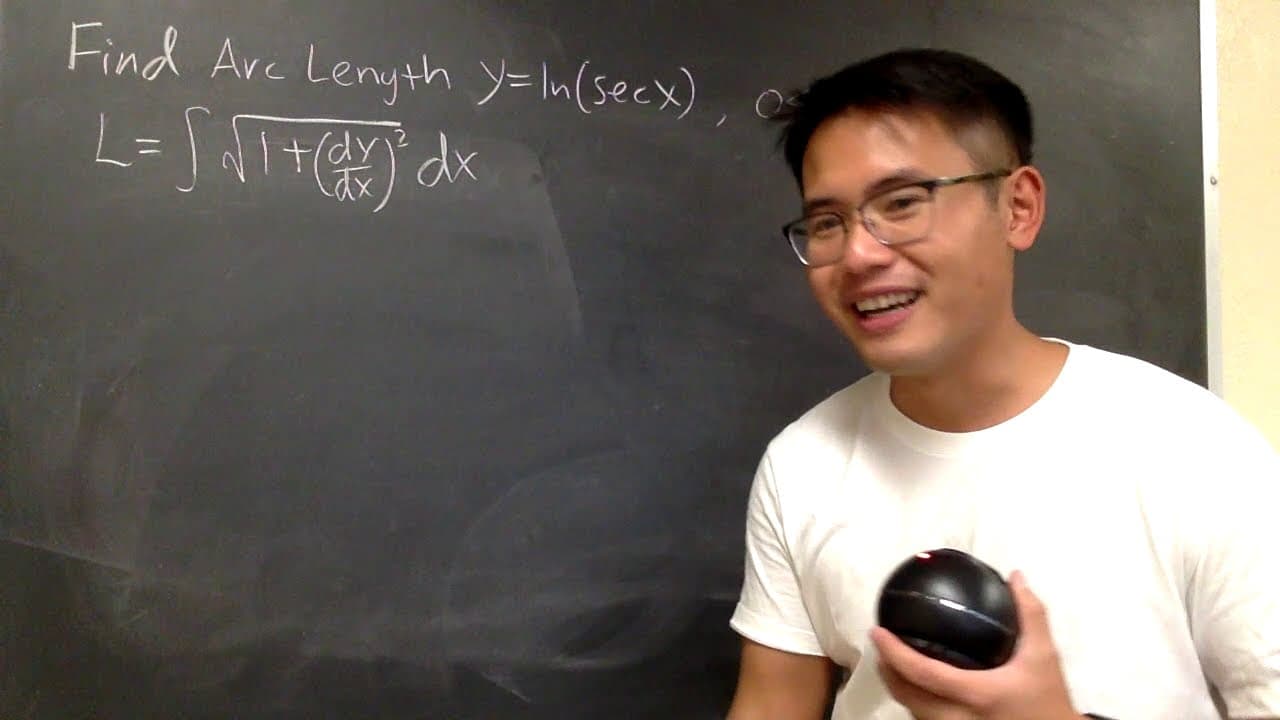
To calculate the arc length of the curve ln(sec(x)) from 0 to π/4, use the integral ∫√(1 + (tan(x))^2) dx. This simplifies to ∫sec(x) dx, resulting in a final arc length of 1/2 ln(√2 + 1) after evaluating the integral at the given limits.
Transcript
okay we are conjugated arc length of this curve from x value 0 to PI over 4 so let's go ahead and get started l4 the arc length it's going to be the integral and you open a square root 1 plus here we are given that Y as a function of X so in here we need to get dy DX and then we square that and then you have the DX on the outside and they will give... Read More
Key Insights
- ❎ Calculating arc length involves finding the integral of the square root of 1 plus the square of the derivative of the curve.
- 📏 The derivative of the given function is found using the chain rule and is equal to tan(x).
- ❓ The integral of 1 + tan^2(x) simplifies to sec^2(x) using a trigonometric identity.
- 🎮 The limits of integration provided in the video are from 0 to π/4.
Install to Summarize YouTube Videos and Get Transcripts
Explore YouTube Video Summarizer or Get YouTube Transcript Extractor
Questions & Answers
Q: How is the derivative of the given function, dy/dx, calculated?
The derivative is found by applying the chain rule to the function. Simplifying the expression gives dy/dx = tan(x).
Q: How is the integral of 1 + tan^2(x) simplified?
By using the trigonometric identity 1 + tan^2(x) = sec^2(x), the expression is simplified to be just sec^2(x).
Q: What are the limits of integration for calculating the arc length?
The limits of integration provided in the video are from 0 to π/4.
Q: What is the final expression for the arc length?
The final expression for the arc length is 1/2 natural log of the square root of 2 plus 1.
Summary & Key Takeaways
-
The video explains how to calculate the arc length of a curve using integration and the formula ∫√(1 + (dy/dx)^2) dx.
-
The derivative of the given function is found to be dy/dx = tan(x), which is squared and incorporated into the formula.
-
The integral of 1 + tan^2(x) simplifies to sec^2(x), allowing for easier calculation.
-
Plugging in the limits of integration, the final arc length is found to be 1/2 natural log of the square root of 2 plus 1.
Read in Other Languages (beta)
Share This Summary 📚
Summarize YouTube Videos and Get Video Transcripts with 1-Click
Try YouTube Summary with ChatGPT & Claude or YouTube Transcript Generator
Explore More Summaries from blackpenredpen 📚


Summarize YouTube Videos and Get Video Transcripts with 1-Click
Try YouTube Summary with ChatGPT & Claude or YouTube Transcript Generator