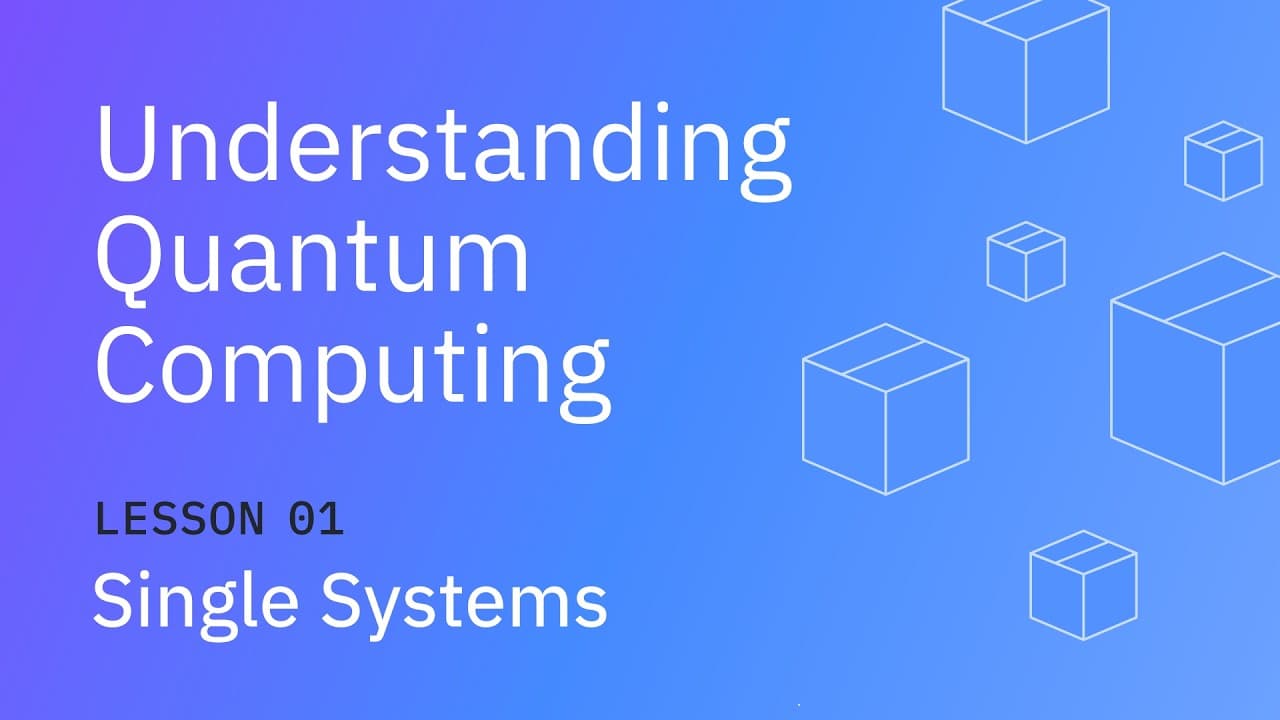
Single Systems | Understanding Quantum Information & Computation | Lesson 01
TL;DR
Introduction to quantum information for single systems using vectors and unitary matrices.
Transcript
Read and summarize the transcript of this video on Glasp Reader (beta).
Key Insights
- Quantum information is an extension of classical information, and understanding classical concepts is essential to grasp quantum mechanics.
- Quantum states are represented as vectors with complex number entries, differing from classical probabilistic states which use real numbers.
- The Dirac notation is central in quantum mechanics, offering a compact way to express vectors and operations.
- Measurements in quantum systems yield classical outcomes, with probabilities derived from the quantum state's vector entries.
- Unitary matrices describe operations on quantum states, preserving the Euclidean norm and ensuring transformations remain within quantum state space.
- Composing unitary operations involves matrix multiplication, maintaining the unitary property and allowing complex operations to be built from simpler ones.
- The Hadamard and Pauli operations are fundamental in quantum computing, enabling state transformations and bit manipulations.
- Quantum operations can achieve transformations not possible in classical systems, exemplified by the square root of not operation.
Install to Summarize YouTube Videos and Get Transcripts
Explore YouTube Video Summarizer or Get YouTube Transcript Extractor
Questions & Answers
Q: What is the relationship between quantum and classical information?
Quantum information is an extension of classical information. While classical information is characterized by definite states and probabilities, quantum information involves complex number amplitudes and superpositions. Understanding classical information is crucial for grasping quantum concepts, as quantum mechanics builds upon classical principles, extending them to include phenomena like entanglement and interference.
Q: How are quantum states represented mathematically?
Quantum states are represented as column vectors with complex number entries, where the indices correspond to the classical states of the system. The sum of the absolute values squared of the entries must equal one, ensuring the vector is a unit vector in the Euclidean sense. This representation allows for the mathematical modeling of quantum systems and their probabilistic nature.
Q: What role does the Dirac notation play in quantum mechanics?
The Dirac notation provides a compact and standardized way to express vectors and operations in quantum mechanics. It uses 'bra' and 'ket' symbols to denote row and column vectors, respectively, facilitating the representation of quantum states and operations. The notation is integral in simplifying complex calculations and visualizing quantum processes, making it a fundamental tool in quantum information theory.
Q: How do measurements work in quantum systems?
Measurements in quantum systems yield classical outcomes, with the probability of each outcome determined by the absolute value squared of the corresponding entry in the quantum state's vector. This process, known as state collapse, transforms the quantum state into a classical state, providing a mechanism for extracting information from quantum systems. The measurement process is central to the interface between quantum and classical information.
Q: What are unitary operations in quantum mechanics?
Unitary operations are transformations on quantum states represented by unitary matrices, which preserve the Euclidean norm of vectors. These operations ensure that quantum states remain valid after transformations, maintaining their probabilistic nature. Unitary operations are fundamental in quantum computing, allowing for the manipulation and evolution of quantum states without loss of information.
Q: Can you explain the significance of the Hadamard and Pauli operations?
The Hadamard and Pauli operations are key transformations in quantum computing. The Hadamard operation creates superpositions of states, enabling quantum parallelism. Pauli operations, including bit flips and phase flips, manipulate quantum bits (qubits) at a fundamental level, allowing for the implementation of quantum gates and algorithms. These operations are building blocks for more complex quantum processes.
Q: What is unique about quantum operations compared to classical ones?
Quantum operations can achieve transformations not possible in classical systems, such as the square root of not operation. This operation, when applied twice, results in a not operation, showcasing the unique nature of quantum transformations. Quantum operations leverage superposition and entanglement, allowing for parallel processing and interference, which are not present in classical operations.
Q: How are unitary operations composed in quantum mechanics?
Unitary operations are composed through matrix multiplication, with the order of operations reversed compared to the sequence of application. This composition maintains the unitary property, ensuring that the resulting operation preserves the quantum state's norm. Composing unitary operations allows for the construction of complex quantum algorithms from simpler transformations, enabling sophisticated quantum computations.
Summary & Key Takeaways
-
This lesson introduces quantum information for single systems, focusing on the representation of quantum states as vectors with complex entries. It explains how quantum states differ from classical probabilistic states and introduces the Dirac notation for expressing vectors and operations.
-
Measurements in quantum systems extract classical information, with probabilities determined by the quantum state vector's entries. The lesson also covers unitary operations, which describe quantum state transformations and are represented by matrices preserving the Euclidean norm.
-
Key operations like the Hadamard and Pauli matrices are discussed, highlighting their role in state transformations. The lesson concludes with composing unitary operations through matrix multiplication, enabling complex quantum operations from simpler components.
Read in Other Languages (beta)
Share This Summary 📚
Summarize YouTube Videos and Get Video Transcripts with 1-Click
Try YouTube Summary with ChatGPT & Claude or YouTube Transcript Generator
Explore More Summaries from Qiskit 📚

Summarize YouTube Videos and Get Video Transcripts with 1-Click
Try YouTube Summary with ChatGPT & Claude or YouTube Transcript Generator