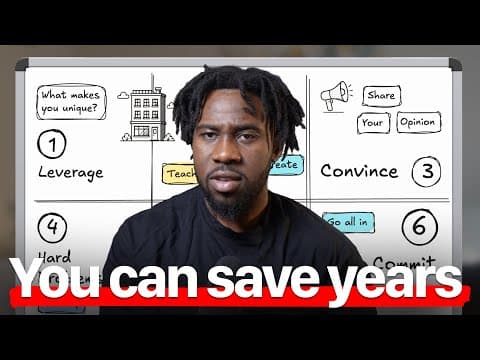
If I started UX in 2025, I’d follow this roadmap.

TL;DR
Learn UX design in 6-9 months with this comprehensive roadmap.
Transcript
Read and summarize the transcript of this video on Glasp Reader (beta).
Key Insights
- To become a UX designer by 2025, you'll need a computer, decent internet, and dedicated time, ideally 2-4 hours daily.
- The roadmap is divided into three phases: learning foundations, working on projects, and job hunting, spanning 6-9 months.
- Understanding the difference between UX and UI design is crucial, as modern roles often require a blend of both skills.
- Begin by mastering visual design elements using tools like Figma, focusing on user flows, typography, and wireframes.
- Soft skills like user research, storytelling, and presentation are vital for effectively communicating design processes and solutions.
- Leverage AI tools like ChatGPT for brainstorming, research, and even building simple projects to enhance your portfolio.
- Building a strong network through horizontal and vertical networking is essential for career growth and finding job opportunities.
- Create a personal website for your portfolio, ensuring it includes at least three detailed case studies to showcase your skills.
Install to Summarize YouTube Videos and Get Transcripts
Explore YouTube Video Summarizer or Get YouTube Transcript Extractor
Questions & Answers
Q: What are the initial steps to become a UX designer by 2025?
The initial steps include acquiring a working computer, decent internet, and dedicating time to learning. The roadmap suggests spending 2-4 hours daily for the first six months to build foundational skills and work on projects. This commitment is crucial for transitioning into a UX design role.
Q: How does the roadmap suggest blending UX and UI design skills?
The roadmap advises not to treat UX and UI as separate entities but to integrate them. It suggests mastering visual design elements first, such as user flows, typography, and wireframes, using tools like Figma. This approach ensures a comprehensive understanding of both user experience and interface design.
Q: Why is networking important in the UX design journey?
Networking is crucial for career growth and job opportunities. The video highlights two types of networking: horizontal, with peers on the same journey, and vertical, with mentors ahead in the field. Both networks provide support, accountability, and guidance, making them essential for a successful UX design career.
Q: What role does AI play in the UX design process according to the roadmap?
AI is a valuable tool for brainstorming, research, and project development. The roadmap suggests using AI tools like ChatGPT for generating ideas, conducting user research, and even building simple projects. This integration of AI can enhance workflow efficiency and help designers stand out in the job market.
Q: What are the key soft skills for a UX designer as per the roadmap?
Key soft skills include user research, storytelling, and presentation. User research helps in understanding user problems and converting them into design insights, while storytelling and presentation skills are vital for effectively communicating design processes and solutions in portfolios and interviews.
Q: How should a UX designer approach building their portfolio?
A personal website is recommended for showcasing a portfolio. It should include at least three detailed case studies that highlight the designer's problem-solving abilities, research, and design process. The portfolio should be visually appealing and demonstrate the ability to organize information effectively.
Q: What strategies are suggested for landing a UX design job?
The roadmap suggests understanding the job market and hiring process, creating a standout portfolio, and growing a professional network. It emphasizes preparing for interviews by practicing confidence, coherence, and conciseness, and ensuring the portfolio and resume effectively communicate problem-solving skills.
Q: What tools are recommended for learning UX design?
Figma is highly recommended as the primary tool for mastering visual design elements. Other tools mentioned include Sketch, Penpot, Framer, and Webflow for various design and prototyping tasks. These tools help in developing the necessary skills to create effective user interfaces and experiences.
Summary & Key Takeaways
-
This video provides a detailed roadmap for becoming a UX designer in 2025, emphasizing the importance of foundational skills, project work, and leveraging AI tools. It outlines a structured timeline and offers insights into the necessary skills and tools to master.
-
The content emphasizes the importance of blending UX and UI skills, understanding the industry landscape, and the significance of networking and building a strong portfolio. It also highlights the evolving role of AI in the design process.
-
Practical advice includes starting with visual design skills, using tools like Figma, and creating a personal website for your portfolio. The video also stresses the importance of continuous learning and adapting to industry changes.
Read in Other Languages (beta)
Share This Summary 📚
Summarize YouTube Videos and Get Video Transcripts with 1-Click
Try YouTube Summary with ChatGPT & Claude or YouTube Transcript Generator
Explore More Summaries from Samuel Fabayo 📚

Summarize YouTube Videos and Get Video Transcripts with 1-Click
Try YouTube Summary with ChatGPT & Claude or YouTube Transcript Generator