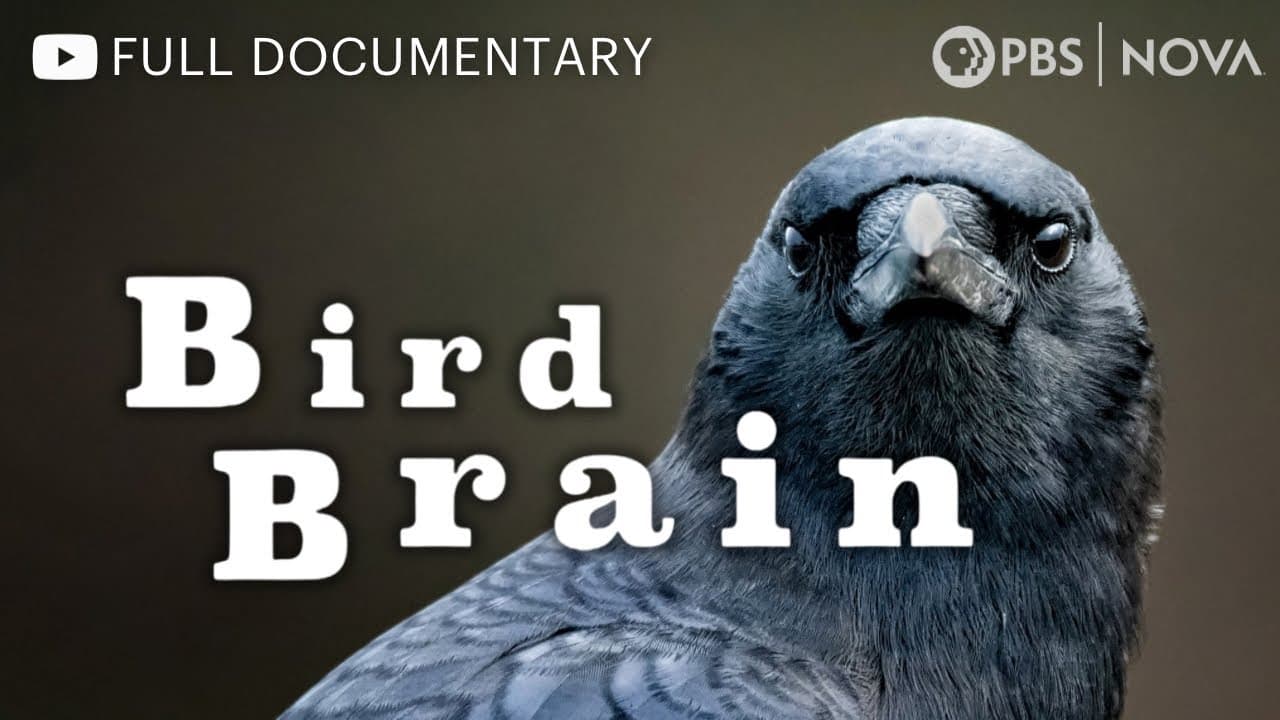
Bird Brain | Full Documentary | NOVA | PBS
TL;DR
Birds exhibit advanced problem-solving skills and emotional intelligence.
Transcript
Read and summarize the transcript of this video on Glasp Reader (beta).
Key Insights
- Birds are traditionally seen as instinct-driven, but recent studies show they possess advanced problem-solving abilities akin to humans.
- Parrots and crows have large brains relative to their body size, which may enable them to solve complex problems and plan for the future.
- Experiments demonstrate that birds like ravens can delay gratification, a trait previously thought unique to humans and certain primates.
- Social learning is evident in birds, as demonstrated by rooks imitating solutions to puzzles after observing other birds' actions.
- Birds such as jackdaws can interpret human eye signals, suggesting they can understand non-verbal communication cues.
- Birds exhibit emotional responses and can form social bonds, indicating they might experience emotions similar to humans.
- The ability to use tools, as seen in New Caledonian crows, shows birds can apply skills learned in the wild to new environments.
- Birds can recognize individual humans and remember past interactions, which shows a level of memory and social awareness.
Install to Summarize YouTube Videos and Get Transcripts
Explore YouTube Video Summarizer or Get YouTube Transcript Extractor
Questions & Answers
Q: What are some examples of birds solving problems?
Birds like Rio, a scarlet macaw, and Bran, a raven, have demonstrated problem-solving abilities. Rio successfully completed a string pull test to obtain food, while Bran used water to extract food from a bottle. These examples highlight birds' ability to visualize and solve puzzles.
Q: How do birds demonstrate social learning?
Social learning in birds is shown through experiments with rooks. When rooks observed a trained bird solving a puzzle, they replicated the solution themselves. This indicates that birds can learn by watching others, a trait associated with higher cognitive processing.
Q: Can birds recognize individual humans?
Yes, birds like crows can recognize individual humans. In experiments, crows remembered a threatening person wearing a specific mask and reacted negatively to that person in future encounters, showing their ability to recognize and remember human faces.
Q: Do birds exhibit emotional responses?
Birds do exhibit emotional responses. For instance, ravens have been observed comforting each other in distressing situations, suggesting they might understand and empathize with each other's emotions, similar to humans.
Q: What is the significance of birds' ability to delay gratification?
Birds' ability to delay gratification, as seen in ravens waiting for a preferred food, indicates advanced cognitive processing. This trait, previously thought to be unique to humans and some primates, shows that birds can plan and make complex decisions.
Q: How do birds use tools in the wild and in experiments?
New Caledonian crows use tools like hook-shaped sticks to extract food in the wild. In experiments, they demonstrated the ability to use unfamiliar tools, indicating their capacity to apply learned skills to new situations, showcasing their cognitive flexibility.
Q: What role does brain size play in bird intelligence?
Parrots and crows have large brains relative to their body size, which is thought to contribute to their intelligence. Their brains contain a high density of neurons, enabling them to solve complex problems and exhibit behaviors similar to mammals.
Q: Can birds communicate with humans?
Birds like jackdaws can communicate with humans by interpreting eye signals. In experiments, jackdaws successfully identified cues from human eye movements to locate hidden food, demonstrating their ability to understand and respond to non-verbal communication.
Summary & Key Takeaways
-
Birds, once thought to be driven solely by instinct, are now recognized for their problem-solving skills and cognitive abilities. Studies have shown that birds like parrots and crows can plan for the future and solve complex puzzles.
-
Social interactions in birds are complex, with evidence of social learning and the ability to recognize individual humans. This suggests that birds have a level of social intelligence comparable to some mammals.
-
Birds demonstrate emotional responses and the ability to delay gratification, indicating that their cognitive processes might be more similar to humans than previously believed. This challenges the traditional view of birds as simple creatures.
Read in Other Languages (beta)
Share This Summary 📚
Summarize YouTube Videos and Get Video Transcripts with 1-Click
Try YouTube Summary with ChatGPT & Claude or YouTube Transcript Generator
Explore More Summaries from NOVA PBS Official 📚




Summarize YouTube Videos and Get Video Transcripts with 1-Click
Try YouTube Summary with ChatGPT & Claude or YouTube Transcript Generator