Why Is x^2 Continuous but Not Uniformly Continuous?
TL;DR
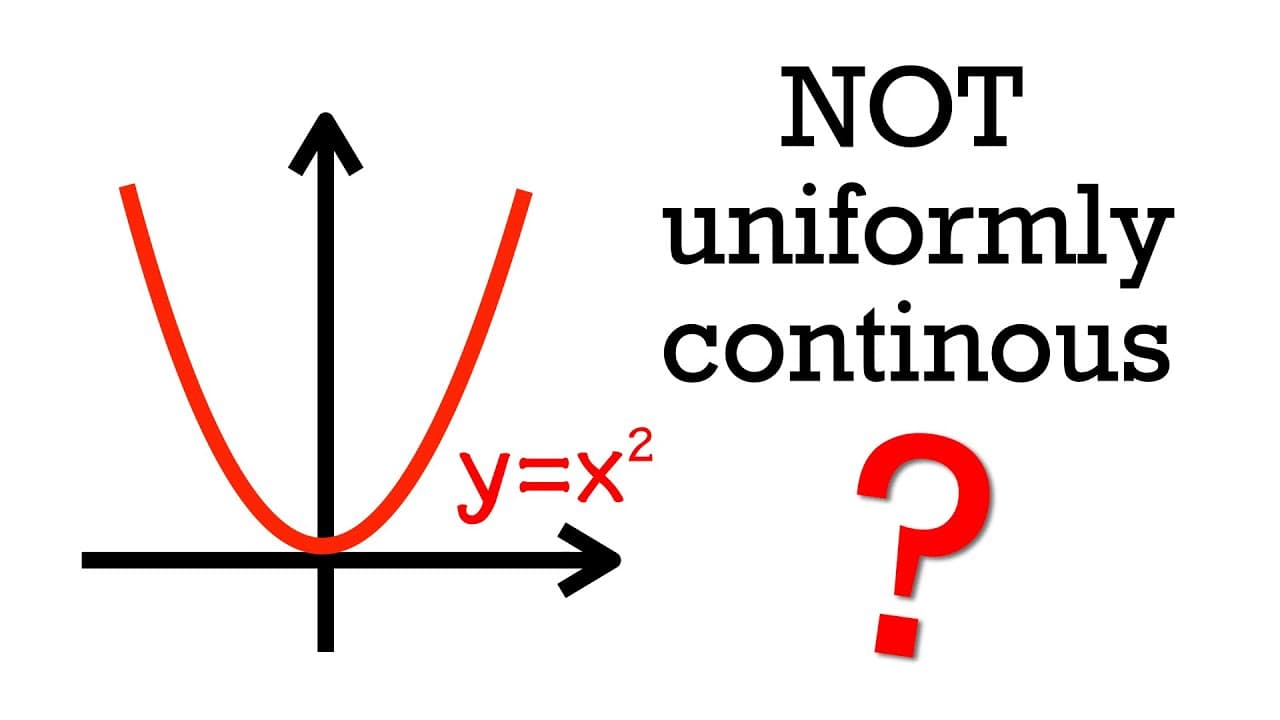
The function x^2 is continuous over the entire real line, but it is not uniformly continuous. While it behaves without gaps or jumps, as x approaches infinity, the function's rate of change increases without bound, violating the criteria for uniform continuity. However, x^2 is uniformly continuous on any closed interval.
Transcript
okay today we are not going to do math for fun but instead we are going to have a small taste of real analysis so if you want to be a math major you are going to see all this one day so have a look first as we all know x squared is continuous from negative infinity to past infinity and we did a proof for that last time right it was not eas... Read More
Key Insights
- ⛔ The definition of continuity in the usual sense involves limits and the absolute value of the difference between function values.
- 😥 Uniform continuity requires that the choice of delta depends only on epsilon and not on the specific points chosen.
- ⛔ The limit of the derivative of a function can determine if it is uniformly continuous.
Install to Summarize YouTube Videos and Get Transcripts
Explore YouTube Video Summarizer or Get YouTube Transcript Extractor
Questions & Answers
Q: What is the difference between continuity and uniform continuity?
Continuity refers to the absence of gaps, holes, or jumps in a function, while uniform continuity requires the same property across the entire interval.
Q: Why is x squared not uniformly continuous from negative infinity to positive infinity?
x squared is not uniformly continuous because the limit of its derivative as x approaches infinity is not infinity.
Q: Can a function be uniformly continuous without its derivative going to infinity?
Yes, there are examples where the derivative of a function does not go to infinity, and it can still be uniformly continuous.
Q: How is the negation of uniform continuity defined?
The negation of uniform continuity reverses the quantifiers in the definition, stating that there exists an epsilon for which, for all deltas, there exist x and y such that the absolute value of the difference between the function values is greater than or equal to epsilon.
Summary & Key Takeaways
-
x squared is continuous in the usual sense, with no gaps, holes, or jumps.
-
x squared is not uniformly continuous from negative infinity to positive infinity.
-
However, it is uniformly continuous on a closed interval.
Read in Other Languages (beta)
Share This Summary 📚
Summarize YouTube Videos and Get Video Transcripts with 1-Click
Try YouTube Summary with ChatGPT & Claude or YouTube Transcript Generator
Explore More Summaries from blackpenredpen 📚

Summarize YouTube Videos and Get Video Transcripts with 1-Click
Try YouTube Summary with ChatGPT & Claude or YouTube Transcript Generator