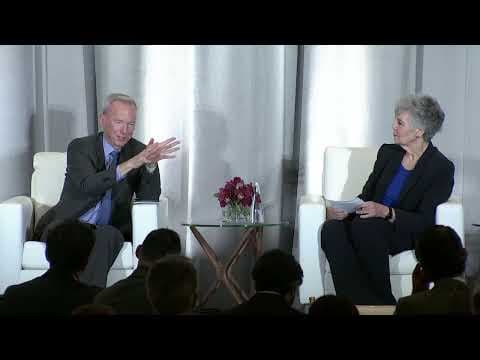
Episode 31: A Conversation with Jensen Huang

TL;DR
Jensen Huang discusses AI's evolution and U.S.-China tech competition.
Transcript
Read and summarize the transcript of this video on Glasp Reader (beta).
Key Insights
- Jensen Huang emphasizes the transformative journey of Nvidia from its inception to becoming a leader in AI, highlighting the American dream and the role of immigrants in innovation.
- The evolution of AI is described in waves: perception, generative, reasoning, and the upcoming physical AI, each representing significant advancements in AI capabilities.
- AI factories are redefining data centers, focusing on producing tokens rather than just storing data, which requires substantial energy resources.
- The intersection of AI development and energy policy is crucial, as energy is needed to support AI factories, aligning with President Trump's pro-energy initiatives.
- AI's impact on the workforce is seen as a positive force for job creation, driven by increased productivity and the emergence of new industries.
- Engaging with AI is vital for everyone, as it serves as an equalizing force, making technology accessible to all, regardless of technical expertise.
- The U.S. must focus on maintaining its leadership in AI by ensuring that American tech stacks become the global standard, winning over developers worldwide.
- Jensen Huang advocates for sovereign AI development, where each country builds AI models reflecting their culture and values, yet based on American technology.
Install to Summarize YouTube Videos and Get Transcripts
Explore YouTube Video Summarizer or Get YouTube Transcript Extractor
Questions & Answers
Q: What is the significance of the 'American dream' in Jensen Huang's narrative?
Jensen Huang's narrative emphasizes the 'American dream' as a testament to the opportunities available in the United States for immigrants and innovators. He shares his personal journey from immigrating to the U.S. at a young age to founding Nvidia, highlighting how the country's environment fosters entrepreneurship and innovation, allowing individuals to achieve remarkable success and contribute significantly to technological advancements.
Q: How does Jensen Huang describe the evolution of AI?
Jensen Huang describes the evolution of AI in distinct waves: perception, generative, reasoning, and physical AI. Each wave represents a significant leap in AI capabilities, from achieving superhuman perception in computer vision and language understanding to generating and reasoning with information. The upcoming wave, physical AI, involves AI interacting with the physical world, incorporating common sense and robotics, marking a new era in AI development.
Q: What are AI factories, and why are they important?
AI factories are a new concept redefining traditional data centers. Unlike classical data centers focused on data retrieval, AI factories are dedicated to producing tokens, which are the building blocks of AI-generated intelligence. These factories require substantial energy resources to operate, making them crucial for supporting the widespread adoption and application of AI across industries. Their development aligns with energy policies, emphasizing the need for sustainable energy solutions to power the AI-driven future.
Q: How does AI impact job creation according to Jensen Huang?
Jensen Huang views AI as a catalyst for job creation, driven by increased productivity and the emergence of new industries. He argues that as productivity rises, companies can explore new ideas and markets, leading to more employment opportunities. Huang emphasizes the optimistic perspective that AI will not only enhance existing jobs but also create new ones, as seen in historical technological revolutions, contributing to economic growth and innovation.
Q: Why is engaging with AI important for everyone?
Engaging with AI is crucial because it serves as an equalizing force, making advanced technology accessible to all individuals, regardless of their technical expertise. Jensen Huang highlights that AI can be used by anyone, from software developers to those unfamiliar with computers, through intuitive interfaces like chatbots. This accessibility empowers individuals across different backgrounds to leverage AI's capabilities, fostering inclusivity and democratizing technology use.
Q: What is Jensen Huang's stance on U.S. leadership in AI?
Jensen Huang advocates for the U.S. to maintain its leadership in AI by ensuring that American technology stacks become the global standard. He emphasizes the importance of winning over developers worldwide, as they are crucial for the development and adoption of AI technologies. Huang stresses that the U.S. must focus on strategic confidence, fostering innovation and collaboration to remain at the forefront of AI advancements and set the global technology standards.
Q: What does sovereign AI mean, and why is it important?
Sovereign AI refers to the development of AI models by individual countries that reflect their unique culture, values, and languages. Jensen Huang advocates for this approach, emphasizing that while countries should use global AI models, they should also build their own indigenous AI systems. This ensures that AI technologies align with local societal norms and needs, fostering cultural diversity and enabling countries to maintain control over their AI ecosystems while leveraging American tech stacks.
Q: How does Jensen Huang view the U.S.-China tech competition?
Jensen Huang views the U.S.-China tech competition as a rivalry between peer competitors, emphasizing that China is an adversary but not an enemy. He acknowledges China's formidable technology companies and manufacturing capabilities, highlighting the interdependencies between the two countries. Huang advocates for strategic confidence, urging the U.S. to focus on re-industrializing and enhancing its technological excellence to maintain leadership while fostering global collaboration and reducing geopolitical tensions.
Summary & Key Takeaways
-
Jensen Huang, CEO of Nvidia, discusses the company's journey and its role in redefining computing through AI. He highlights the significance of the American dream and the contributions of immigrants to innovation. Huang elaborates on the evolution of AI, describing it in waves: perception, generative, reasoning, and physical AI.
-
AI factories are transforming data centers by focusing on token production, requiring significant energy resources. Huang aligns this need with President Trump's pro-energy initiatives. He sees AI as a force for job creation, driven by productivity and new industries, and stresses the importance of engaging with AI as an equalizing technology.
-
Huang emphasizes the need for the U.S. to maintain its AI leadership by making American tech stacks the global standard. He advocates for sovereign AI development, where countries create AI models reflecting their values, yet based on American technology. He also discusses the U.S.-China tech competition, highlighting the importance of strategic confidence and interdependence.
Read in Other Languages (beta)
Share This Summary 📚
Summarize YouTube Videos and Get Video Transcripts with 1-Click
Try YouTube Summary with ChatGPT & Claude or YouTube Transcript Generator
Explore More Summaries from Special Competitive Studies Project 📚

Summarize YouTube Videos and Get Video Transcripts with 1-Click
Try YouTube Summary with ChatGPT & Claude or YouTube Transcript Generator