How Does a BJT Constant Current Sweep Circuit Work?
TL;DR
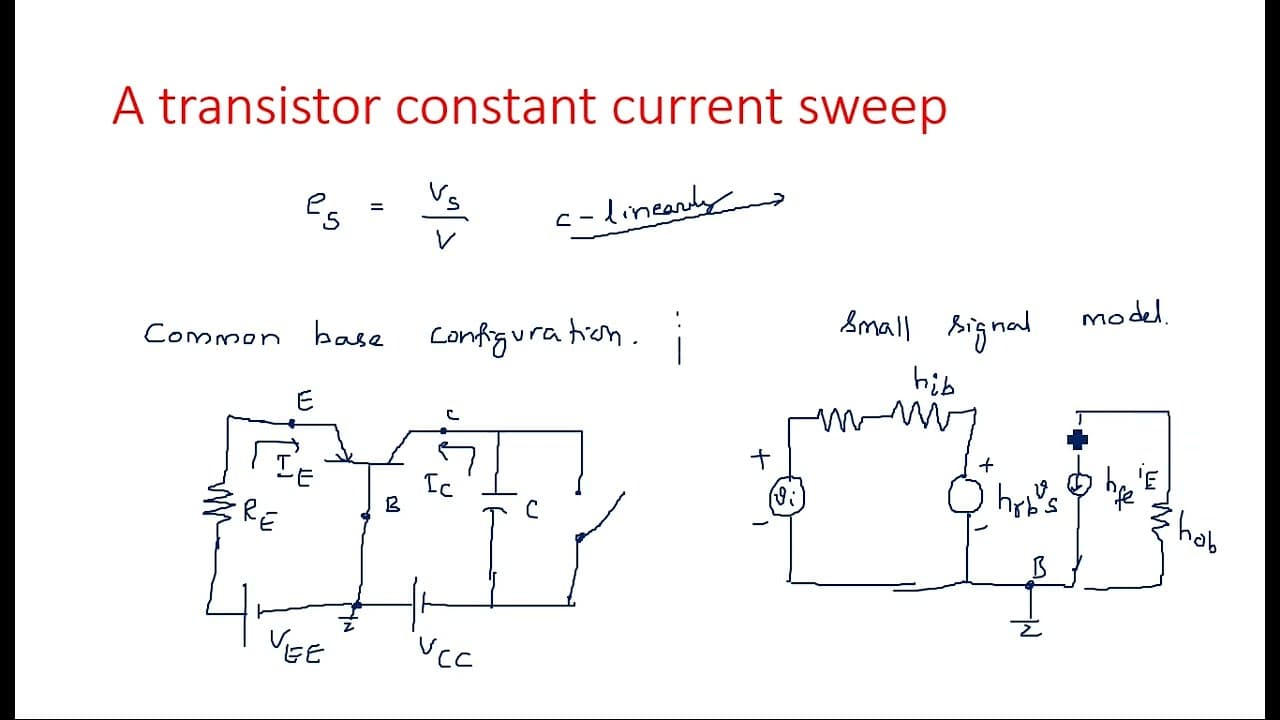
A BJT constant current sweep circuit ensures linear capacitor charging, which is essential for accurate voltage output. This circuit uses a common base configuration to maintain low slope error during the sweeping process, resulting in enhanced performance compared to simpler designs. The design incorporates capacitors, resistors, and specific transistor parameters to achieve this precision.
Transcript
hi everyone in this video I am going to explain about a BJT or a transistor constant current sweep circuit so in the previous video I have explained you about a transistor sweep circuit how to generate a sweep circuit that sweep must be having very low slope error that means the slope must be linear okay so whenever we are trying to generate a Time... Read More
Key Insights
- ⚡ The constant current design ensures linear capacitor charging, crucial for precise voltage measurements.
- 💐 Utilizing a common base configuration stabilizes current flow, reducing errors during charging.
- ❓ Accurate capacitor behavior relies on well-calibrated resistance and bias supply configurations.
- ⌛ Understanding slope error is vital to optimizing circuit designs for time-dependent electrical applications.
- 🎨 The integration of multiple biasing supplies enhances device performance compared to simpler previous designs.
- 🆘 Transistor parameter considerations, such as h-parameters, help optimize the circuit's response characteristics.
- 🎨 The upcoming discussions on Miller and bootstrap techniques highlight the ongoing advancements in electronic circuit design.
Install to Summarize YouTube Videos and Get Transcripts
Explore YouTube Video Summarizer or Get YouTube Transcript Extractor
Questions & Answers
Q: What is the primary goal of the BJT constant current sweep circuit demonstrated in the video?
The primary goal of the BJT constant current sweep circuit is to achieve a linear charging of the capacitor to minimize the slope errors in voltage output. By maintaining a constant current through the capacitor, the circuit ensures predictable and accurate time-based voltage measurements, crucial for applications requiring precision.
Q: Why is a common base configuration preferred in this circuit design?
The common base configuration is preferred because it allows for better control over the currents in the transistor. In this setup, the base terminal is shared between the input and output, allowing for more stable operation and efficient current gain, essential for achieving the low slope errors desired in the output voltage.
Q: How does the circuit manage the linear charging of the capacitor?
The circuit manages linear charging by ensuring that a constant current flows through the capacitor, which allows it to charge at a uniform rate over time. This is facilitated by precisely calculated resistors and biasing voltages ensuring that variations in current do not lead to inconsistency in the charging curve, resulting in a desired linear output.
Q: What are the implications of slope error in the circuit design?
Slope error impacts the accuracy of voltage output during the charging process of the capacitor. A higher slope error would lead to non-linear charging, making it difficult to predict voltage changes. Therefore, minimizing slope error is crucial to ensure the circuit provides linear and accurate outputs for time-dependent applications.
Q: What factors contribute to calculating the slope error in this circuit?
Slope error is calculated based on several parameters including the output voltage, the rate of change of the voltage over time, and the circuit's resistive and capacitive components. The relationship between input and output voltages, current gain factors, and the specific configuration used also play significant roles in determining the overall slope error.
Q: Can you explain the significance of biasing supplies in this design?
Biasing supplies are critical as they provide the necessary voltage levels to the transistor to operate efficiently in its active region. They influence the emitter and collector currents, which are vital for achieving the desired constant current in the sweep circuit, directly affecting the linearity of the capacitor charge.
Q: What comparisons are made between the current circuit design and previous designs?
The current design using a common base configuration is compared favorably against older designs, which often used a single transistor and lacked the same level of control over charging linearity. The new configuration reduces slope error significantly, enhancing the performance of the time-based generator, and hence, improving measurement consistency.
Q: What future topics will be covered related to this circuit?
The upcoming discussion will include advanced techniques such as Miller and bootstrap circuits, which promise to provide even better performance and lower slope errors compared to both the current BJT constant current sweep circuit and previous designs, creating enhancements in capacitor charging efficiency and uniform behavior.
Summary & Key Takeaways
-
The video details the construction and function of a transistor-based constant current sweep circuit, emphasizing a linear charge behavior for accurate voltage output.
-
A common base configuration is used, incorporating elements like capacitors, resistors, and transistor parameters to minimize slope error during time-based sweeping.
-
The significance of maintaining low slope error in the charging process is highlighted, comparing this design to previous single transistor configurations for better performance.
Read in Other Languages (beta)
Share This Summary 📚
Summarize YouTube Videos and Get Video Transcripts with 1-Click
Try YouTube Summary with ChatGPT & Claude or YouTube Transcript Generator