What Led to the Goodwin Witchcraft Trials?
TL;DR
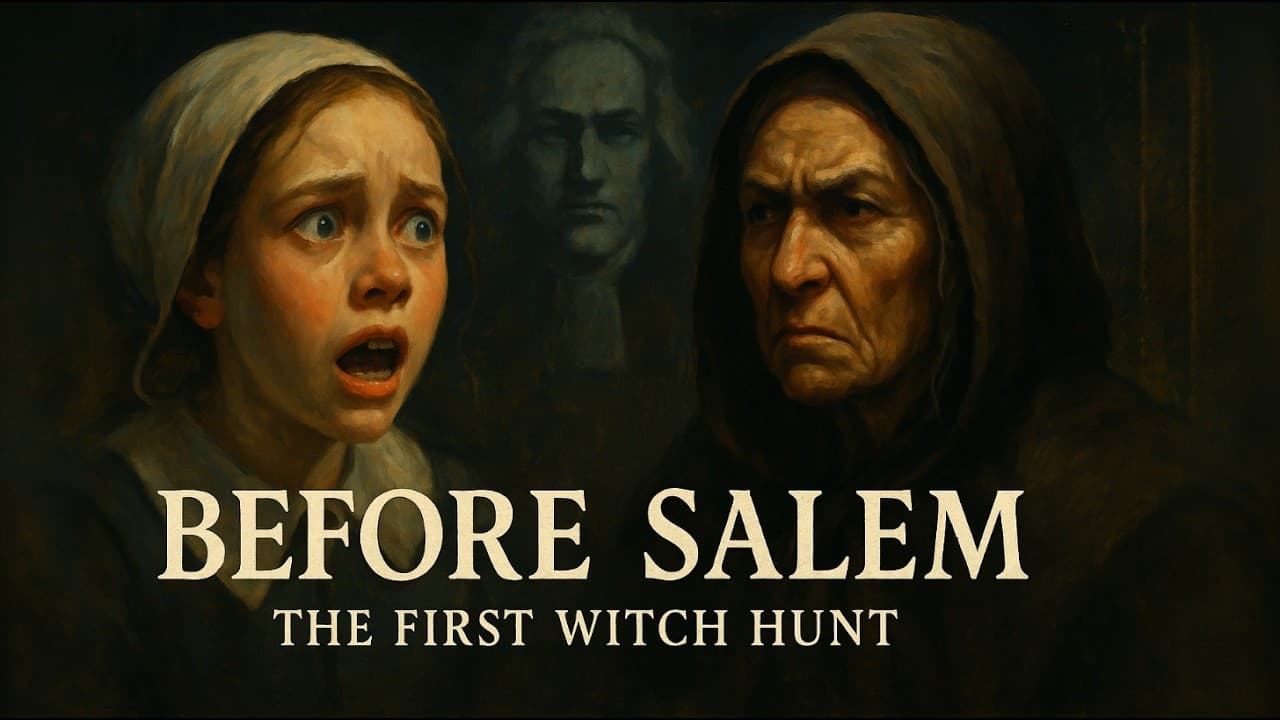
The Goodwin Witchcraft Trials of 1688 were a precursor to the infamous Salem Witch Trials, marked by the afflictions of the Goodwin children and the execution of Goody Glover. Cotton Mather's involvement and subsequent publication of 'Memorable Providences' provided a framework that influenced the hysteria in Salem, demonstrating how societal fears and religious fervor can lead to tragic outcomes.
Transcript
The year is 1692 and the small Puritan colony of Massachusetts is tearing itself apart. It is a time of paranoia, of spectral accusers, and of weeping prisoners in overcrowded jails. It is the year of the gallows, a year when 19 men and women convicted of the capital crime of witchcraft were led to this barren hill to be hanged. This was the Salem ... Read More
Key Insights
- The Goodwin Witchcraft Trials in 1688 predated the Salem Witch Trials by four years and set a precedent for the events in Salem.
- Cotton Mather, a prominent Puritan minister, played a significant role in shaping the narrative of the Goodwin case through his book 'Memorable Providences.'
- The Goodwin children exhibited symptoms that were interpreted as witchcraft, leading to the accusation and execution of Goody Glover.
- Mather's book served as a guide for identifying and prosecuting witches, influencing the legal proceedings in Salem.
- Spectral evidence, where victims claimed to see ghostly apparitions of witches, became a key component in witchcraft accusations.
- The trials were fueled by societal fears, religious fervor, and a rigid Puritan worldview that saw the devil as an active threat.
- The Goodwin case highlights the dangers of confirmation bias and the power of influential narratives in shaping public perception.
- The Salem Witch Trials were not an isolated incident but the culmination of a process that began with the Goodwin case.
Install to Summarize YouTube Videos and Get Transcripts
Explore YouTube Video Summarizer or Get YouTube Transcript Extractor
Questions & Answers
Q: What were the Goodwin Witchcraft Trials?
The Goodwin Witchcraft Trials occurred in 1688 in Boston and involved the mysterious afflictions of the Goodwin children, who accused Goody Glover of witchcraft. This case set a precedent for the Salem Witch Trials, highlighting the role of societal fears and religious fervor in leading to tragic outcomes.
Q: Who was Cotton Mather and what was his role in the Goodwin Trials?
Cotton Mather was a prominent Puritan minister who played a significant role in the Goodwin Witchcraft Trials by documenting the events and publishing 'Memorable Providences.' His book provided a framework for identifying and prosecuting witches, influencing the Salem Witch Trials and demonstrating the power of influential narratives.
Q: What is spectral evidence and how was it used in witch trials?
Spectral evidence refers to testimony where victims claim to see ghostly apparitions of witches. It was a key component in the Goodwin and Salem Witch Trials, legitimized by Cotton Mather's book. This type of evidence was treated as valid, despite being based on invisible and unverifiable claims, leading to wrongful accusations and executions.
Q: How did the Goodwin Trials influence the Salem Witch Trials?
The Goodwin Trials influenced the Salem Witch Trials by providing a precedent for the use of spectral evidence and the legal framework for prosecuting witches. Cotton Mather's 'Memorable Providences' served as a guide for the Salem authorities, leading to a replication of the hysteria and tragic outcomes seen in the earlier trials.
Q: What role did societal fears play in the witch trials?
Societal fears played a crucial role in the witch trials by amplifying the paranoia and suspicion that fueled accusations of witchcraft. In Puritan society, the belief in the devil as an active threat led to a climate of fear and religious fervor, where unexplained events were often attributed to supernatural causes, resulting in tragic outcomes.
Q: What was 'Memorable Providences' and why was it significant?
'Memorable Providences' was a book written by Cotton Mather documenting the Goodwin Witchcraft Trials. It was significant because it provided a detailed account of the events, legitimized spectral evidence, and influenced the Salem Witch Trials by serving as a guide for identifying and prosecuting witches, demonstrating the power of influential narratives.
Q: Who was Goody Glover and what happened to her?
Goody Glover was an elderly Irish Catholic woman accused of witchcraft during the Goodwin Witchcraft Trials. She was executed based on the spectral evidence provided by the afflicted Goodwin children. Her case highlights the role of cultural prejudice and societal fears in leading to wrongful accusations and executions during the witch trials.
Q: How did the Goodwin case demonstrate the dangers of confirmation bias?
The Goodwin case demonstrated the dangers of confirmation bias as Cotton Mather and the authorities approached the events with a pre-existing belief in witchcraft, interpreting every action as proof of demonic influence. This led to a self-reinforcing cycle of accusations and convictions, illustrating how rigid worldviews can lead to tragic outcomes.
Summary & Key Takeaways
-
In 1688, the Goodwin Witchcraft Trials in Boston involved the afflictions of the Goodwin children and the execution of Goody Glover, an Irish Catholic woman accused of witchcraft. Cotton Mather's involvement and his book 'Memorable Providences' laid the groundwork for the Salem Witch Trials, illustrating how societal fears and religious fervor can lead to tragic outcomes.
-
Cotton Mather's 'Memorable Providences' provided a detailed account of the Goodwin case, legitimizing spectral evidence and influencing the Salem Witch Trials. The book served as a guide for identifying witches, showcasing the power of influential narratives in shaping public perception and legal proceedings.
-
The Goodwin Witchcraft Trials set a precedent for the Salem Witch Trials by demonstrating how societal fears, religious fervor, and confirmation bias can lead to hysteria. The trials highlight the dangers of influential narratives and the role of Cotton Mather's book in shaping the events that followed.
Read in Other Languages (beta)
Share This Summary 📚
Summarize YouTube Videos and Get Video Transcripts with 1-Click
Try YouTube Summary with ChatGPT & Claude or YouTube Transcript Generator
Explore More Summaries from Fading Lore 📚


Summarize YouTube Videos and Get Video Transcripts with 1-Click
Try YouTube Summary with ChatGPT & Claude or YouTube Transcript Generator