Aircraft Stability Explained (PPL Lesson 6)
TL;DR
Aircraft stability is crucial for pilot training and safe flight control.
Transcript
Read and summarize the transcript of this video on Glasp Reader (beta).
Key Insights
- Aircraft stability is essential for pilots to control and safely navigate airplanes, especially during training.
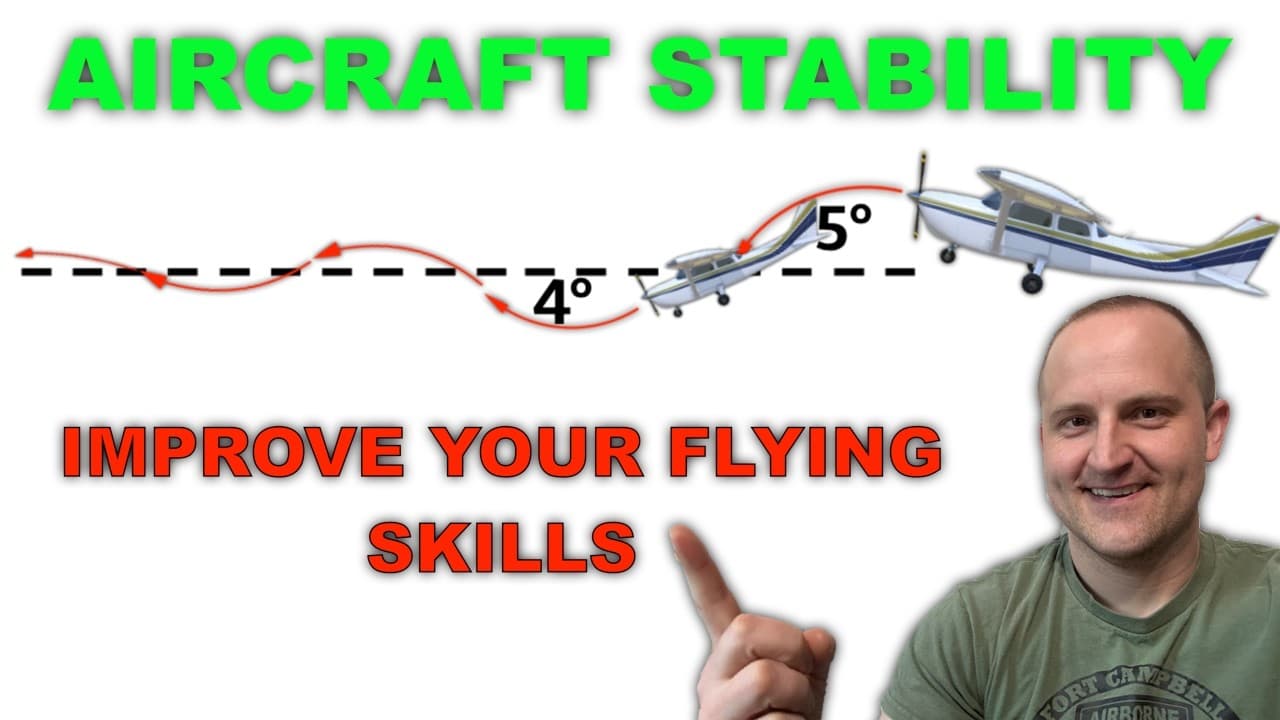
- Stability refers to an aircraft's ability to return to its original flight path after disturbances.
- There are two types of stability: static stability, which is the initial response, and dynamic stability, which is the response over time.
- Positive static stability means the aircraft will return to its original position, while negative static stability means continued deviation.
- Dynamic stability involves oscillations that either diminish (positive), remain constant (neutral), or increase (negative) over time.
- Longitudinal stability is achieved through proper balancing of the aircraft's lateral axis and involves the center of gravity and lift.
- Lateral stability is influenced by wing design, such as dihedral or keel effect, which helps maintain level flight.
- Directional stability is achieved through vertical stabilizers, which align the aircraft with the relative wind, similar to a weather vane.
Install to Summarize YouTube Videos and Get Transcripts
Explore YouTube Video Summarizer or Get YouTube Transcript Extractor
Questions & Answers
Q: Why is aircraft stability important for pilots?
Aircraft stability is vital for pilots because it ensures that the aircraft can return to its original flight path after disturbances, making it easier to control and navigate. It is especially important for new pilots during training, as understanding stability helps prevent overcontrolling and pilot-induced oscillations.
Q: What are the two types of aircraft stability?
The two types of aircraft stability are static and dynamic stability. Static stability refers to the aircraft's initial response to disturbances, while dynamic stability describes how the aircraft responds over time. Positive static stability means the aircraft returns to its original position, while dynamic stability involves oscillations that can diminish, remain constant, or increase.
Q: How does longitudinal stability work in an aircraft?
Longitudinal stability is achieved by balancing the aircraft's lateral axis. It involves the center of gravity and the center of lift. The aircraft is designed with the center of gravity slightly ahead of the center of lift, and a horizontal stabilizer on the tail produces downforce, helping maintain balance and stability during flight.
Q: What is the role of dihedral in lateral stability?
Dihedral is a wing design feature where the wingtips are higher than the wing root, commonly found in low-wing aircraft. It enhances lateral stability by creating a higher angle of attack on the lower wing during a roll, generating more lift and drag, which helps the aircraft return to level flight, reducing oscillations.
Q: How does the keel effect contribute to stability?
The keel effect contributes to lateral stability in high-wing aircraft by acting like a pendulum. The center of lift is above the center of gravity, so when the aircraft rolls, the weight shifts upward but naturally returns to level flight due to gravity, helping maintain stability and reducing oscillations during flight.
Q: What ensures directional stability in an aircraft?
Directional stability is ensured by the vertical stabilizer or fins on the aircraft's tail. These components align the aircraft with the relative wind, similar to a weather vane, ensuring the aircraft maintains its intended direction. This design helps prevent unwanted yaw and maintains stability along the yaw axis.
Q: Why shouldn't pilots ignore stability concepts after passing exams?
Pilots shouldn't ignore stability concepts after exams because understanding stability is crucial for safe flight control. It helps prevent overcontrolling and pilot-induced oscillations, common issues for new pilots. Experienced pilots use stability knowledge to make precise control inputs, maintaining smooth and stable flight, which is essential for safety.
Q: How can pilots adjust an aircraft's stability during flight?
Pilots can adjust an aircraft's stability during flight by using trim. Trim adjusts the tail's downforce, aligning the apparent center of gravity with the center of lift. This adjustment ensures the aircraft remains balanced and stable at different speeds, reducing the need for constant control inputs and improving overall flight stability.
Summary & Key Takeaways
-
Aircraft stability is crucial for pilots, helping them control and navigate planes safely. It involves static stability, which is the initial response to disturbances, and dynamic stability, which is the long-term response. Understanding these concepts is vital for passing the FAA written exam and practical flight training.
-
Static stability determines how an aircraft initially reacts to control inputs or external forces. Positive static stability returns the aircraft to its original position, while negative static stability leads to further deviation. Dynamic stability involves oscillations that can diminish, remain constant, or increase over time.
-
Longitudinal stability is achieved by balancing the aircraft's lateral axis, involving the center of gravity and lift. Lateral stability is influenced by wing design, such as dihedral or keel effect, which helps maintain level flight. Directional stability is achieved through vertical stabilizers, aligning the aircraft with the relative wind.
Read in Other Languages (beta)
Share This Summary 📚
Summarize YouTube Videos and Get Video Transcripts with 1-Click
Try YouTube Summary with ChatGPT & Claude or YouTube Transcript Generator
Explore More Summaries from Free Pilot Training 📚


Summarize YouTube Videos and Get Video Transcripts with 1-Click
Try YouTube Summary with ChatGPT & Claude or YouTube Transcript Generator