Why Do Crabs Leave the Ocean to Live on Land?
TL;DR
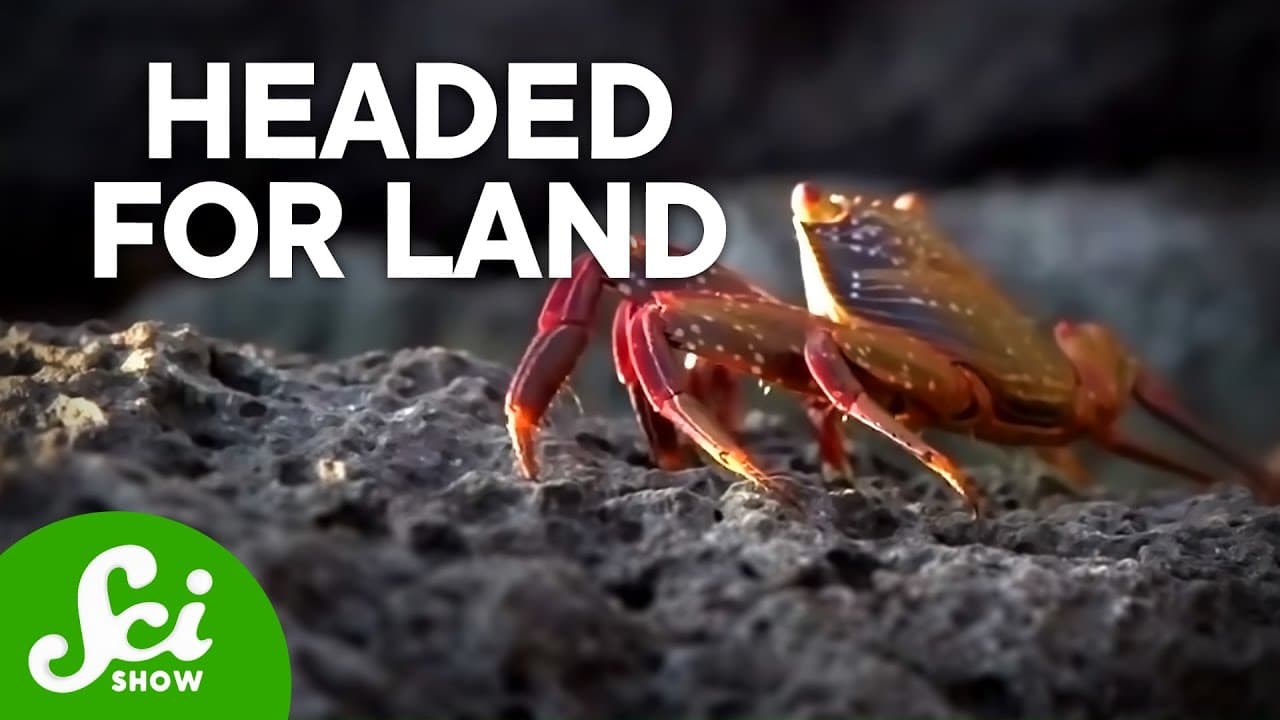
Crabs have evolved to leave the ocean for land multiple times, driven by factors such as food availability and predator pressure. To survive on land, they developed adaptations like lungs for breathing air, a hydrostatic skeleton for support against gravity, and unique reproductive strategies to manage their larvae away from water.
Transcript
this episode is brought to you by the music for scientists album now available on all streaming services when most of us think of crabs we probably picture marine animals living in the ocean eating fish and things the life aquatic but there are also quite a few crabs that have basically abandoned the water we're talking land crabs not just semi-aqu... Read More
Key Insights
- 🦀 Crabs have transitioned from an aquatic to a terrestrial lifestyle through the process of terrestrialization, which has occurred multiple times in crustaceans.
- 🫢 Adapting to breathing on land involved the development of lungs or modified gills for gas exchange.
- 🏋️ Supporting their body weight on land is achieved through a hydrostatic skeleton, which involves pressurized internal fluids.
- 😅 Land crabs have adapted to eating tough plant materials by growing more slowly, living longer, and potentially relying on gut microbes for digestion.
- 💦 Reproduction on land varies among crab species, with some still depending on water for their larvae, while others have developed unique strategies for caring for their young away from water.
- 🫷 Understanding the adaptations of crabs requires expanding our knowledge and pushing the boundaries of evolutionary biology.
Install to Summarize YouTube Videos and Get Transcripts
Explore YouTube Video Summarizer or Get YouTube Transcript Extractor
Questions & Answers
Q: How do crabs breathe on land?
Land crabs have adapted through the use of lungs or modified gills. Lungs, such as those found in robber crabs, allow them to breathe air. They breathe in through openings near the base of their walking legs and out through their mouths. Some crabs also switch between gills and lungs as needed.
Q: What is a hydrostatic skeleton, and how does it help crabs on land?
A hydrostatic skeleton involves pressurized internal fluids that help support the crab's body on land. While all crabs have this system, land crabs require higher fluid pressure to counteract gravity. However, this can make them more prone to rupturing their new exoskeletons.
Q: How do land crabs adapt to eating in a terrestrial environment?
Land crabs primarily rely on vascular plants, fruits, and leaves as their food sources. These foods are tougher and often have hard-to-digest fibers and compounds that can be potentially toxic. Land crabs have developed adaptations such as slower growth, longer lifespan, gut enzymes to digest cellulose, and possibly a reliance on gut microbes to help digest these tough plant materials.
Q: How do land crabs reproduce on land?
Most land crabs still depend on water for their larvae. Some species, like hermit crabs, release their eggs near high cliffs, allowing the hatchlings to reach the ocean. Others solve this challenge through brooding, where they carry their young in pouches until the time is right. Some remarkable species actively care for their young and raise them away from water, creating unique environments for their offspring.
Summary & Key Takeaways
-
Crabs have transitioned from living in water to living on land through a process called terrestrialization, which has happened at least five times in crustaceans.
-
Breathing on land is one of the most significant challenges for crabs, but they have adapted through the use of lungs, modified gills, or a combination of both.
-
Supporting their body weight on land is achieved through the use of a hydrostatic skeleton, which involves pressurized internal fluids that act as a support system.
Read in Other Languages (beta)
Share This Summary 📚
Summarize YouTube Videos and Get Video Transcripts with 1-Click
Try YouTube Summary with ChatGPT & Claude or YouTube Transcript Generator
Explore More Summaries from SciShow 📚
Summarize YouTube Videos and Get Video Transcripts with 1-Click
Try YouTube Summary with ChatGPT & Claude or YouTube Transcript Generator