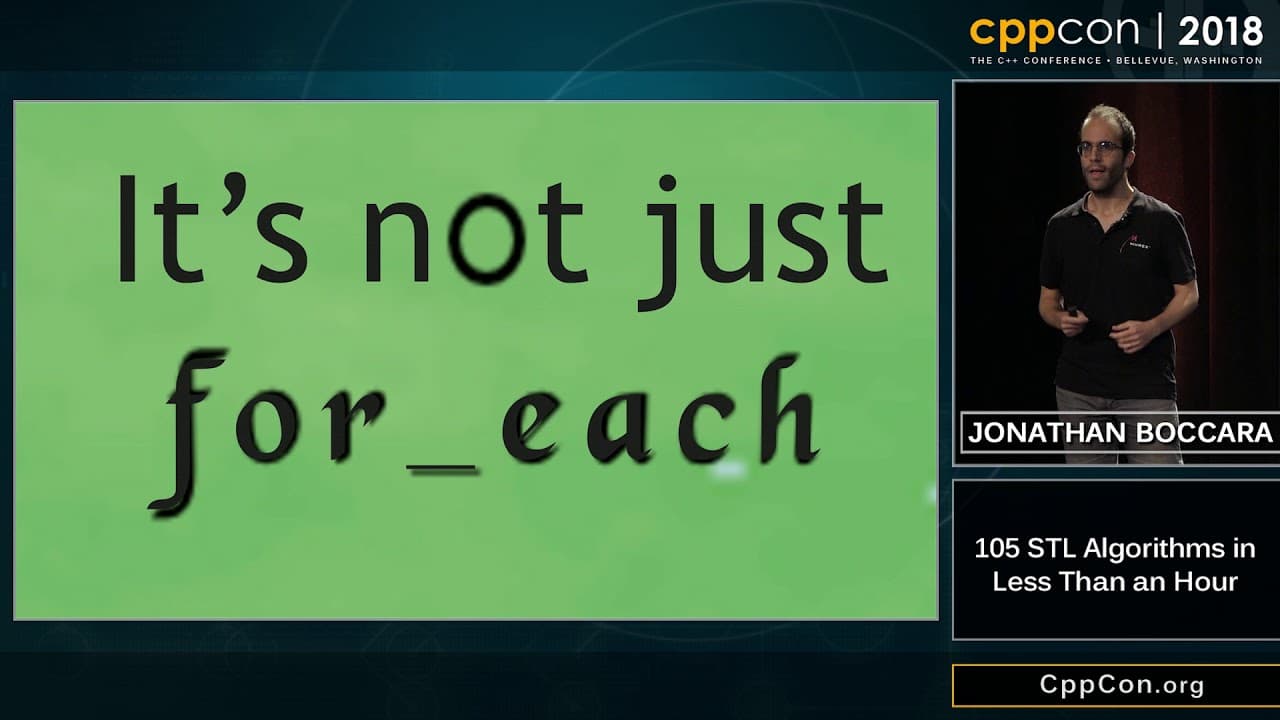
CppCon 2018: Jonathan Boccara “105 STL Algorithms in Less Than an Hour”
TL;DR
Discover all 105 STL algorithms in under an hour.
Transcript
Read and summarize the transcript of this video on Glasp Reader (beta).
Key Insights
- STL algorithms enhance code expressiveness by raising abstraction levels, allowing developers to focus on what to do rather than how to do it.
- Using STL algorithms reduces the risk of errors associated with manual for-loops, such as going beyond collection bounds.
- STL algorithms are standard and widely used, making them a reliable choice for writing robust C++ code.
- The presentation categorizes STL algorithms into regions, such as permutation, queries, and sets, to aid understanding.
- Heaps are data structures with specific properties, and STL provides algorithms like make_heap and sort_heap for heap operations.
- Sorting algorithms like sort, partial_sort, and nth_element are part of the STL, offering efficient ways to organize data.
- Partitioning algorithms use predicates to organize data, with stable_partition maintaining element order.
- STL algorithms are complemented by Boost libraries, offering additional functionality beyond the standard library.
Install to Summarize YouTube Videos and Get Transcripts
Explore YouTube Video Summarizer or Get YouTube Transcript Extractor
Questions & Answers
Q: Why is it important to know STL algorithms?
Knowing STL algorithms is crucial because they make code more expressive by raising abstraction levels. This allows developers to focus on what they want to achieve rather than how to implement it. Additionally, STL algorithms help avoid errors associated with manual loops, such as going beyond collection bounds, which can lead to undefined behavior.
Q: What are the risks of using manual for-loops instead of STL algorithms?
Manual for-loops can lead to errors like going beyond the bounds of a collection, resulting in undefined behavior in C++. This can cause unpredictable program outcomes, including crashes. STL algorithms mitigate these risks by handling common iteration tasks safely and efficiently, ensuring code robustness.
Q: How are STL algorithms categorized in the presentation?
STL algorithms are categorized into regions based on their logical relationships. These categories include permutation, queries, sets, movers, value modifiers, and structure changers. This organization helps developers understand the purpose and functionality of each algorithm, making them easier to remember and apply.
Q: What are heaps, and how are they used in STL algorithms?
Heaps are data structures that resemble trees, where each node is smaller than its children. In C++, heaps are typically max heaps, where each parent is larger than its children. STL provides algorithms like make_heap to construct heaps and sort_heap to sort them, facilitating efficient data organization and retrieval.
Q: What is the significance of sorting algorithms in STL?
Sorting algorithms in STL, such as sort, partial_sort, and nth_element, provide efficient ways to organize data. They leverage the power of C++'s standard library to perform sorting operations quickly and accurately, ensuring that developers can manage data effectively without manually implementing complex sorting logic.
Q: How do partitioning algorithms work in STL?
Partitioning algorithms use predicates to organize data into two groups: those that satisfy the predicate and those that do not. For example, partition separates elements based on a condition, while stable_partition maintains the relative order of elements. These algorithms help manage data efficiently by categorizing it according to specific criteria.
Q: What are some additional resources for learning more about STL algorithms?
Beyond STL, developers can explore Boost libraries, which offer additional algorithms that complement the standard library. Jonathan Boccara's blog, Fluent C++, provides articles and insights into expressive C++ coding, including detailed discussions on STL algorithms. These resources help deepen understanding and expand algorithmic knowledge.
Q: What is the role of Boost libraries in relation to STL algorithms?
Boost libraries provide additional algorithms that complement STL, offering extended functionality and more specialized operations. They are designed to integrate seamlessly with STL, allowing developers to leverage a broader range of tools for complex programming tasks. This makes Boost a valuable resource for enhancing C++ code expressiveness and robustness.
Summary & Key Takeaways
-
Jonathan Boccara's talk at CppCon 2018 covers all 105 STL algorithms, emphasizing their importance in writing expressive C++ code. He categorizes these algorithms into logical groups, making them easier to understand and remember.
-
The presentation highlights the benefits of using STL algorithms, such as reducing errors and improving code readability. Boccara also discusses the risks of manual for-loops and the undefined behavior they can cause.
-
Boccara encourages developers to explore STL algorithms, understand their complexities, and consider writing their own algorithms. He also suggests using Boost libraries for additional algorithmic support.
Read in Other Languages (beta)
Share This Summary 📚
Summarize YouTube Videos and Get Video Transcripts with 1-Click
Try YouTube Summary with ChatGPT & Claude or YouTube Transcript Generator
Explore More Summaries from CppCon 📚
Summarize YouTube Videos and Get Video Transcripts with 1-Click
Try YouTube Summary with ChatGPT & Claude or YouTube Transcript Generator