Monostable multivibrator | Collector Coupled | Pulse Digital Circuits ( PDC ) | Lec-54
TL;DR
This video explains monostable multivibrators, including their operation and differences from bistable multivibrators.
Transcript
hi everyone in this video I am going to explain about the monostable multivibrator which is a second type of multivibrators the classification of multivibrators I have explained you about the three different types of multivibrators first one was bystable multivibrator which I have completed in the past videos now monostable multi vibrator mono stab... Read More
Key Insights
- 🥺 Monostable multivibrators consist of one stable state and one quasi-stable state, leading to simplified operation compared to bistable alternatives.
- 💗 The triggering pulse is critical for changing states; a negative pulse initiates the transition necessary for functionality.
- 🧑🤝🧑 Collector coupled and emitter coupled types categorize monostable multivibrators, indicating different circuit arrangements and configurations.
- ⚡ The capacitor’s role in charging and controlling voltage is essential for creating the quasi-stable state that defines the monostable multivibrator operation.
- 💐 Understanding the voltage and current flow through transistors during transitions provides insight into how to manage output states.
- 💗 The application of a negative triggering pulse is necessary to shift the system from a stable state to a quasi-stable state effectively.
- ❓ The waveforms produced during operation illustrate the relationship between stable and quasi-stable states, further enhancing the comprehension of multivibrator behaviors.
Install to Summarize YouTube Videos and Get Transcripts
Explore YouTube Video Summarizer or Get YouTube Transcript Extractor
Questions & Answers
Q: What are the key differences between monostable multivibrators and bistable multivibrators?
The primary difference lies in their stable states: monostable multivibrators have one stable state and one quasi-stable state, needing just one triggering pulse to change states, whereas bistable multivibrators possess two stable states that require two triggering pulses to transition between them.
Q: How does the monostable multivibrator act as a gating circuit?
The monostable multivibrator is often called a gating circuit because it can control the timing of input signals from other circuits, allowing those signals to perform functions only for a specific duration based on the quasi-stable state.
Q: Can you explain the role of the capacitor in the operation of monostable multivibrators?
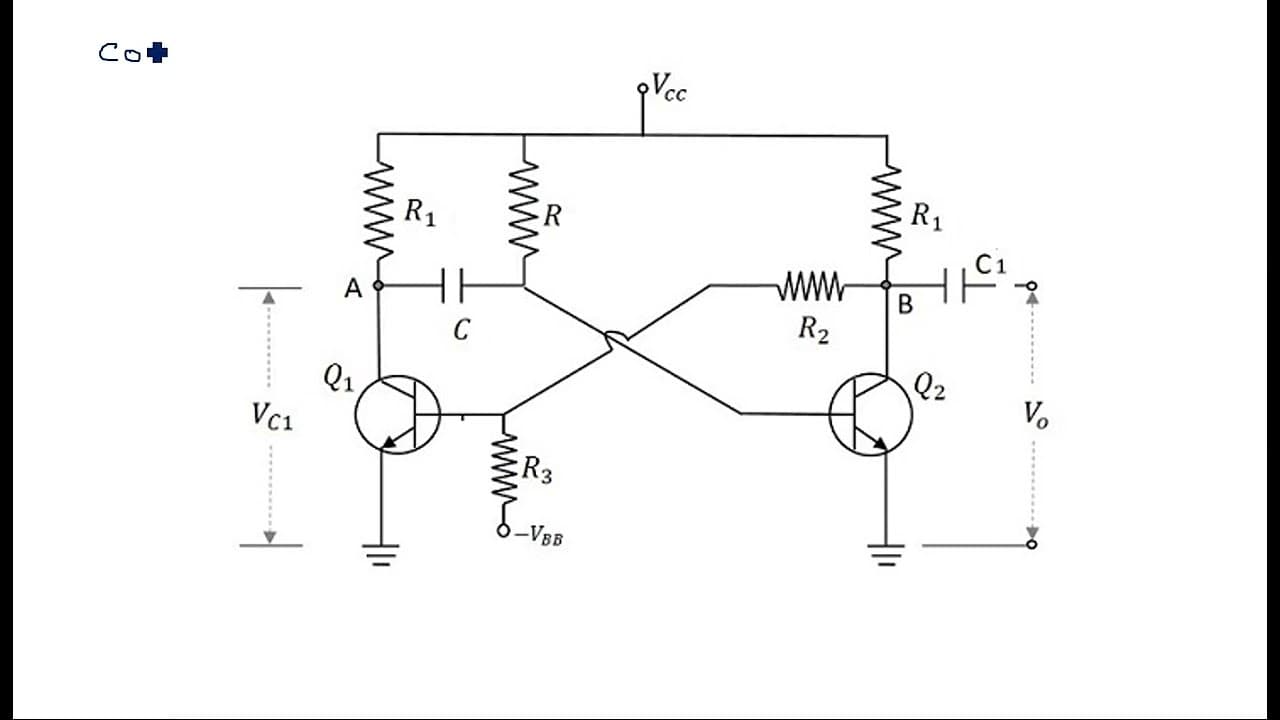
In a monostable multivibrator, the capacitor allows for charge and discharge cycles that create the quasi-stable state. When a triggering pulse is applied, the capacitor may charge up to the maximum voltage, which is crucial for reversing the transistor states and reverting back to the stable state.
Q: What components are essential in constructing a monostable multivibrator?
Essential components include two transistors, capacitors, resistors for biasing, and a power supply. These components work together to create the multivibrator’s functionality through current flow and voltage manipulation, allowing the circuit to operate correctly.
Summary & Key Takeaways
-
The video describes the monostable multivibrator, highlighting that it has one stable and one quasi-stable state, contrasting it with the bistable multivibrator, which has two stable states.
-
A negative triggering pulse is necessary to change the state of the transistors in a monostable multivibrator, and the components involved include capacitors and resistors to facilitate the charging and discharging process.
-
The video presents the circuit diagram of the collector-coupled monostable multivibrator and explains how the transistors operate during both stable and quasi-stable states, emphasizing the significance of the charging capacitor.
Read in Other Languages (beta)
Share This Summary 📚
Summarize YouTube Videos and Get Video Transcripts with 1-Click
Try YouTube Summary with ChatGPT & Claude or YouTube Transcript Generator