Jason Lemkin, Founder of SaaStr: What Are His Investment Criteria and How Can Companies Maximize Growth?
TL;DR
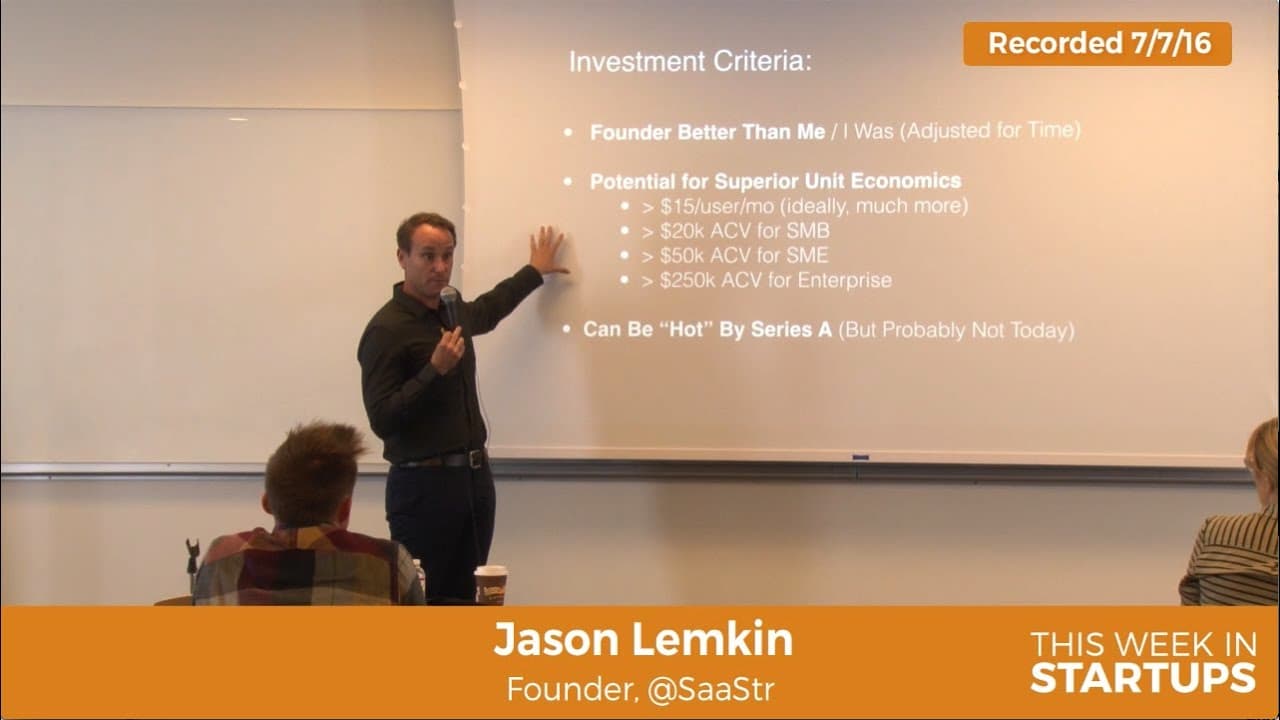
Jason Lemkin, founder of SaaStr, looks for founders who are better than him adjusted for time, a compelling one-slide case for changing the world, and strong unit economics. He says traction can stall with a founder who is not great, while more revenue per customer and more leads can accelerate growth. Read on for his pricing thresholds, deal signals, and investment approach.
Transcript
but what I've learned and you I would recommend you could you integrate at least the first two points in your pitches if we're doing some some some pitching prep here I learned I really there's there's two big things I look for um first of all I look for Founders that are better than me adjusted for time um and and and what does that mean right it'... Read More
Key Insights
- "first of all I look for Founders that are better than me adjusted for time" (0:17)
- "if you can really convince folks in one slide why you're changing the world why you're crazy in a good mostly in a good way" (1:09)
- "traction W with the founder that's not great like eventually it's just going to stall out" (1:39)
- "for most of us if we can drive our unit economics up that's the fastest way to to accelerate" (2:33)
- "most small businesses will spend $20,000 a year on one product" (3:41)
Install to Summarize YouTube Videos and Get Transcripts
Explore YouTube Video Summarizer or Get YouTube Transcript Extractor
Questions & Answers
Q: What investment criteria does Jason Lemkin use when evaluating founders?
Jason Lemkin first looks for founders who are better than him, adjusted for time. He also looks for founders who can convincingly explain why their company is changing the world and show signs that their unit economics can support faster growth.
Q: What does Jason Lemkin mean by a founder being better than him adjusted for time?
He compares a founder's ability at the same relative stage, accounting for experience and knowledge gained over time. A less experienced founder may not know everything he knows now but can still demonstrate greater potential at an equivalent point.
Q: Why does Jason Lemkin recommend a one-slide pitch?
A one-slide pitch can show investors why the company is changing the world and why the founder is unusually ambitious in a good way. Lemkin says a convincing version makes his eyes light up and believes other investors respond similarly.
Q: Why does Jason Lemkin say traction can be misleading?
His two worst investments had the most traction when he invested. He says traction paired with a founder who is not great will eventually stall because building the company is too difficult.
Q: How can SAS founders accelerate company growth?
Lemkin recommends getting more money from each customer and generating more leads. Because many companies remain constrained by leads for a long time, improving unit economics is the fastest way for most of them to accelerate.
Q: What pricing signal does Jason Lemkin look for among small-business customers?
He looks for evidence that a small business might pay about $20,000 per year for one important B2B application. He considers that unusual willingness to pay a sign that the product may have something magical.
Q: What does Jason Lemkin consider a real enterprise deal?
He does not consider a deal a real enterprise deal unless it reaches $250,000. A small purchase by several employees at a company such as Ford may look impressive on a website, but it does not show that the broader enterprise purchased the product.
Q: What early customer pattern can signal larger future deals?
Lemkin gives the example of 10 customers, with eight paying $6,000 per year and two paying $20,000 or $45,000 per year. If the higher-paying customers love the product, he sees an opportunity to help the company find more customers like them.
Summary & Key Takeaways
-
Look for founders who are better than you, adjusted for time, as they have a higher chance of success.
-
A powerful one-slide pitch that convincingly explains how the startup is changing the world is highly effective in attracting investors.
-
Unit economics play a crucial role in the growth of SAS companies, as increasing revenue per customer and lead generation are key to accelerating growth.
Read in Other Languages (beta)
Share This Summary 📚
Summarize YouTube Videos and Get Video Transcripts with 1-Click
Try YouTube Summary with ChatGPT & Claude or YouTube Transcript Generator
Explore More Summaries from This Week in Startups 📚




Summarize YouTube Videos and Get Video Transcripts with 1-Click
Try YouTube Summary with ChatGPT & Claude or YouTube Transcript Generator