Curso de química desde 0 ✅ [COMPLETO Y REEDITADO]
TL;DR
Comprehensive chemistry course covering atoms, molecules, and periodic table.
Transcript
Read and summarize the transcript of this video on Glasp Reader (beta).
Key Insights
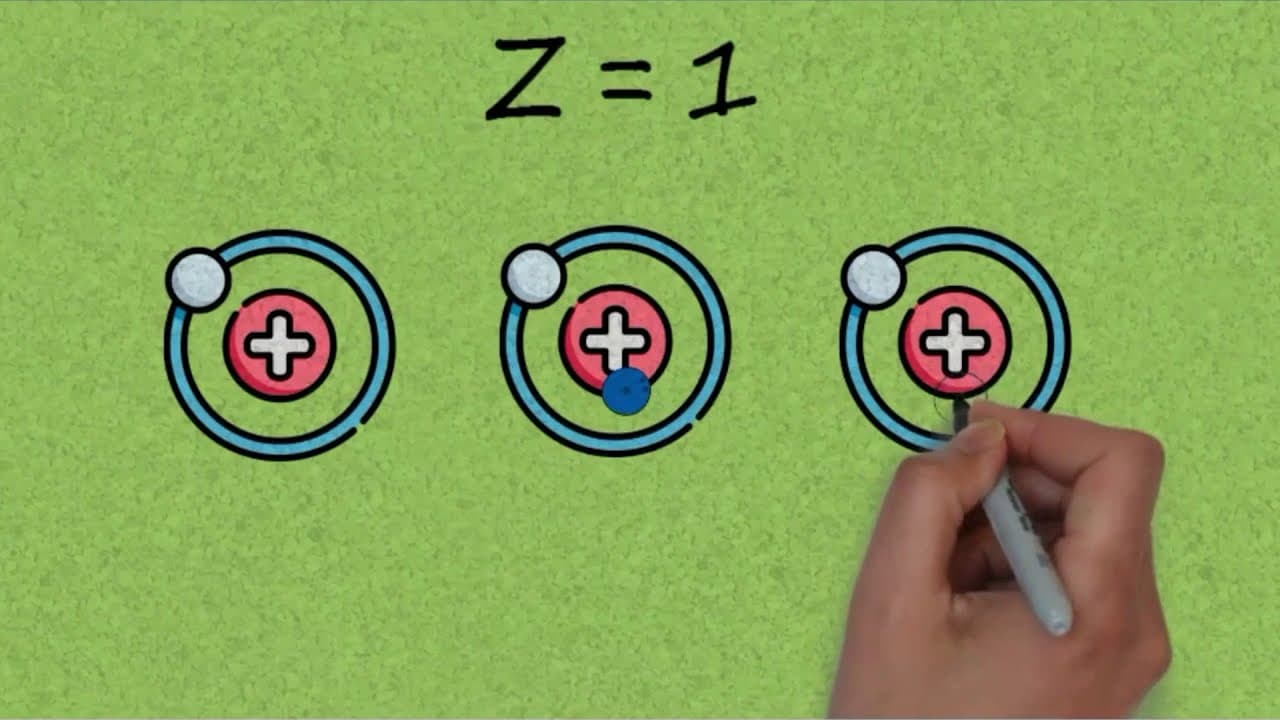
- Atoms are the smallest units of matter, consisting of a nucleus with protons and neutrons, and electrons in the crust.
- Chemical elements are formed by atoms with the same number of protons and are organized in the periodic table by similar characteristics.
- Molecules are stable groups of atoms, either identical or different, that form structures like water with covalent bonds.
- The atomic number equals the number of protons and electrons in a neutral atom, while the mass number includes protons and neutrons.
- Isotopes of an element have the same atomic number but different mass numbers due to varying neutrons, affecting their properties.
- Ions form when atoms gain or lose electrons, resulting in positive (cation) or negative (anion) charges, leading to neutral compounds.
- The mole is a unit of substance quantity, defined by Avogadro's number, and is essential for measuring atomic quantities.
- Quantum numbers define electron properties in atoms, including energy levels, orbital shapes, and spin, crucial for electronic configuration.
Install to Summarize YouTube Videos and Get Transcripts
Explore YouTube Video Summarizer or Get YouTube Transcript Extractor
Questions & Answers
Q: What is an atom and its structure?
An atom is the smallest unit of matter, consisting of a central nucleus containing protons with a positive charge and neutrons with no charge. Surrounding the nucleus is the electron cloud, where negatively charged electrons orbit. This structure allows atoms to interact and form chemical elements and compounds.
Q: How are chemical elements organized in the periodic table?
Chemical elements are organized in the periodic table based on their atomic number, which corresponds to the number of protons in an atom. Elements with similar properties are grouped into columns called groups, while rows, known as periods, represent elements with increasing atomic numbers. This organization highlights periodic trends in element properties.
Q: What defines a molecule, and how do they form?
A molecule is a stable group of two or more atoms bonded together, either of the same or different elements. Molecules form through covalent bonds, where atoms share electrons to achieve electrical stability. Water, for example, is a molecule composed of two hydrogen atoms and one oxygen atom bonded covalently.
Q: What are isotopes and their significance?
Isotopes are variants of the same chemical element that have the same number of protons (atomic number) but different numbers of neutrons, resulting in different mass numbers. Isotopes can have different physical or chemical properties, making them significant in applications like radiometric dating and medical imaging.
Q: How do ions form, and what are their types?
Ions form when an atom gains or loses electrons, resulting in an imbalance between protons and electrons. A cation is a positively charged ion formed by losing electrons, while an anion is negatively charged, formed by gaining electrons. These ions combine to form neutral compounds, such as salts.
Q: What is the significance of the mole in chemistry?
The mole is a fundamental unit in chemistry representing a quantity of substance containing Avogadro's number of particles, approximately 6.022 x 10^23. It allows chemists to measure and compare amounts of substances at the atomic and molecular levels, facilitating calculations in chemical reactions and stoichiometry.
Q: How are electrons arranged in atoms?
Electrons in atoms are arranged in orbitals around the nucleus, following specific rules of electronic configuration. Orbitals have different shapes and energy levels, with s orbitals holding two electrons, p orbitals six, d orbitals ten, and f orbitals fourteen. The arrangement is guided by principles like Pauli's exclusion and Hund's rule.
Q: What are periodic properties, and why are they important?
Periodic properties are characteristics of elements that vary predictably across the periodic table, such as atomic and ionic radii, ionization energy, electron affinity, and electronegativity. These properties are crucial for understanding element behavior, reactivity, and bonding tendencies, aiding in predictions of chemical reactions and compound formation.
Summary & Key Takeaways
-
The course introduces basic chemistry concepts, covering the structure of atoms, chemical elements, and the formation of molecules. It explains atomic and mass numbers, isotopes, and ions, providing a foundation for understanding chemical reactions and compounds.
-
Detailed explanations of the periodic table, including group and period organization, highlight the significance of elements' properties and periodic trends. The course also covers electron configurations, quantum numbers, and orbital types, essential for understanding chemical behavior.
-
Periodic properties such as atomic and ionic radii, ionization energy, electron affinity, and electronegativity are discussed, emphasizing their variation across the periodic table. The course concludes with insights into metallic character and its relation to electron loss tendencies.
Read in Other Languages (beta)
Share This Summary 📚
Summarize YouTube Videos and Get Video Transcripts with 1-Click
Try YouTube Summary with ChatGPT & Claude or YouTube Transcript Generator
Explore More Summaries from Quimiclan 📚

Summarize YouTube Videos and Get Video Transcripts with 1-Click
Try YouTube Summary with ChatGPT & Claude or YouTube Transcript Generator